
Rhode Island Lease Agreement
A Rhode Island rental lease agreement establishes a legally binding contract between landlords and tenants. This comprehensive document outlines rental terms, payment obligations, property rules, and the rights of both parties. The agreement protects landlord investments while ensuring tenants understand their responsibilities throughout the tenancy.
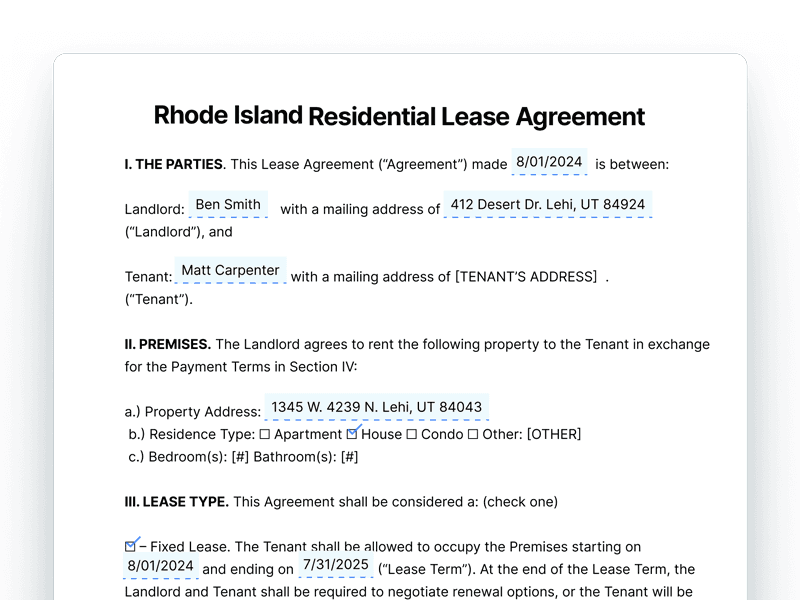


Understanding Rhode Island Lease Agreement Requirements
State Legal Framework
Rhode Island landlord tenant law provides the foundation for all residential rental agreements in the state. The Rhode Island Residential Landlord and Tenant Act (Rhode Island General Laws Title 34, Chapter 18) establishes comprehensive rights and responsibilities for both parties. Rhode Island provides relatively balanced protections for landlords and tenants while maintaining efficient procedures for addressing disputes. The state does not impose rent control, allowing landlords flexibility in setting rental rates and lease terms. The Rhode Island rental lease agreement becomes enforceable when both parties sign the document, creating mutual obligations that govern the entire landlord-tenant relationship under Rhode Island’s Residential Landlord and Tenant Act.
Written Agreement Standards
Rhode Island does not legally require written lease agreements for tenancies under one year. However, creating a written residential lease agreement Rhode Island landlords can reference provides essential documentation and legal protection. Written agreements prevent disputes by establishing explicit terms both parties acknowledge and accept.
Essential Elements of a Rhode Island Lease Agreement
Parties and Property Identification
Complete Party Information Every Rhode Island lease agreement template should identify all parties involved in the rental arrangement. Required information includes:
- Full legal names of all landlords or property managers
- Full legal names of all adult tenants
- Complete property address including unit numbers
- Legal property description when applicable
Accurate identification prevents confusion about who holds rights and responsibilities under the agreement.
Lease Term and Duration
Fixed-Term Agreements Fixed-term leases establish specific start and end dates for tenancies. Most Rhode Island rental contracts run for 12-month periods, though landlords can create agreements for any duration. Fixed-term leases provide stability for both parties and establish clear expectations about tenancy length.
Month-to-Month Arrangements Month-to-month rental agreements offer flexibility for landlords and tenants who prefer shorter commitments. These arrangements automatically renew each month until either party provides proper termination notice. Rhode Island requires 30 days written notice to terminate month-to-month tenancies.
Rent Payment Terms
Payment Obligations Rhode Island lease agreements must clearly state rent payment requirements including:
- Monthly rent amount
- Payment due date
- Accepted payment methods
- Where tenants should submit payments
- Grace period provisions
Rhode Island requires landlords to provide a 15-day grace period for rent payments. Rent cannot be considered late for purposes of late fees until after this grace period expires. This is one of the longest grace periods in the nation.
Late Fee Provisions Rhode Island does not impose specific statutory caps on late fee amounts, but fees must be reasonable. Late fees cannot be charged until after the 15-day grace period. Late fee policies should appear clearly in the rental agreement Rhode Island tenants receive.
Security Deposit Requirements in Rhode Island
Deposit Limits and Handling
Statutory Cap Rhode Island limits security deposits to one month’s rent. This is one of the stricter security deposit limits in the nation.
No Separate Account Requirements Rhode Island does not require landlords to hold security deposits in separate escrow accounts. However, landlords must maintain proper records of deposits received.
Return Procedures
20-Day Timeline Rhode Island landlords must return security deposits within 20 days after tenants vacate properties. This is one of the shorter return periods in the nation. The timeline applies to both the deposit return and required itemized statements of deductions.
Itemization Requirements If landlords withhold any portion of the deposit, they must provide a written itemized statement of deductions describing:
- Each item of damage claimed
- Actual cost of repairs
- Any unpaid rent or charges
Allowable Deductions Landlords can deduct from security deposits for:
- Unpaid rent
- Damage beyond normal wear and tear
- Costs to restore property to move-in condition
- Cleaning costs if not left in same condition
- Unpaid utility charges
- Other legitimate charges
Providing itemized deduction statements with remaining deposit balances prevents tenant disputes and potential legal claims.
Wrongful Withholding Penalties
Rhode Island imposes penalties on landlords who wrongfully withhold security deposits. Landlords who fail to return deposits or provide proper itemization within 20 days may be liable for:
- Double the amount wrongfully withheld
- Reasonable attorney fees
- Court costs
These penalties apply when landlords fail to comply with statutory requirements.
Required Disclosures for Rhode Island Rental Agreements
Lead-Based Paint Disclosure
Federal law mandates lead-based paint disclosures for all rental properties built before 1978. Rhode Island has additional state-level lead requirements. Landlords must provide:
- Written disclosure of known lead-based paint presence
- EPA pamphlet “Protect Your Family from Lead in Your Home”
- Ten-day opportunity for lead inspection
- Signed acknowledgment of disclosure receipt
- Lead hazard mitigation certificate (for pre-1978 properties)
Rhode Island requires landlords of pre-1978 properties to obtain a Lead Hazard Mitigation Certificate and provide it to tenants.
Owner/Agent Identification
Rhode Island requires landlords to disclose:
- Name and address of the property owner
- Name and address of any person authorized to manage the property
- Name and address of person authorized to receive notices and demands
This information must be provided in the lease agreement or separately at the beginning of tenancy.
Code Violations Disclosure
Rhode Island requires landlords to disclose any outstanding housing code violations that affect the rental unit. This disclosure must be made before the tenant signs the lease agreement.
Fire Safety Disclosure
Rhode Island requires landlords to provide information about:
- Fire safety features in the building
- Location of fire exits
- Smoke detector and carbon monoxide detector locations
- Fire safety procedures
Mold Disclosure
Rhode Island does not mandate specific mold disclosures. However, landlords should consider:
- Disclosing known mold problems as a best practice
- Addressing mold prevention in lease terms
- Responding promptly to tenant mold reports
Bed Bug Disclosure
Rhode Island does not require specific bed bug disclosures. Best practices include:
- Disclosing known infestation history
- Establishing reporting procedures in lease terms
- Clarifying treatment responsibilities
Radon Disclosure
Rhode Island does not mandate radon disclosure but recommends it as a best practice in certain areas.
Flood Zone Disclosure
Rhode Island recommends disclosing flood zone status, particularly important given the state’s coastal geography and hurricane vulnerability.
Landlord and Tenant Rights Under Rhode Island Law
Landlord Obligations
Warranty of Habitability Rhode Island imposes strong implied warranty of habitability requirements on landlords. Required maintenance includes:
- Compliance with all applicable building and housing codes materially affecting health and safety
- Making all repairs necessary to keep premises fit and habitable
- Keeping common areas clean and safe
- Maintaining electrical, plumbing, sanitary, heating, ventilating, and air conditioning systems
- Providing running water and reasonable amounts of hot water
- Providing adequate heat (minimum 68°F from October 1 through May 31)
- Maintaining working smoke detectors and carbon monoxide detectors
- Providing garbage receptacles and arranging for removal
- Extermination of pest infestations (including bed bugs)
- Maintaining weathertight conditions
- Providing secure locks on doors and windows
Landlords must complete repairs within a reasonable time after receiving notice from tenants (generally 20 days for non-emergency repairs).
Property Access Rights Rhode Island requires landlords to provide at least two days (48 hours) advance notice before entering rental properties. Entry must occur at reasonable times for legitimate purposes including:
- Inspections
- Repairs and maintenance
- Showing property to prospective tenants or buyers
- Emergencies (no notice required)
Landlords cannot abuse the right of access or use it to harass tenants.
Tenant Responsibilities
Property Care Standards Tenants must maintain rental units according to Rhode Island statutory requirements including:
- Keeping the property clean and sanitary
- Using electrical, plumbing, heating, and other systems properly
- Disposing of garbage in a clean and sanitary manner
- Not deliberately or negligently destroying property
- Not disturbing neighbors’ peaceful enjoyment
- Complying with housing and building codes
- Allowing reasonable landlord access with proper notice
- Maintaining smoke and carbon monoxide detectors (battery replacement)
Lease Termination and Eviction Procedures
Voluntary Termination
Notice Requirements Rhode Island termination notice requirements depend on lease type:
- Fixed-term leases end automatically on specified dates
- Month-to-month tenancies require 30 days written notice
- Week-to-week tenancies require 10 days written notice
Including clear termination procedures in lease agreements prevents misunderstandings about proper notice protocols.
Rent Increases
Rhode Island requires landlords to provide at least 30 days written notice before increasing rent. For tenants 62 years of age or older, 60 days notice is required.
Eviction Processes
Rhode Island uses eviction actions for removing tenants.
Nonpayment of Rent Rhode Island landlords can begin eviction proceedings when tenants fail to pay rent. The process requires:
- 15-day notice to pay rent or quit (after the 15-day grace period)
- Filing eviction complaint if tenant fails to comply
- Court hearing and judgment
- Writ of execution for physical removal
Note: Because of the 15-day grace period, tenants effectively have 30 days from the rent due date before formal eviction notice can be served.
Lease Violations Landlords can pursue eviction for material lease violations:
- 20-day notice to cure (for first violation)
- If violation continues, eviction may proceed
- Court filing and proceedings
Subsequent Violations For similar violations within six months:
- Landlord may proceed with eviction without opportunity to cure
Retaliatory Eviction Protections
Rhode Island prohibits retaliatory evictions. Landlords cannot evict or retaliate against tenants for:
- Complaining about code violations to appropriate governmental agencies
- Exercising legal rights under the Residential Landlord and Tenant Act
- Organizing or joining tenant unions
- Testifying in housing-related proceedings
Retaliatory actions within six months of protected activity are presumed retaliatory.
Creating an Effective Rhode Island Lease Agreement
Documentation Best Practices
Comprehensive Terms Strong Rhode Island lease agreements include provisions addressing:
- Pet policies and deposits (within statutory limits)
- Guest and occupancy limits
- Maintenance responsibilities
- Utility payment assignments
- Parking and storage rules
- Noise and conduct standards
- Renewal and termination procedures
- Entry notice procedures (48 hours minimum)
- Snow removal responsibilities
- Lead hazard mitigation certificate acknowledgment
- Fire safety acknowledgment
Professional Templates Using a Rhode Island lease agreement template ensures contracts include all legally required elements. Given Rhode Island’s lead paint requirements and long grace period, professional templates help landlords maintain compliance.
Tenant Screening Integration
Application Procedures Thorough tenant screening before lease signing helps landlords select reliable tenants. Screening should include:
- Credit history review
- Employment and income verification
- Rental history and references
- Background checks where permitted
Rhode Island does not prohibit source of income discrimination statewide. Documenting screening criteria and applying standards consistently protects landlords from discrimination claims.
Rhode Island-Specific Considerations
Providence Metro Area
The Providence metropolitan area dominates Rhode Island’s rental market:
- State’s largest city with diverse rental stock
- Brown University and RISD student markets
- Providence College area rentals
- Growing healthcare and education employment
- Historic East Side neighborhoods
- Federal Hill and other established rental areas
- Downtown revitalization
Newport and Coastal Properties
Newport and coastal areas present unique considerations:
- Historic mansion district regulations
- Tourism and seasonal rental demand
- Naval Station Newport workforce housing
- Vacation rental regulations
- Flood zone awareness
- Hurricane preparation provisions
- High summer season demand
- Waterfront access provisions
College Town Rentals
Rhode Island has significant college student rental markets despite its small size:
- Brown University (Providence)
- Rhode Island School of Design (Providence)
- Providence College
- University of Rhode Island (Kingston)
- Rhode Island College (Providence)
- Bryant University (Smithfield)
- Roger Williams University (Bristol)
- Johnson & Wales University (Providence)
Landlords in college areas should consider:
- Academic year lease terms
- Parental guarantor requirements
- Move-in/move-out timing around semesters
- Multiple roommate arrangements
- Summer subletting provisions
Hurricane and Coastal Storm Provisions
Rhode Island’s coastal vulnerability creates essential rental considerations:
- Hurricane preparation provisions
- Evacuation procedures and responsibilities
- Flood zone disclosures recommended
- Storm damage lease provisions
- Rent abatement for uninhabitable conditions
- Insurance requirements (wind, flood)
- Property access during emergencies
- Coastal erosion awareness
Winter Weather Provisions
Rhode Island winters create rental considerations:
- Snow and ice removal responsibilities
- Heating requirements (68°F minimum October 1 through May 31)
- Emergency heating failure procedures
- Pipe freezing prevention
- Driveway and sidewalk maintenance
Lease agreements should clearly assign winter maintenance duties.
Historic Properties
Rhode Island has significant historic housing stock:
- Providence historic districts
- Newport historic mansions and properties
- Historic preservation requirements
- Renovation limitations in some areas
- Older electrical and plumbing systems
- Lead paint prevalence (pre-1978 buildings)
Military Tenant Considerations
Rhode Island’s military presence requires understanding:
- Servicemembers Civil Relief Act (SCRA) protections
- Lease termination rights upon deployment or PCS orders
- Naval Station Newport tenant considerations
- Coast Guard presence
- Rhode Island National Guard activations
- Eviction protections during active duty
Lead Paint Requirements
Rhode Island has extensive lead paint requirements:
- Lead Hazard Mitigation Certificate required for pre-1978 properties
- Certificate must be provided to tenants
- Regular inspections required
- Remediation requirements for identified hazards
- Significant penalties for non-compliance
- Child under six reporting requirements
Manufactured Housing
Rhode Island has limited manufactured housing but specific regulations apply:
- Mobile home park regulations
- Lot rental agreement distinctions
- Community rules and enforcement
HOA and Condominium Rentals
Some Rhode Island rentals occur within homeowner associations:
- Association approval requirements
- Tenant compliance with community rules
- Rental restrictions and caps
- Application processes and fees
- Common area usage rules
Landlords should verify HOA rental policies before marketing properties.
Short-Term Rentals
Rhode Island regulates short-term rentals at local levels:
- Providence vacation rental regulations
- Newport short-term rental requirements
- Coastal community restrictions
- Local registration and licensing varies
- Hotel tax obligations
- HOA restrictions
Waterfront and Beach Access
Rhode Island’s extensive coastline creates considerations:
- Beach access rights
- Waterfront property regulations
- Dock and mooring provisions
- Coastal Commission requirements
- Erosion and sea level rise awareness
Elderly Tenant Protections
Rhode Island provides additional protections for elderly tenants:
- 60-day notice required for rent increases for tenants 62+
- Additional eviction protections in some circumstances
- Senior housing considerations
Cannabis Considerations
Rhode Island has legalized recreational cannabis:
- Landlords can prohibit cannabis smoking in lease agreements
- Cannot discriminate based on lawful cannabis use
- Smoking restrictions apply
- Growing may be restricted in rentals
- Federal housing programs maintain prohibitions
Small State Considerations
Rhode Island’s compact size creates unique dynamics:
- Proximity to Massachusetts and Connecticut markets
- Cross-border commuter considerations
- Boston metro employment patterns
- Limited housing supply relative to demand in some areas
- High property values in desirable areas
Energy Efficiency
Rhode Island promotes energy efficiency in rentals:
- Energy disclosure recommendations
- Weatherization programs
- Utility cost considerations
- Green building initiatives
Security Deposit
| TOPIC | RULE |
| Security Deposit Maximum: | Cannot exceed one (1) month’s rent R.I. Gen. Laws § 34-18-19 |
| Security Deposit Interest: | No statute. |
| Separate Security Deposit Bank Account: | No statute. |
| Non-refundable fees: | No statute. |
| Pet Deposits and Additional Fees: | No statute. |
| Deadline for Returning Security Deposit: | The landlord is required to deliver the itemized notice, along with the amount of the security deposit owed to the tenant, within twenty (20) days following the later of the termination of the tenancy, the delivery of possession of the dwelling unit, or the tenant providing the landlord with a forwarding address for the purpose of receiving the security deposit. R.I. Gen. Laws § 34-18-19 |
| Permitted Uses of the Deposit: | The security deposit can be used for any amount of unpaid accrued rent, the amount due, if any, for reasonable cleaning expenses, for reasonable trash disposal expenses and the amount of physical damages to the premises, other than ordinary wear and tear, that the landlord has suffered by reason of the tenant’s noncompliance . R.I. Gen. Laws § 34-18-19 |
| Security Deposit can be Withheld: | The security deposit can be used for any amount of unpaid accrued rent, the amount due, if any, for reasonable cleaning expenses, for reasonable trash disposal expenses and the amount of physical damages to the premises, other than ordinary wear and tear, that the landlord has suffered by reason of the tenant’s noncompliance. The landlord must provide an itemized list of any monies kept from the deposit. R.I. Gen. Laws § 34-18-19 |
| Require Written Description/Itemized List of Damages and Charges: | An itemized list of damages and charges is required. R.I. Gen. Laws § 34-18-19 |
| Receipt of Security Deposit: | No statute. |
| Record Keeping of Deposit Withholdings: | No statute. |
| Failure to Comply: | If the landlord fails to comply with the regulations regarding the return of the security deposit, the tenant has the right to recover the amount due, along with damages equal to twice (2X) the amount that was wrongfully withheld, as well as reasonable attorney fees. R.I. Gen. Laws § 34-18-19 |
Lease, Rent & Fees
| TOPIC | RULE |
| Rent is Due: | Rent payments are due as agreed in the lease. If no agreement, rent must be paid at the beginning of the month. R.I. Gen. Laws § 34-18-15 |
| Payment Methods: | No statute. |
| Rent Increase Notice: | A 60-day notice is required for a rent increase prior to the effective date. For month-to-month tenants over the age of 62, 120 days’ notice is mandatory. R.I. Gen. Laws § 34-18-16.1 |
| Late Fees: | No statute. |
| Application Fees: | Landlords, or people representing the landlord shall not be allowed to require or demand any prospective tenant to pay for a rental application fee. R.I. Gen. Laws § 34-18-59 |
| Prepaid Rent: | Any prepaid rent for a period after the effective termination of a residential lease must be refunded within 30 days. R.I. Gen. Laws § 34-18-15 |
| Returned Check Fees: | Those who fail to pay the amount demanded within thirty (30) days of the mailing of the notice of dishonored check shall be liable to the holder for: (1) The amount of the check or other instrument; (2) A collection fee of twenty-five dollars ($25.00); (3) An amount equal to three (3) times the amount of the check or instrument, but in no case less than two hundred dollars ($200) and in no case more than one thousand dollars ($1,000). R.I. Gen. Laws § 6-42-3 |
| Tenant Allowed to Withhold Rent for Failure to Provide Essential Services (Water, Heat, etc.): | Allowed. The tenant may take reasonable measures to secure essential services and are permitted to deduct their costs from the rent. If doing so, tenant must follow all provisions in the statute. R.I. Gen. Laws § 34-18-31 |
| Tenant Allowed to Repair and Deduct Rent: | If the reasonable cost of compliance is less than five hundred dollars ($500) total per year, the tenant may have repairs done in a skilled manner, in compliance with applicable state and local codes, and deduct from their rent the actual and reasonable cost or the fair and reasonable value of the repairs. To be eligible, tenants must follow all provisions of the statute. R.I. Gen. Laws § 34-18-30 |
| Self-Help Evictions: | Self-help evictions are illegal and could result in criminal or civil penalties. |
| Landlord Allowed to Recover Court and Attorney’s Fees: | If the tenant’s holdover is not in good faith, the landlord may recover (in addition to possession of the property) an amount not to exceed three (3) months’ periodic rent or three times (3X) the actual damages sustained by the landlord, whichever amount is greater, along with reasonable attorney fees. R.I. Gen. Laws § 34-18-38 |
| Landlord Must Make a Reasonable Attempt to Mitigate Damages to Lessee, including an Attempt to Re-rent: | Yes. R.I. Gen. Laws § 34-18-40 |
Notices and Entry
| TOPIC | RULE |
| Notice to Terminate Tenancy: | Notice is not required as the lease simply terminates. |
| Notice to Terminate a Periodic Lease – Month-to-Month: | A written notice is required and must be delivered to the other party at least thirty (30) days before the date specified in the notice. R.I. Gen. Laws § 34-18-37 |
| Notice to Terminate a Periodic Lease – Week-to-week: | A written notice is required and must be delivered to the other party at least ten (10) days before the date specified in the notice. R.I. Gen. Laws § 34-18-37 |
| Notice to Terminate Lease due to Sale of Property: | |
| Notice of date/time of Move-Out Inspection: | No statute. |
| Notice of Termination for Nonpayment: | Landlords must provide a five day written notice before lease is terminated if monthly rent is 15 or more days late. R.I. Gen. Laws § 34-18-35 |
| Notice for Lease Violation: | Landlords must provide written notice before lease is terminated if noncompliance was made by the tenant. See statute for requirements. R.I. Gen. Laws § 34-18-35 |
| Required Notice before Entry: | Tenants shall not withold entry from the landlord for routine inspections and/or maintenance. Entry must be made “at a reasonable time.” R.I. Gen. Laws § 34-18-26 |
| Entry Allowed with Notice for Maintenance and Repairs: | Tenants shall not withold entry from the landlord for routine inspections and/or maintenance. Entry must be made “at a reasonable time.” R.I. Gen. Laws § 34-18-26 |
| Emergency Entry Allowed without Notice: | Landlords may enter the dwelling unit without the tenant’s consent in the event of an emergency, provided the entry is reasonably necessary for the protection of the property. R.I. Gen. Laws § 34-18-26 |
| Entry Allowed During Tenant’s Extended Absence: | Landlords may enter the dwelling unit without the tenant’s consent if the tenant has been absent for more than seven (7) days, provided the entry is reasonably necessary for the protection of the property. The rental agreement may require that the tenant notify the landlord of any planned extended absence from the premises in excess of ten (10) days. The notice should be given no later than the first day of the extended absence. R.I. Gen. Laws § 34-18-26 |
| Entry Allowed with Notice for Showing the Property: | Tenants shall not withold entry from the landlord for routine inspections and/or maintenance. Entry must be made “at a reasonable time.” R.I. Gen. Laws § 34-18-27 |
| Notice to Tenants for Pesticide Use: | No statute. |
| Lockouts Allowed: | Lockouts are not permitted. See statute listed for tenant’s remedies if a lockout is attempted R.I. Gen. Laws § 34-18-34 |
| Utility Shut-offs Allowed: | Utility shut-offs are not permitted. See statute listed for tenant’s remedies if services are interrupted without consent. R.I. Gen. Laws § 34-18-34 |
| Electronic Notices Allowed: | no |
Disclosures
- Name and Addresses: Landlord must disclose in writing the name and address of the owner or agent. (R.I. Gen. Laws § 34-18-20)
- Copy of the Lease: Tenant must be provided with a copy of the lease. (R.I. Gen. Laws § 34-18-20)
- Domestic Violence Situations: Victims may terminate lease with 30 days’ notice and protective order. (R.I. Gen. Laws § 34-18-21)
Duties
Landlord’s Duties
- Compliance: Must comply with building and housing codes. (R.I. Gen. Laws § 34-18-22)
- Repairs: Maintain premises in habitable condition. (R.I. Gen. Laws § 34-18-22)
- Common Areas: Keep clean and safe. (R.I. Gen. Laws § 34-18-22)
- Maintenance: Ensure heat, plumbing, electricity, and water. (R.I. Gen. Laws § 34-18-22)
- Garbage: Provide receptacles for trash. (R.I. Gen. Laws § 34-18-22)
Tenant’s Duties
- Cleanliness: Keep dwelling clean and safe. (R.I. Gen. Laws § 34-18-24)
- Trash: Dispose of garbage properly. (R.I. Gen. Laws § 34-18-24)
- Plumbing: Use facilities and appliances properly. (R.I. Gen. Laws § 34-18-24)
- Appliances: Use responsibly. (R.I. Gen. Laws § 34-18-24)
- Damage: Do not deliberately destroy property. (R.I. Gen. Laws § 34-18-24)
- Quiet Enjoyment: Avoid disturbing neighbors. (Common law)
- Subleasing: Subject to lease agreement. (Lease-specific)
- Retaliation: Not permitted. (R.I. Gen. Laws § 34-18-46)
- Lead Disclosure: Required by federal law.
By Type (19)
Protecting Your Rhode Island Rental Investment
A well-drafted Rhode Island rental lease agreement forms the foundation of successful property management. Given Rhode Island’s strict security deposit limit, 15-day grace period, lead paint requirements, and coastal considerations, comprehensive documentation becomes essential. Clear terms addressing hurricane procedures, heating requirements, and lead hazard mitigation protect both landlord and tenant interests.
RocketRent provides Rhode Island lease agreement templates designed to meet state requirements and protect landlord investments. Our platform streamlines property management with integrated tools for lease creation, rent collection, and tenant screening. Create your Rhode Island rental lease agreement today and manage your properties with confidence.
Rhode Island Lease Agreement PDF
FAQs
Rhode Island does not legally require written lease agreements for tenancies under one year. However, written agreements provide essential documentation and legal protection for both landlords and tenants.
Rhode Island limits security deposits to one month’s rent. This is one of the stricter deposit limits in the nation.
Rhode Island landlords must return security deposits within 20 days after the tenant vacates. Wrongful withholding may result in liability for double the amount withheld plus attorney fees.
Rhode Island requires 30 days written notice from either party to terminate a month-to-month rental agreement. Week-to-week tenancies require 10 days notice.
Rhode Island requires landlords to provide at least two days (48 hours) advance notice before entering rental properties. This is longer than most states. Entry must occur at reasonable times except for emergencies.
Rhode Island requires landlords to disclose owner/agent identification, code violations, fire safety information, and lead hazard mitigation certificate (for pre-1978 properties). Federal lead-based paint disclosures are also required for pre-1978 properties.
Rhode Island requires landlords to provide a 15-day grace period for rent payments. This is one of the longest grace periods in the nation. Late fees and eviction proceedings cannot begin until after this period expires.