
Lead Based Paint Disclosure


(1)
Lead-based paint disclosure requirements protect tenants from lead poisoning hazards. They also ensure landlord compliance with federal law. In short, proper disclosure procedures apply to all rental properties built before 1978. Without them, landlords risk serious legal and financial consequences.
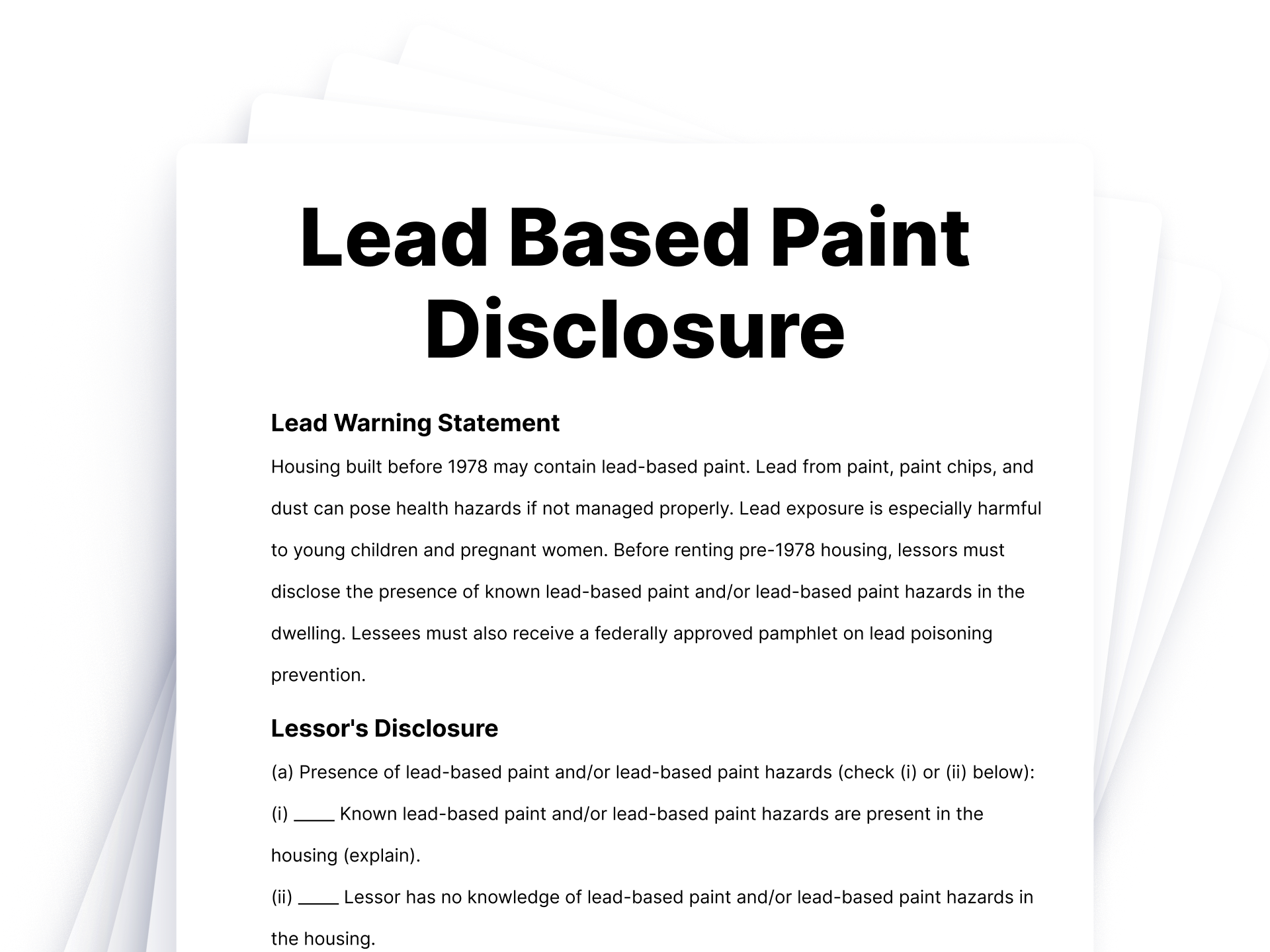
Download as PDF when complete
 Google Doc,
  PDF &
PDF &  Word) or create one online!
Federal Requirements for Pre-1978 Rental Properties
Pre-1978 rental properties must provide mandatory lead hazard disclosures. Additionally, landlords must distribute EPA educational pamphlets and collect tenant acknowledgment signatures. Together, these steps demonstrate full compliance with federal housing law. In fact, skipping any one of these steps can expose landlords to significant penalties.
Smart Strategies for Lead-Based Paint Compliance
Smart property owners use federal-compliant lead disclosure procedures to protect their investments. Furthermore, proper documentation ensures legal compliance, maintains positive tenant relationships, and helps avoid costly federal violations. In addition, consistent procedures make it easier to manage compliance across multiple properties.
The Scope of Lead-Based Paint Hazards
Indeed, lead-based paint hazards affect millions of American rental properties built before the 1978 federal ban. Therefore, proper disclosure procedures are essential for landlord legal protection and tenant safety throughout the rental process.
Why Lead-Based Paint Disclosure Is Essential for Pre-1978 Rentals
Federal Legal Framework for Lead Disclosure
The Residential Lead-Based Paint Hazard Reduction Act of 1992 and EPA Title X regulations establish mandatory disclosure requirements. Specifically, these apply to all rental properties built before 1978, when lead-based paint was banned for residential use. Federal law requires landlords to complete disclosure procedures before lease signing, including:
- Hazard notifications and EPA educational materials
- Tenant acknowledgment documentation
Key Benefits of Federal Lead Disclosure Compliance
Federal lead-based paint disclosure provides critical legal protection, including:
- EPA compliance with Title X regulations under 24 CFR Part 35
- HUD notification standards with proper documentation
- Legal liability protection against federal violations and tenant lead poisoning claims
- Tenant safety education through EPA pamphlets
- Federal penalty avoidance — up to $16,000 per violation
Critical Components of Lead-Based Paint Disclosure
EPA Disclosure Statement Requirements
Federal EPA regulations require specific disclosure statements before lease signing. Your disclosure must include:
- Known lead-based paint hazards and available inspection records
- Hazard remediation documentation
- Landlord knowledge statements in EPA-approved language
Furthermore, all content must comply with federal documentation standards under 24 CFR Part 35.
EPA Educational Pamphlet Distribution
Federal law requires landlords to distribute the EPA’s “Protect Your Family from Lead in Your Home” pamphlet to all tenants in pre-1978 properties. In particular, this pamphlet covers lead hazards, prevention methods, and health risks. Additionally, distribution must be documented through signed tenant acknowledgments to verify federal compliance.
Tenant Acknowledgment and Record-Keeping
EPA regulations require tenants to sign acknowledgment forms confirming receipt of disclosure documents and the EPA pamphlet. Your documentation should include:
- Tenant signatures and date stamps
- Acknowledgment statements confirming receipt
- Comprehensive records for federal compliance verification
Federal Lead-Based Paint Laws and Regulatory Framework
The Residential Lead-Based Paint Hazard Reduction Act
The Act covers all residential rentals including apartments, houses, and room rentals. It establishes mandatory disclosures, tenant education, and documentation procedures that protect tenant health while ensuring landlord compliance. Specifically, the Act sets clear standards for:
- Disclosure timing and content
- Documentation requirements
- Tenant notification procedures
Overall, these requirements form the legal backbone of lead-based paint disclosure obligations nationwide.
EPA Title X Regulations and Enforcement
EPA Title X regulations under 24 CFR Part 35 provide detailed implementation requirements. These include disclosure forms, pamphlet distribution, and record retention standards. Furthermore, federal enforcement includes penalties for non-compliance, inspection authority, and tenant complaint investigation. As a result, property owners face significant consequences for failing to meet lead-based paint disclosure obligations.
HUD Implementation and State Coordination
HUD Lead Disclosure Requirements and Standards
Federal lead disclosure requirements are enforced by HUD through specific forms, procedures, and compliance standards. Working alongside EPA regulations, these requirements provide additional tenant protections. Specifically, HUD requirements cover:
- Proper disclosure timing and form completion
- Documentation standards ensuring comprehensive compliance
- Tenant safety protection measures
State and Local Lead Disclosure Coordination
Federal lead-based paint disclosure requirements coordinate with state and local regulations. Additionally, states may provide extra protections, disclosure requirements, or remediation standards beyond federal minimums. Therefore, property owners must comply with both federal requirements and applicable state and local regulations to ensure full compliance.
Lead-Based Paint Disclosure Timing and Procedures
Pre-Lease Disclosure Requirements
Federal law requires lead-based paint disclosure before lease execution. This gives tenants sufficient time to review hazard information and make informed decisions. Disclosure timing must:
- Allow reasonable tenant consideration
- Ensure proper documentation completion
- Verify federal compliance before tenancy begins
Lease Renewal and Continuing Disclosure Obligations
Lead-based paint disclosure requirements also apply to lease renewals and tenancy extensions. Updated information must include any new inspection results, remediation activities, or changes in hazard status. Therefore, continuing disclosure obligations ensure ongoing tenant safety awareness throughout extended rental relationships.
Emergency and Newly Discovered Lead Hazard Disclosure
Notifying Tenants of Newly Discovered Lead Hazards
When lead-based paint hazards are discovered during tenancy, federal regulations require prompt tenant notification. Your notification should include:
- A description of the hazard and its location
- Remediation plans and timeline
- Safety precautions tenants should take
Additionally, discovery notification procedures must ensure immediate tenant safety and proper remediation coordination.
Disclosing Inspection and Testing Results
Lead-based paint inspection or testing results must be disclosed to tenants within federal timeframes. Specifically, disclosures should cover:
- Positive findings and remediation requirements
- Ongoing monitoring procedures
Furthermore, result disclosure should provide comprehensive hazard information and ensure tenant safety awareness.
EPA Educational Requirements and Tenant Protection
The EPA Lead Hazard Pamphlet
EPA’s required educational pamphlet provides comprehensive lead hazard information. It covers health risks, prevention methods, testing procedures, and remediation guidance. Specifically, pamphlet distribution must be documented and acknowledged to ensure tenants receive current EPA safety information.
Lead Hazard Health Information for Tenants
Federal educational requirements include health risk information covering:
- Childhood lead poisoning and adult health effects
- Pregnancy risks from lead exposure
- Prevention strategies for tenant families
Therefore, health information should address both immediate safety concerns and long-term prevention guidance.
Tenant Rights Under Federal Lead Disclosure Law
Tenant Inspection Rights and Professional Testing
Federal law gives tenants the right to request professional lead-based paint inspections, testing procedures, and hazard assessments. Additionally, landlords must cooperate with inspection access requests. In particular, these rights ensure tenants can independently verify property safety. As a result, landlords should never obstruct or delay inspection requests.
Federal Complaint and Enforcement Procedures
Tenants have the right to file EPA complaints regarding disclosure violations, hazard notifications, and landlord non-compliance. These procedures include:
- Comprehensive investigation by federal authorities
- Enforcement actions for confirmed violations
- Tenant protection throughout the complaint process
Consequently, complaint procedures provide tenants with meaningful federal oversight and enforcement.
Lead-Based Paint Inspection and Testing Standards
Professional Inspection and Certification Requirements
Lead-based paint inspections must be conducted by EPA-certified professionals. Specifically, inspectors must meet:
- EPA training and examination standards
- Continuing education requirements
- Approved equipment and reporting procedures
These standards ensure accurate hazard assessment and consistent federal compliance. In other words, only qualified professionals can provide results that hold up under federal scrutiny.
Approved Testing Methods for Lead Detection
Federal regulations specify approved testing methods, including:
- XRF (X-ray fluorescence) analysis
- Paint chip sampling
- Dust wipe testing
Each method has specific accuracy requirements and quality assurance procedures. Furthermore, testing standards ensure reliable hazard identification and consistent results across all lead-based paint disclosure inspections. Consequently, choosing the right testing method is critical for producing legally valid results.
Inspection Reports and Record Retention
What Lead Inspection Reports Must Include
Lead-based paint inspection reports must include comprehensive hazard identification, location mapping, condition assessments, and remediation recommendations. Additionally, reports must comply with federal reporting standards. Your documentation should:
- Provide detailed hazard information
- Ensure tenant understanding of risks
- Support ongoing federal compliance verification
Federal Record Retention Requirements
Federal law requires landlords to maintain inspection records, testing results, and remediation documentation for specific retention periods. Additionally, tenants must have access to these records on request. Therefore, a strong record retention system protects you legally and demonstrates ongoing compliance with lead-based paint disclosure obligations.
Lead-Based Paint Remediation and Safety Procedures
EPA RRP Rule for Renovation Work
EPA’s Renovation, Repair, and Painting (RRP) Rule applies to any renovation work in pre-1978 properties that could disturb lead-based paint. Specifically, compliance requires:
- Certified contractors and lead-safe work practices
- Containment, worker protection, and waste disposal procedures
- Tenant notification before and during renovation
Consequently, RRP compliance ensures tenant safety during all renovation activities.
Clearance Testing and Ongoing Monitoring
After remediation work, completed lead-based paint remediation requires professional clearance testing and safety verification. After remediation, properties still require:
- Ongoing monitoring for paint condition and wear patterns
- Regular maintenance to prevent new hazard development
- Documentation of all monitoring and maintenance activities
Furthermore, ongoing monitoring ensures federal compliance and tenant safety throughout the rental period.
Federal Penalties for Non-Compliance
EPA Violation Penalties and Enforcement
EPA enforcement of lead disclosure violations includes:
- Civil penalties up to $16,000 per occurrence
- Criminal prosecution for willful violations
- Corrective action requirements to restore compliance
Therefore, these penalties promote industry-wide compliance with lead-based paint disclosure standards.
Landlord Liability for Lead Poisoning Claims
Property owners face significant legal liability for tenant lead poisoning injuries when disclosure requirements are not met. Liability can include medical costs, damages, and legal fees. Additionally, comprehensive lead-based paint disclosure compliance, proper documentation, and ongoing safety maintenance all help reduce this liability risk. In short, prevention through disclosure is always less costly than litigation.
State and Local Lead-Based Paint Requirements
State Enhanced Disclosure Standards
Many states have enhanced lead-based paint disclosure requirements that exceed federal minimums. These may include additional testing, disclosure content, or tenant notification procedures. Therefore, property owners must research state-specific requirements in addition to federal obligations. Otherwise, compliance with federal law alone may not be sufficient.
Local Municipal Lead Ordinances
Local municipalities often maintain lead-based paint ordinances including inspection requirements and remediation procedures. Additionally, local requirements may include property registration and periodic testing. As a result, property owners operating in multiple jurisdictions must stay current with all applicable regulations. Moreover, non-compliance with local ordinances can trigger penalties separate from federal violations.
Technology and Modern Lead Disclosure Management
Digital Disclosure Systems for Federal Compliance
Modern lead-based paint disclosure increasingly uses digital platforms for form distribution, tenant acknowledgment, and documentation retention. Notably, these systems comply with federal electronic signature laws and record retention requirements. Furthermore, technology integration enhances compliance efficiency while maintaining comprehensive federal documentation standards.
Automated Compliance Tracking and Tenant Communication
Property management software can automate federal lead disclosure requirements including:
- Deadline tracking and form generation
- Compliance monitoring and documentation management
- Tenant notification delivery and confirmation
Consequently, automated systems reduce administrative burden while ensuring consistent adherence to lead-based paint disclosure obligations.
Download Your Free Federal Lead-Based Paint Disclosure Forms
Our comprehensive federal lead-based paint disclosure package provides essential legal framework for EPA Title X compliance. It protects both property owners and tenants. This federal-compliant package addresses EPA disclosure requirements, HUD notification procedures, and documentation standards.
Package features include:
- Complete EPA Title X compliance with federal disclosure requirements
- HUD-approved disclosure forms with tenant acknowledgment procedures
- EPA educational pamphlet distribution guidance
- Federal notification procedures for hazard discovery and remediation
- Tenant rights protection with federal complaint procedure information
- Multi-state compatibility with federal baseline requirements
Sample
FAQs
All residential rental properties built before 1978 require mandatory lead-based paint disclosure under the Residential Lead-Based Paint Hazard Reduction Act of 1992 and EPA Title X regulations.
Landlords must provide a completed disclosure statement about known lead hazards, distribute the EPA’s “Protect Your Family from Lead in Your Home” pamphlet, and obtain signed tenant acknowledgment before lease signing.
Landlords who violate federal lead disclosure requirements face civil penalties of up to $16,000 per occurrence, plus potential criminal prosecution for willful violations and liability for tenant lead poisoning claims.
Yes — disclosure requirements apply to lease renewals and tenancy extensions, and must include any updated information about inspection results, remediation activities, or changes in hazard status.
No — lead-based paint inspections must be conducted by EPA-certified professionals using approved testing methods such as XRF analysis, paint chip sampling, or dust wipe testing.