
New York Lease Agreement
A New York rental lease agreement establishes a legally binding contract between landlords and tenants. This comprehensive document outlines rental terms, payment obligations, property rules, and the rights of both parties. The agreement protects landlord investments while ensuring tenants understand their responsibilities throughout the tenancy.
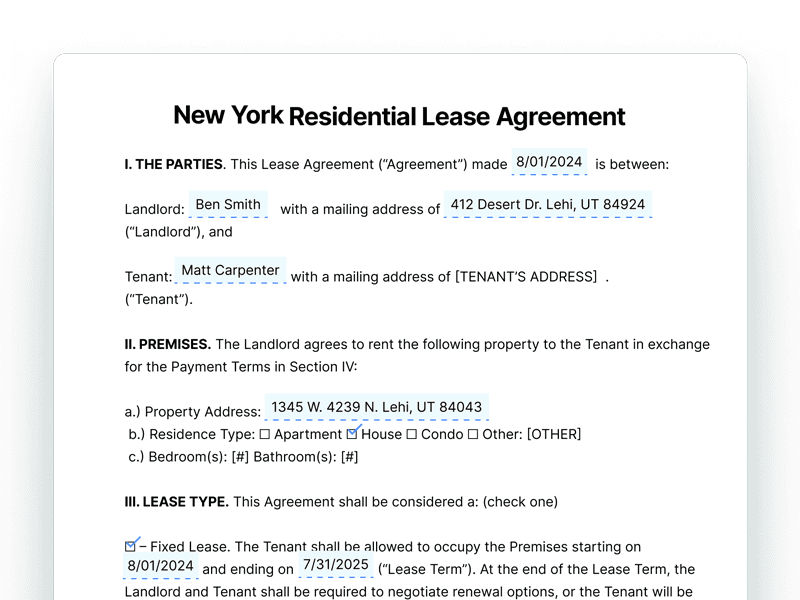


Understanding New York Lease Agreement Requirements
State Legal Framework
New York landlord tenant law provides some of the strongest tenant protections in the nation. New York Real Property Law, Real Property Actions and Proceedings Law, and the landmark Housing Stability and Tenant Protection Act of 2019 (HSTPA) establish comprehensive rights and responsibilities. New York City has additional regulations including rent stabilization for qualifying buildings. The regulatory framework varies significantly between New York City, other cities with rent regulations, and the rest of the state, requiring landlords to understand their specific jurisdiction’s requirements. The New York rental lease agreement becomes enforceable when both parties sign the document, creating mutual obligations that govern the entire landlord-tenant relationship under New York’s extensive landlord-tenant statutes and regulations.
Written Agreement Standards
New York requires written lease agreements for tenancies of one year or longer. For shorter tenancies, oral agreements are enforceable but written agreements provide essential documentation. Given New York’s complex tenant protections, a written residential lease agreement New York landlords can reference becomes critical for compliance and dispute resolution.
Essential Elements of a New York Lease Agreement
Parties and Property Identification
Complete Party Information Every New York lease agreement template should identify all parties involved in the rental arrangement. Required information includes:
- Full legal names of all landlords or property managers
- Full legal names of all adult tenants
- Complete property address including unit numbers
- Legal property description when applicable
Accurate identification prevents confusion about who holds rights and responsibilities under the agreement.
Lease Term and Duration
Fixed-Term Agreements Fixed-term leases establish specific start and end dates for tenancies. Most New York rental contracts run for one or two-year periods. In rent-stabilized apartments, tenants have the right to renewal leases of one or two years at their option.
Month-to-Month Arrangements Month-to-month rental agreements automatically renew each month until either party provides proper termination notice. New York requires varying notice periods depending on tenancy length:
- Less than one year: 30 days notice
- One to two years: 60 days notice
- Two or more years: 90 days notice
Rent Payment Terms
Payment Obligations New York lease agreements must clearly state rent payment requirements including:
- Monthly rent amount
- Payment due date
- Accepted payment methods
- Where tenants should submit payments
- Grace period provisions
New York does not mandate a specific grace period by statute, though many leases include grace periods before late fees apply.
Late Fee Provisions New York strictly limits late fees under the HSTPA to the lesser of:
- $50, OR
- 5% of the monthly rent
Late fees cannot be charged until rent is five or more days overdue. Fees exceeding these limits are unenforceable.
Security Deposit Requirements in New York
Deposit Limits and Handling
Statutory Cap New York limits security deposits to one month’s rent under the HSTPA. This applies statewide regardless of property type or rental amount. Landlords cannot collect:
- More than one month’s rent as security deposit
- Additional deposits for pets (pet deposits prohibited)
- Last month’s rent in advance
- Any other fees that function as additional security
Separate Account Requirements New York requires landlords to hold security deposits in interest-bearing accounts at New York banking institutions. Landlords must:
- Maintain deposits separate from personal funds
- Provide tenants with bank name and address
- Pay interest annually (minus 1% administrative fee landlord may retain)
For buildings with six or more units, landlords must use interest-bearing accounts and pay interest to tenants.
Return Procedures
14-Day Timeline New York landlords must return security deposits within 14 days after tenants vacate properties. This is one of the shortest return periods in the nation.
Itemization Requirements If landlords withhold any portion of the deposit, they must provide a written itemized statement of deductions describing:
- Each item of damage claimed
- Actual cost of repairs (not estimates)
- Any unpaid rent
Allowable Deductions Landlords can deduct from security deposits for:
- Unpaid rent
- Damage beyond normal wear and tear
- Actual costs to repair damage
Deductions for normal wear and tear, routine painting, or carpet cleaning due to normal use are prohibited.
Wrongful Withholding Penalties
New York imposes penalties on landlords who wrongfully withhold security deposits. Landlords who fail to return deposits or provide proper itemization within 14 days forfeit the right to retain any portion of the deposit. Tenants may also recover:
- The full deposit amount
- Reasonable attorney fees
- Punitive damages in cases of bad faith
Required Disclosures for New York Rental Agreements
Lead-Based Paint Disclosure
Federal law mandates lead-based paint disclosures for all rental properties built before 1978. New York landlords must provide:
- Written disclosure of known lead-based paint presence
- EPA pamphlet “Protect Your Family from Lead in Your Home”
- Ten-day opportunity for lead inspection
- Signed acknowledgment of disclosure receipt
New York City has additional lead paint requirements under Local Law 1.
Bed Bug Disclosure
New York requires landlords to disclose bed bug infestation history. Landlords must provide:
- Written disclosure of bed bug history for the specific unit
- Building-wide bed bug infestation history for the past year
- This disclosure must be provided before lease signing
Flood Zone Disclosure
New York requires landlords to disclose if the property is located in a flood zone. The disclosure must indicate:
- Whether the property is in a designated flood zone
- History of flooding at the property
- Whether flood insurance is required
Sprinkler System Disclosure
New York requires landlords to disclose whether the building has a sprinkler system. The disclosure must indicate:
- Presence or absence of sprinkler system
- Location of sprinklers if present
Smoke Detector Disclosure
New York requires landlords to:
- Install and maintain smoke detectors
- Provide written notice of tenant’s responsibility to maintain detectors
- Include information about smoke detector requirements
Carbon Monoxide Detector Disclosure
New York requires landlords to:
- Install and maintain carbon monoxide detectors
- Provide written notice about detector requirements
- Disclose detector locations
Air Contamination Disclosure
For properties in areas with known air contamination (such as near industrial sites), landlords must provide disclosure of potential air quality issues.
Owner/Agent Identification
New York requires landlords to disclose:
- Name and address of the property owner
- Name and address of any managing agent
- Name and address of person authorized to receive notices and legal process
For buildings with three or more units, the owner’s name and address must be filed with the county clerk.
Rent Stabilization Disclosure
For rent-stabilized apartments, landlords must provide:
- Rent stabilization rider with required terms
- Notice of tenant’s rights under rent stabilization
- Rent history for the unit
Stove Knob Covers (NYC)
In New York City, for units with children under six, landlords must provide stove knob covers upon request and disclose this right.
Landlord and Tenant Rights Under New York Law
Landlord Obligations
Warranty of Habitability New York imposes one of the nation’s strongest implied warranties of habitability. Landlords must maintain rental properties with:
- Compliance with all building and housing codes
- Making all repairs necessary to keep premises fit and habitable
- Keeping common areas clean, safe, and well-lit
- Maintaining electrical, plumbing, sanitary, heating, and ventilating systems
- Providing running water and adequate hot water
- Providing adequate heat (68°F when outside temp is below 55°F during day; 62°F at night)
- Maintaining working smoke detectors and carbon monoxide detectors
- Providing garbage receptacles and arranging for removal
- Extermination of pest infestations (including bed bugs, roaches, mice)
- Maintaining weathertight conditions
- Providing secure locks on doors and windows
- Maintaining elevator service (where applicable)
- Providing working intercoms (where applicable)
The warranty of habitability cannot be waived and any lease provision attempting to waive it is void.
Property Access Rights New York requires landlords to provide reasonable notice before entering rental properties. While no specific statutory timeframe exists statewide, reasonable advance notice is required. Entry must occur at reasonable times for legitimate purposes including:
- Inspections
- Repairs and maintenance
- Showing property to prospective tenants or buyers
- Emergencies (no notice required)
New York City recommends at least 24 hours notice for non-emergency entry.
Tenant Responsibilities
Property Care Standards Tenants must maintain rental units according to New York law including:
- Keeping the property clean and sanitary
- Using electrical, plumbing, heating, and other systems properly
- Disposing of garbage in a clean and sanitary manner
- Not deliberately or negligently destroying property
- Not disturbing neighbors’ peaceful enjoyment
- Complying with housing and building codes
- Allowing reasonable landlord access with proper notice
- Maintaining smoke and carbon monoxide detectors (battery replacement)
Rent Regulation in New York
Rent Stabilization
Rent stabilization applies to many New York City apartments and some units in nearby counties:
- Buildings with six or more units built before 1974 (NYC)
- Buildings receiving certain tax benefits
- Limits on rent increases (set by Rent Guidelines Board)
- Tenant right to lease renewal
- Succession rights for family members
- Required lease riders and disclosures
Rent Control
A small number of units remain under rent control:
- Tenants who have lived continuously in the unit since before July 1, 1971
- Strict limits on rent increases
- Strong eviction protections
Emergency Tenant Protection Act (ETPA)
ETPA extends rent stabilization to certain buildings in Nassau, Westchester, and Rockland counties.
Lease Termination and Eviction Procedures
Voluntary Termination
Notice Requirements New York termination notice requirements vary by tenancy length under HSTPA:
- Less than one year: 30 days written notice
- One to two years: 60 days written notice
- Two or more years: 90 days written notice
These notice requirements apply to both landlords and tenants for terminations and non-renewals.
Rent Increases
New York requires advance notice before rent increases:
- Same notice periods as termination (30/60/90 days based on tenancy length)
- Rent-stabilized apartments: Increases limited by Rent Guidelines Board
Eviction Processes
New York evictions proceed through Housing Court with significant tenant protections.
Nonpayment of Rent New York landlords can begin eviction proceedings when tenants fail to pay rent. The process requires:
- 14-day written notice demanding rent
- Filing nonpayment petition in Housing Court
- Court hearing and judgment
- Warrant of eviction (with minimum 14-day stay)
- Marshal or sheriff execution
Tenants can pay all rent owed plus fees at any time before actual eviction to stop the process.
Holdover Proceedings For lease violations or tenancy termination:
- Proper notice based on violation type
- Filing holdover petition
- Court hearing and judgment
- Warrant of eviction
Good Cause Eviction Recent New York legislation has enacted good cause eviction protections in many areas, limiting landlord ability to refuse lease renewals or evict without cause.
Retaliatory Eviction Protections
New York prohibits retaliatory evictions. Landlords cannot evict or retaliate against tenants for:
- Complaining about code violations to authorities
- Exercising legal rights under landlord-tenant law
- Organizing or participating in tenant organizations
- Testifying in housing-related proceedings
Retaliatory actions within one year of protected activity are presumed retaliatory.
Creating an Effective New York Lease Agreement
Documentation Best Practices
Comprehensive Terms Strong New York lease agreements include provisions addressing:
- Pet policies (no separate pet deposits allowed)
- Guest and occupancy limits (subject to roommate law limitations)
- Maintenance responsibilities
- Utility payment assignments
- Parking and storage
- Noise and conduct standards
- Renewal procedures
- Entry notice procedures
- Security deposit interest provisions
- Required disclosure acknowledgments
- Rent stabilization rider (if applicable)
Professional Templates Using a New York lease agreement template ensures contracts include all legally required elements. Given New York’s extensive regulations, professional templates help landlords avoid costly violations.
Tenant Screening Integration
Application Procedures Thorough tenant screening before lease signing helps landlords select reliable tenants. New York limits application fees to $20 maximum. Screening may include:
- Credit history review
- Employment and income verification
- Rental history and references
- Background checks (with limitations)
New York prohibits discrimination based on source of income. Criminal history screening has significant limitations.
New York-Specific Considerations
New York City Regulations
New York City has extensive additional regulations:
- HPD registration requirements
- Heat and hot water requirements
- Lead paint Local Law 1 compliance
- Bed bug disclosure and treatment
- Rent stabilization (where applicable)
- Certificate of occupancy requirements
- Multiple dwelling registration
- Housing maintenance code enforcement
Rent Guidelines Board
For rent-stabilized apartments in NYC:
- Annual rent increase limits
- Lease renewal guidelines
- Major capital improvement (MCI) increases (limited)
- Individual apartment improvement (IAI) increases (limited under HSTPA)
Upstate New York Markets
Markets outside NYC have different dynamics:
- Buffalo, Rochester, Syracuse, Albany rental markets
- Different regulatory requirements
- University town considerations
- Less rent regulation but HSTPA applies statewide
College Town Rentals
New York has significant college student rental markets:
- Columbia University, NYU, CUNY system (NYC)
- Cornell University (Ithaca)
- Syracuse University
- University at Buffalo
- University of Rochester
- SUNY campuses statewide
Landlords in college areas should consider:
- Academic year lease terms
- Parental guarantor requirements
- Roommate law compliance
- Multiple occupant arrangements
Winter Weather Provisions
New York winters create rental considerations:
- Heat requirements (68°F day/62°F night)
- Heating season October 1 through May 31
- Snow and ice removal responsibilities
- Pipe freezing prevention
- Emergency heating provisions
Short-Term Rentals
New York heavily regulates short-term rentals:
- NYC Multiple Dwelling Law restrictions
- Local Law 18 registration requirements
- Minimum 30-day rentals in most NYC buildings
- Airbnb and platform regulations
- Significant penalties for violations
Co-op and Condo Rentals
Many New York rentals involve cooperative or condominium units:
- Board approval requirements (co-ops)
- Subletting limitations
- Building rules compliance
- Additional fees and requirements
Rent Stabilization Outside NYC
ETPA extends stabilization to certain buildings in:
- Nassau County
- Westchester County
- Rockland County
Military Tenant Considerations
New York’s military connections require understanding:
- Servicemembers Civil Relief Act (SCRA) protections
- Lease termination rights upon deployment
- Fort Drum tenant considerations
- West Point area housing
- Various installations throughout the state
Source of Income Protections
New York prohibits discrimination based on source of income:
- Housing Choice Voucher (Section 8) acceptance required
- FHEPS and other subsidies protected
- Cannot refuse based on lawful income source
Cannabis Considerations
New York has legalized recreational cannabis:
- Landlords can prohibit smoking in lease agreements
- Cannot discriminate based on lawful cannabis use
- Smoking restrictions apply
- Federal housing maintains prohibitions
Security Deposit
| TOPIC | RULE |
| Security Deposit Maximum: | No deposit should exceed one month’s rent. N.Y. Gen. Oblig. Law § 7-108 |
| Security Deposit Interest: | For rental properties containing six or more family dwelling units, the landlords receiving security deposits are required to deposit them in an interest bearing account in a banking organization within the state. The account shall earn interest at a rate which shall be the prevailing rate earned by other such deposits made with banking organizations in such area. N.Y. Gen. Oblig. Law § 7-103 |
| Separate Security Deposit Bank Account: | Security deposits cannot be mingled with a landlord’s personal funds or become an asset of the person receiving the funds. For rental properties containing six or more family dwelling units, the landlords receiving security deposits are required to deposit them in an interest bearing account in a banking organization within the state. N.Y. Gen. Oblig. Law § 7-103 |
| Non-refundable fees: | No statute. |
| Pet Deposits and Additional Fees: | No statute. |
| Deadline for Returning Security Deposit: | Landlords must return security deposits to tenants no latger than 14 days after the lease termination and tenant move out. N.Y. Gen. Oblig. Law § 7-108 |
| Permitted Uses of the Deposit: | Partial security deposits can be lawfully retained for the reasonable and itemized costs due to non-payment of rent, damage caused by the tenant beyond normal wear and tear, non-payment of utility charges payable directly to the landlord under the terms of the lease or tenancy, and moving and storage of the tenant’s belongings. N.Y. Gen. Oblig. Law § 7-108 |
| Security Deposit can be Withheld: | Partial security deposits can be lawfully retained for the reasonable and itemized costs due to non-payment of rent, damage caused by the tenant beyond normal wear and tear, non-payment of utility charges payable directly to the landlord under the terms of the lease or tenancy, and moving and storage of the tenant’s belongings. N.Y. Gen. Oblig. Law § 7-108 |
| Require Written Description/Itemized List of Damages and Charges: | Partial security deposits can be lawfully retained for the reasonable and itemized costs due to non-payment of rent, damage caused by the tenant beyond normal wear and tear, non-payment of utility charges payable directly to the landlord under the terms of the lease or tenancy, and moving and storage of the tenant’s belongings. N.Y. Gen. Oblig. Law § 7-108 |
| Receipt of Security Deposit: | Landlords are required to notify in writing each of the persons making such security deposit or advance, giving the name and address of the banking organization in which the deposit of security money is made, and the amount of the deposit(s) made. N.Y. Gen. Oblig. Law § 7-103 |
| Record Keeping of Deposit Withholdings: | No statute. |
| Failure to Comply: |
Lease, Rent & Fees
| TOPIC | RULE |
| Rent is Due: | No statute. |
| Payment Methods: | No statute. |
| Rent Increase Notice: | Written notice is required and shall be based on the cumulative amount of time the tenant has occupied the residence or the length of the tenancy in each lease, whichever is longer. N.Y. Real Prop. Law § 226-C |
| Late Fees: | No statute. |
| Application Fees: | Landlords may charge a fee to reimburse costs associated with conducting a background check and credit check, provided the cumulative fee for such checks is no more than the actual cost of the background check and credit check or twenty dollars, whichever is less. Landlords must waive the fee if the potential tenant provides a copy of a background check or credit check conducted within the past thirty days. N.Y. Real Prop. Law § 238-A |
| Prepaid Rent: | Landlords may not demand any payment, fee, or charge for the late payment of rent unless the payment of rent has not been made within five (5) days of the date it was due, and such payment, fee, or charge shall not exceed fifty ($50) dollars or five percent (5%) of the monthly rent, whichever is less. N.Y. Real Prop. Law § 238-A |
| Returned Check Fees: | Landlords may collect a fee for a dishonored check for no more than twenty dollars ($20) if specified in the lease. N.Y. Gen. Oblig. Law § 5-328 |
| Tenant Allowed to Withhold Rent for Failure to Provide Essential Services (Water, Heat, etc.): | Tenants are allowed to make a direct payment to a municipality if the landlord has failed ot make the appropriate payment. The tenant may deduct the amount paid from a future rent payment according to the statute stipulations. N.Y. Real Prop. Law § 235-A |
| Tenant Allowed to Repair and Deduct Rent: | Tenants are permitted to repair damages to the dwelling unit and deduct rent in some instances. N.Y. Real Prop. Law § 235-B |
| Self-Help Evictions: | Landlords are prohibited from using self-help tactics to evict a tenant. |
| Landlord Allowed to Recover Court and Attorney’s Fees: | |
| Landlord Must Make a Reasonable Attempt to Mitigate Damages to Lessee, including an Attempt to Re-rent: |
Notices and Entry
| TOPIC | RULE |
| Notice to Terminate Tenancy: | No notice is required to terminate a lease with a definite term, outside the city of New York. N.Y. Real Prop. Law § 232-B |
| Notice to Terminate a Periodic Lease – Month-to-Month: | Notice of termination by the tenant or for a tenancy other than a residential tenancy the landlord, upon the tenant’s or non-residential landlord’s notifying the landlord or non-residential tenant at least one month before the expiration of the term of the tenant’s election to terminate outside New York City. If within New York City, 30 days’ notice is required. N.Y. Real Prop. Law § 232-B |
| Notice to Terminate a Periodic Lease – Week-to-week: | Written notice must be provided with no less than seven (7) days’ notice. N.Y. Real Prop. Law § 232-B |
| Notice to Terminate Lease due to Sale of Property: | |
| Notice of date/time of Move-Out Inspection: | No statute. |
| Notice of Termination for Nonpayment: | For rental units outside of New York City, notice must be given five (5) days since the rent is past due. Tenant has 14 days to remedy the past due rent or quit. |
| Notice for Lease Violation: | For rental units outside of New York City, notice must be given five (5) days since the rent is past due. Tenant has 14 days to remedy the past due rent or quit. |
| Required Notice before Entry: | No statute, but “reasonable” notice is recommended of at least 24 hours. |
| Entry Allowed with Notice for Maintenance and Repairs: | No statute, but “reasonable” notice is recommended of at least 24 hours. |
| Emergency Entry Allowed without Notice: | No statute. |
| Entry Allowed During Tenant’s Extended Absence: | No statute. |
| Entry Allowed with Notice for Showing the Property: | No statute, but “reasonable” notice is recommended of at least 24 hours. |
| Notice to Tenants for Pesticide Use: | No statute. |
| Lockouts Allowed: | Lockouts are not permitted. |
| Utility Shut-offs Allowed: | Utility shut-offs are not permitted. |
| Electronic Notices Allowed: | no |
Disclosures
- Name and Addresses: Landlord must disclose name and address of owner and managing agent. (N.Y. Real Prop. Law § 235-a)
- Copy of the Lease: Tenant must be provided with a copy of the lease. (Standard practice)
- Domestic Violence Situations: Victims may terminate lease with court order of protection. (N.Y. Real Prop. Law § 227-c)
Duties
Landlord’s Duties
- Compliance: Must comply with housing codes. (NY Real Prop L § 235-B)
- Repairs: Maintain premises in habitable condition.
- Common Areas: Keep clean and safe. (Common law)
- Maintenance: Provide heat, hot water, and essential services. (N.Y.C. Admin. Code § 27-2029)
- Garbage: Provide waste disposal. (Local law)
Tenant’s Duties
- Cleanliness: Maintain unit clean. (Common law)
- Trash: Dispose properly. (Local law)
- Plumbing: Use fixtures reasonably. (Common law)
- Appliances: Use responsibly. (Common law)
- Damage: Avoid causing damage. (Common law)
- Quiet Enjoyment: Do not disturb others. (Common law)
- Subleasing: Permitted with consent. (N.Y. Real Prop. Law § 226-b)
- Retaliation: Not permitted. (N.Y. Real Prop. Law § 223-b)
- Lead Disclosure: Required by federal law.
By Type (19)
Protecting Your New York Rental Investment
A well-drafted New York rental lease agreement forms the foundation of successful property management. Given New York’s extensive tenant protections, rent regulations, and strict security deposit requirements, comprehensive documentation and strict compliance become essential. Clear terms addressing heating requirements, bed bug procedures, and required disclosures protect both landlord and tenant interests.
RocketRent provides New York lease agreement templates designed to meet state and local requirements while protecting landlord investments. Our platform streamlines property management with integrated tools for lease creation, rent collection, and tenant screening. Create your New York rental lease agreement today and manage your properties with confidence.
New York Lease Agreement PDF
FAQs
New York requires written lease agreements for tenancies of one year or longer. For shorter tenancies, written agreements are strongly recommended given New York’s complex regulatory requirements.
New York limits security deposits to one month’s rent under the HSTPA. Pet deposits and additional fees functioning as security are prohibited.
New York landlords must return security deposits within 14 days after the tenant vacates. This is one of the shortest return periods in the nation. Failure to comply results in forfeiture of the right to retain any portion.
New York requires 30 days notice for tenancies under one year, 60 days for one to two years, and 90 days for tenancies of two or more years. These requirements apply to both landlords and tenants.
New York requires landlords to provide reasonable advance notice before entering rental properties. While no specific statutory timeframe exists, 24 hours notice is recommended. Entry must occur at reasonable times except for emergencies.
New York requires extensive disclosures including bed bug history, flood zone status, sprinkler system presence, smoke and carbon monoxide detectors, and owner identification. Properties built before 1978 require lead-based paint disclosures. Rent-stabilized units require additional disclosures.
New York limits late fees to $50 or 5% of the monthly rent, whichever is less. Late fees cannot be charged until rent is at least five days overdue.