
Massachusetts Lease Agreement
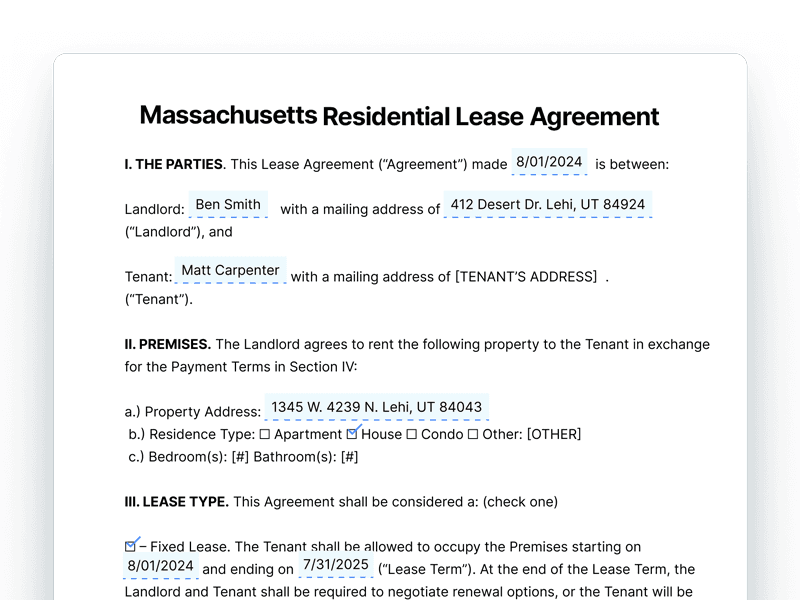
A Massachusetts rental lease agreement establishes a legally binding contract between landlords and tenants. This comprehensive document outlines rental terms, payment obligations, property rules, and the rights of both parties. The agreement protects landlord investments while ensuring tenants understand their responsibilities throughout the tenancy.


(No Ratings Yet)


Understanding Massachusetts Lease Agreement Requirements
State Legal Framework
Massachusetts landlord tenant law provides extensive protections for renters while establishing clear obligations for property owners. Massachusetts General Laws Chapter 186 governs residential rental agreements, with additional regulations under the Security Deposit Law (Chapter 186, Section 15B) and the State Sanitary Code. Massachusetts maintains some of the strongest tenant protections in the country, including strict security deposit regulations, detailed habitability standards, and extensive disclosure requirements. The Massachusetts rental lease agreement becomes enforceable when both parties sign the document, creating mutual obligations that govern the entire landlord-tenant relationship under Massachusetts General Laws and one of the nation’s most comprehensive tenant protection frameworks.
Written Agreement Standards
Massachusetts does not legally require written lease agreements for tenancies under one year. However, creating a written residential lease agreement Massachusetts landlords can reference provides essential documentation and legal protection. Written agreements prevent disputes by establishing explicit terms both parties acknowledge and accept. Given Massachusetts’s complex regulatory environment, comprehensive written leases become particularly important.
Essential Elements of a Massachusetts Lease Agreement
Parties and Property Identification
Complete Party Information Every Massachusetts lease agreement template should identify all parties involved in the rental arrangement. Required information includes:
- Full legal names of all landlords or property managers
- Full legal names of all adult tenants
- Complete property address including unit numbers
- Legal property description when applicable
Accurate identification prevents confusion about who holds rights and responsibilities under the agreement.
Lease Term and Duration
Fixed-Term Agreements Fixed-term leases establish specific start and end dates for tenancies. Most Massachusetts rental contracts run for 12-month periods, though landlords can create agreements for various durations. Fixed-term leases provide stability for both parties and establish clear expectations about tenancy length.
Month-to-Month Arrangements Month-to-month rental agreements offer flexibility for landlords and tenants who prefer shorter commitments. These arrangements automatically renew each month until either party provides proper termination notice. Massachusetts requires 30 days written notice or notice equal to the rental period (whichever is longer) to terminate month-to-month tenancies.
Rent Payment Terms
Payment Obligations Massachusetts lease agreements must clearly state rent payment requirements including:
- Monthly rent amount
- Payment due date
- Accepted payment methods
- Where tenants should submit payments
- Grace period provisions
Massachusetts law provides tenants a 30-day grace period before landlords can begin eviction proceedings for nonpayment. However, rent is still due on the date specified in the lease.
Late Fee Provisions Massachusetts strictly regulates late fees. Late fees must be:
- Reasonable in amount
- Clearly stated in the lease agreement
- Only assessed after rent is overdue
Massachusetts courts scrutinize late fee provisions and may refuse to enforce fees deemed excessive or punitive.
Security Deposit Requirements in Massachusetts
Deposit Limits and Handling
Statutory Cap Massachusetts limits security deposits to one month’s rent. This is one of the strictest security deposit limits in the nation. Landlords cannot charge:
- More than one month’s rent as security deposit
- Last month’s rent exceeding one month’s rent
- More than the cost of a new lock for lock changes
Separate Escrow Account Requirements Massachusetts requires landlords to hold security deposits in separate, interest-bearing escrow accounts at Massachusetts banks. Landlords must:
- Deposit funds in a federally insured Massachusetts bank
- Maintain deposits in a separate account from personal funds
- Provide tenants with a receipt containing bank name and account number
- Pay annual interest to tenants at the rate of 5% or the actual bank rate (whichever is less)
Receipt Requirements Massachusetts requires landlords to provide a detailed receipt within 30 days of receiving the security deposit. The receipt must include:
- Amount of deposit
- Name of person receiving deposit
- Date deposit was received
- Description of the rental unit
- Name and location of the bank holding the deposit
- Account number
Statement of Condition
Massachusetts requires landlords to provide a Statement of Condition within 10 days of the tenancy beginning or within 10 days of receiving the security deposit (whichever is later). This statement must:
- Describe the condition of the rental unit in detail
- List any existing damage
- Be signed by the landlord
- Be provided to the tenant who has 15 days to review and note disagreements
Failure to provide the Statement of Condition prevents landlords from making deductions for pre-existing conditions.
Return Procedures
30-Day Timeline Massachusetts landlords must return security deposits within 30 days after tenants vacate properties. This timeline applies to both the deposit return and required itemized statements of deductions.
Allowable Deductions Landlords can only deduct from security deposits for:
- Unpaid rent (not including last month’s rent if collected separately)
- Unpaid water charges
- Damage beyond normal wear and tear (with itemized list and repair estimates)
- Real estate tax increases if lease allows
Deductions for cleaning costs or general maintenance are generally not permitted unless damage occurred.
Wrongful Withholding Penalties
Massachusetts imposes severe penalties on landlords who violate security deposit laws. Landlords who fail to comply with any requirement may be liable for:
- Three times the security deposit amount
- Five percent interest from the date of deposit
- Court costs and reasonable attorney fees
These penalties apply for violations including failure to provide receipts, improper account handling, late return, or improper deductions.
Required Disclosures for Massachusetts Rental Agreements
Lead-Based Paint Disclosure
Massachusetts has extensive lead paint requirements exceeding federal standards. For properties built before 1978, landlords must:
- Provide federal EPA pamphlet “Protect Your Family from Lead in Your Home”
- Complete Massachusetts Lead Paint Property Transfer Notification Certification
- Disclose known lead-based paint presence
- Provide lead inspection reports if available
- Comply with Massachusetts Lead Law requirements
Massachusetts requires de-leading or interim control of lead hazards in units where children under six reside.
Security Deposit Bank Information
Massachusetts requires landlords to provide written notice of:
- Name and address of the bank holding the security deposit
- Account number
- Amount of deposit
- Statement that tenant is entitled to interest
This disclosure must be provided within 30 days of receiving the deposit.
Statement of Condition
As described above, landlords must provide a detailed written statement of the rental unit’s condition within 10 days.
Smoke Detector and Carbon Monoxide Detector Disclosure
Massachusetts requires landlords to:
- Install and maintain smoke detectors and carbon monoxide detectors
- Provide written certification that detectors are operational
- Obtain signed acknowledgment from tenants
Insurance Disclosure
Massachusetts recommends landlords inform tenants that:
- Landlord’s insurance does not cover tenant’s personal property
- Tenants should obtain renter’s insurance
- This can be included as a lease provision
Utility Disclosure
If utilities are shared or sub-metered, Massachusetts requires disclosure of:
- How utility costs are calculated
- Which utilities are included in rent
- Metering arrangements
Owner/Agent Identification
Massachusetts requires landlords to disclose:
- Name and address of the property owner
- Name and address of any person authorized to manage the property
- Name and address of person authorized to receive notices and demands
Landlord and Tenant Rights Under Massachusetts Law
Landlord Obligations
Warranty of Habitability Massachusetts imposes one of the nation’s strongest implied warranties of habitability through the State Sanitary Code (105 CMR 410). Landlords must maintain rental properties with:
- Compliance with State Sanitary Code and local building codes
- Adequate heating (minimum 68°F from September 16 to June 14)
- Hot and cold running water
- Functional plumbing and sewage systems
- Safe electrical systems
- Weathertight windows and doors
- Clean and sanitary common areas
- Proper garbage removal facilities
- Working smoke and carbon monoxide detectors
- Extermination of pest infestations (including bed bugs)
- Secure locks on doors and windows
- Safe stairways and railings
- Adequate ventilation
- Freedom from lead paint hazards (for units with children under six)
Landlords must make repairs within a reasonable time after receiving notice. For serious violations, tenants have extensive remedies including rent withholding, repair-and-deduct, and lease termination.
Property Access Rights Massachusetts requires landlords to provide reasonable notice before entering rental properties. While no specific statutory timeframe exists, 24 hours advance notice is standard practice. Entry must occur at reasonable times for legitimate purposes including:
- Inspections
- Repairs and maintenance
- Showing property to prospective tenants or buyers
- Emergencies (no notice required)
Repeated or unreasonable entry may constitute harassment.
Tenant Responsibilities
Property Care Standards Tenants must maintain rental units according to Massachusetts law including:
- Keeping the property clean and sanitary
- Using electrical, plumbing, heating, and other systems properly
- Disposing of garbage properly
- Not deliberately or negligently destroying property
- Not disturbing neighbors’ peaceful enjoyment
- Complying with Sanitary Code requirements for tenants
- Allowing reasonable landlord access
- Maintaining smoke and carbon monoxide detectors (battery replacement)
Lease Termination and Eviction Procedures
Voluntary Termination
Notice Requirements Massachusetts termination notice requirements depend on lease type:
- Fixed-term leases end automatically on specified dates
- Month-to-month tenancies require 30 days notice or notice equal to rental period (whichever is longer)
- Tenancies at will require proper written notice
Including clear termination procedures in lease agreements prevents misunderstandings about proper notice protocols.
Rent Increases
Massachusetts does not have statewide rent control, but:
- Some municipalities may have local regulations
- Landlords should provide reasonable advance notice of increases
- Increases during a fixed-term lease require lease provision allowing them
Eviction Processes
Massachusetts uses summary process procedures for evictions with significant tenant protections.
Nonpayment of Rent Massachusetts landlords can begin eviction proceedings when tenants fail to pay rent. The process requires:
- 14-day Notice to Quit for nonpayment
- Filing Summary Process Summons and Complaint if tenant fails to pay
- Court hearing and judgment
- Execution (10 days after judgment for tenant to vacate)
Tenants can stop eviction by paying rent owed plus court costs before judgment.
Lease Violations Landlords can pursue eviction for material lease violations:
- 30-day Notice to Quit (or as specified in lease)
- Court filing after notice period expires
- Court proceedings and judgment
No-Fault Termination For tenancies at will:
- 30 days notice or notice equal to rental period
- Proper written notice required
- Court filing if tenant fails to vacate
Retaliatory Eviction Protections
Massachusetts provides strong protection against retaliatory evictions. Landlords cannot evict or retaliate against tenants for:
- Reporting code violations to authorities
- Exercising legal rights under landlord-tenant law
- Joining or organizing tenant unions
- Withholding rent due to uninhabitable conditions
- Testifying in housing-related proceedings
Retaliatory actions within six months of protected activity are presumed retaliatory.
Creating an Effective Massachusetts Lease Agreement
Documentation Best Practices
Comprehensive Terms Strong Massachusetts lease agreements include provisions addressing:
- Pet policies (no separate pet deposits allowed beyond security deposit limit)
- Guest and occupancy limits
- Maintenance responsibilities
- Utility payment assignments
- Parking and storage rules
- Noise and conduct standards
- Renewal and termination procedures
- Entry notice procedures
- Snow removal responsibilities
- Security deposit interest payment procedures
- Statement of Condition acknowledgment
Professional Templates Using a Massachusetts lease agreement template ensures contracts include all legally required elements. Given Massachusetts’s strict security deposit laws and extensive disclosure requirements, professional templates help landlords avoid costly violations.
Tenant Screening Integration
Application Procedures Thorough tenant screening before lease signing helps landlords select reliable tenants. Screening should include:
- Credit history review
- Employment and income verification
- Rental history and references
- Background checks where permitted
Massachusetts prohibits discrimination based on source of income including housing vouchers. Documenting screening criteria and applying standards consistently protects landlords from discrimination claims.
Massachusetts-Specific Considerations
Boston and Greater Boston Area
The Boston metropolitan area presents unique rental considerations:
- High rental demand and competitive markets
- Historic property regulations
- Strict lead paint enforcement
- Student housing around numerous universities
- Rent stabilization discussions
- September 1 lease cycles tied to academic calendar
Cambridge and Somerville Regulations
These cities near Boston have additional tenant protections:
- Enhanced just cause eviction considerations
- Additional tenant rights provisions
- Strict code enforcement
- High rental demand from students and professionals
College Town Rentals
Massachusetts has extensive college student rental markets:
- Harvard University and MIT (Cambridge)
- Boston University, Northeastern, Boston College
- Tufts University (Medford/Somerville)
- UMass Amherst
- Worcester colleges (WPI, Holy Cross, Clark)
- Amherst College, Smith College, Mount Holyoke
Landlords in college towns should consider:
- September 1 lease start dates (Boston tradition)
- Academic year lease terms
- Parental guarantor requirements
- Multiple roommate arrangements
- Summer subletting provisions
- High move-in/move-out volume on September 1
Winter Weather Provisions
Massachusetts winters create essential rental considerations:
- Snow and ice removal responsibilities (landlord typically responsible for common areas)
- Heating requirements (68°F minimum September 16 to June 14)
- Emergency heating failure procedures
- Pipe freezing prevention
- Ice dam prevention
- Driveway and sidewalk maintenance
Lease agreements should clearly assign winter maintenance duties.
Heating Season Requirements
Massachusetts has strict heating requirements:
- Landlords must provide adequate heat from September 16 to June 14
- Minimum temperature of 68°F between 7 AM and 11 PM
- Minimum temperature of 64°F between 11 PM and 7 AM
- Heating system must be capable of maintaining required temperatures
- Tenant cannot be required to pay for heat if not separately metered
Coastal Properties
Massachusetts coastal properties require attention to:
- Flood zone disclosures
- Storm surge and erosion awareness
- Hurricane preparation requirements
- Cape Cod and Islands rental regulations
- Seasonal rental considerations
Short-Term and Vacation Rentals
Massachusetts regulates short-term rentals at state and local levels:
- State registration requirements
- Local regulations vary by municipality
- Boston short-term rental ordinance
- Cape Cod and Islands restrictions
- Tax collection obligations
- Insurance requirements
Lead Paint Law Compliance
Massachusetts has stringent lead paint requirements:
- Mandatory inspection for properties with children under six
- De-leading or interim control requirements
- Strict liability for lead poisoning
- Registration and certification requirements
- Significant penalties for non-compliance
- Lead-safe renovation practices
Source of Income Protections
Massachusetts prohibits discrimination based on source of income:
- Housing Choice Voucher (Section 8) acceptance required
- Other government assistance programs protected
- Cannot refuse tenants based on lawful income source
- Reasonable screening criteria still permitted
Condominium Conversion Protections
Massachusetts provides protections for tenants in buildings undergoing condo conversion:
- Extended notice requirements
- Right of first refusal to purchase
- Relocation assistance in some circumstances
- Protections for elderly and disabled tenants
Security Deposit
| TOPIC | RULE |
| Security Deposit Maximum: | 1x monthly rent Mass. Gen. Laws ch. 186 § 15B(1)(b)(iii) |
| Security Deposit Interest: | 5% or any interest amount paid by the bank must be paid to the tenant for leases that are a minimum of 1 year. The interest must be paid each year of tenancy. Mass. Gen. Laws ch. 186 § 15B(3)(b) |
| Separate Security Deposit Bank Account: | Yes. Receipt must be given to tenant within 30 days indicating the name and location of the bank where it’s being held. Mass. Gen. Laws ch. 186 § 15B(3)(a) |
| Non-refundable fees: | Not allowed unless stated in the lease and agreed to by tenant. Mass. Gen. Laws ch. 186 § 15B(1)(b)(iii)(B)(l) |
| Pet Deposits and Additional Fees: | No statute |
| Deadline for Returning Security Deposit: | 30 days at the end of tenancy. Mass. Gen. Laws ch. 186 § 15B(4) |
| Permitted Uses of the Deposit: | Unpaid rent, unpaid water charges, unpaid increase in real estate taxes, reasonable amounts to repair damages. etc. Mass. Gen. Laws ch. 186 § 15B(4)(i)(ii)(iii) |
| Security Deposit can be Withheld: | Yes Mass. Gen. Laws ch. 186 § 15B(4)(i)(ii)(iii) |
| Require Written Description/Itemized List of Damages and Charges: | Yes Mass. Gen. Laws ch. 186 § 15B(4)(iii) |
| Receipt of Security Deposit: | Yes Mass. Gen. Laws ch. 186 § 15B(3)(a) |
| Record Keeping of Deposit Withholdings: | Yes. 2 years of records must be kept for each dwelling unit. Mass. Gen. Laws ch. 186 § 15B(2)(d)(iii) |
| Failure to Comply: | Landlord forfeits right to withhold any portion of the deposit Mass. Gen. Laws ch. 186 § 15B(6) |
Lease, Rent & Fees:
| TOPIC | RULE |
| Rent is Due: | No statute. Usually it’s at the beginning of the month or each term, unless otherwise stated in the lease. |
| Payment Methods: | No statute |
| Rent Increase Notice: | No statute. Common practice is 30-day notice |
| Late Fees: | Can be imposed 30 days after rent is due Mass. Gen. Laws ch. 186 § 15B(1)(c) |
| Application Fees: | No statute |
| Prepaid Rent: | A landlord can require the first and last month as a security deposit. Mass. Gen. Laws ch. 186 § 15B(1)(a)(i)(ii) |
| Returned Check Fees: | If the amount is less than $2,500 the penalty is $25. If it exceeds that amount, the fee is 1% of the check amount. Mass. Gen. Laws ch. 60 § 57A |
| Tenant Allowed to Withhold Rent for Failure to Provide Essential Services (Water, Heat, etc.): | Yes Mass. Gen. Laws ch. 239 § 8A |
| Tenant Allowed to Repair and Deduct Rent: | Yes. The amount may not exceed 4 months’ rent in any 12-month period. Mass. Gen. Laws ch. 111 § 127L |
| Self-Help Evictions: | Not allowed. Punishable by a fine of up to $300 or imprisonment of up to 6 months. Mass. Gen. Laws ch. 186 § 14 |
| Landlord Allowed to Recover Court and Attorney’s Fees: | No statute |
| Landlord Must Make a Reasonable Attempt to Mitigate Damages to Lessee, including an Attempt to Re-rent: | No statute |
Notices and Entry:
| TOPIC | RULE |
| Notice to Terminate Tenancy: | 3-month notice for payment intervals of 3 months or more. If it’s under 3 months, then notice should be in equal intervals to payments or 30 days whichever is longer. Mass. Gen. Laws ch. 186 § 12 |
| Notice to Terminate a Periodic Lease – Week-to-week: | Notice should be in equal intervals to payments or 30 days whichever is longer. Mass. Gen. Laws ch. 186 § 12 |
| Notice to Terminate a Periodic Lease – Month-to-Month: | Notice should be in equal intervals to payments or 30 days whichever is longer. Mass. Gen. Laws ch. 186 § 12 |
| Notice to Terminate Lease due to Sale of Property: | No specific statute. General notice of termination states it should be in equal intervals to payments or 30 days, whichever is longer. Mass. Gen. Laws ch. 186 § 12 |
| Notice of date/time of Move-Out Inspection: | No statute |
| Notice of Termination for Nonpayment: | 14-day notice to quit or remedy. Mass. Gen. Laws ch. 186 § 11 |
| Notice for Lease Violation: | No specific statute. General notice of termination states it should be in equal intervals to payments or 30 days, whichever is longer. Mass. Gen. Laws ch. 186 § 12 |
| Required Notice before Entry: | The statute doesn’t specify how much notice must be given, but common practice is 24-hour notice minimum. Mass. Gen. Laws ch. 186 § 15B(1)(a) |
| Entry Allowed with Notice for Maintenance and Repairs: | Yes Mass. Gen. Laws ch. 186 § 15B(1)(a) |
| Emergency Entry Allowed without Notice: | No specific statute. Usually it is allowed |
| Entry Allowed During Tenant’s Extended Absence: | Yes Mass. Gen. Laws ch. 186 § 15B(1)(a)(ii) |
| Entry Allowed with Notice for Showing the Property: | Yes Mass. Gen. Laws ch. 186 § 15B(1)(a) |
| Notice to Tenants for Pesticide Use: | No statute |
| Lockouts Allowed: | No Mass. Gen. Laws ch. 186 § 14 |
| Utility Shut-offs Allowed: | No Mass. Gen. Laws ch. 186 § 14 |
| Electronic Notices Allowed: | Must be agreed to by all parties Mass. Gen. Laws ch. 110G § 15 |
Disclosures
- Name and Addresses: Landlord must provide the name, address, and phone number of the property manager and owner. (Mass. Gen. Laws ch. 186 § 1)
- Copy of the Lease: Tenants must receive a signed copy of the lease. (Common practice)
- Domestic Violence Situations: Tenants can break the lease with proof of abuse. (Mass. Gen. Laws ch. 186 § 24)
Duties
Landlord’s Duties
- Compliance: Must meet state sanitary and building codes. (105 CMR 410.003)
- Repairs: Responsible for necessary repairs to keep the premises habitable. (105 CMR 410.003)
- Common Areas: Keep in good repair and safe condition. (105 CMR 410.003)
- Maintenance: Must ensure all essential services work properly. (105 CMR 410.003)
- Garbage: Must provide for removal and receptacles. (105 CMR 410.600-602)
Tenant’s Duties
- Cleanliness: Keep the premises clean. (105 CMR 410.600-602)
- Trash: Dispose of garbage in a sanitary manner. (105 CMR 410.600-602)
- Plumbing: Use plumbing fixtures properly. (105 CMR 410.003)
- Appliances: Operate reasonably. (105 CMR 410.003)
- Damage: Do not cause damage. (105 CMR 410.003)
- Quiet Enjoyment: Avoid disturbing others. (Common law)
- Subleasing: Subject to lease terms. (Lease-specific)
- Retaliation: Illegal for landlords to retaliate. (Mass. Gen. Laws ch. 186 § 18)
- Lead Disclosure: Federal requirement.
By Type (19)
Protecting Your Massachusetts Rental Investment
A well-drafted Massachusetts rental lease agreement forms the foundation of successful property management. Given Massachusetts’s strict security deposit laws, extensive habitability requirements, and lead paint regulations, comprehensive documentation and strict compliance become essential. Clear terms addressing heating requirements, security deposit procedures, and disclosure obligations protect both landlord and tenant interests.
RocketRent provides Massachusetts lease agreement templates designed to meet state requirements and protect landlord investments. Our platform streamlines property management with integrated tools for lease creation, rent collection, and tenant screening. Create your Massachusetts rental lease agreement today and manage your properties with confidence.
Massachusetts Lease Agreement PDF
FAQs
Massachusetts does not legally require written lease agreements for tenancies under one year. However, written agreements provide essential documentation given Massachusetts’s strict regulatory requirements.
Massachusetts limits security deposits to one month’s rent only. Landlords can also collect first month’s rent and last month’s rent, but cannot charge pet deposits, cleaning deposits, or other fees beyond this limit.
Massachusetts landlords must return security deposits within 30 days after the tenant vacates. Violations can result in liability for three times the deposit amount plus attorney fees.
Massachusetts requires 30 days written notice or notice equal to the rental payment period, whichever is longer, to terminate month-to-month tenancies.
Massachusetts requires landlords to provide reasonable advance notice before entering rental properties, typically 24 hours. Entry must occur at reasonable times except for emergencies.
Massachusetts requires extensive disclosures including security deposit bank information, Statement of Condition, smoke and carbon monoxide detector certification, and lead paint information. Lead paint requirements are particularly stringent for pre-1978 properties.
Yes, Massachusetts requires landlords to hold security deposits in interest-bearing accounts and pay tenants annual interest at 5% or the actual bank rate, whichever is less.