
Fair Housing Compliance Log
A Fair Housing Compliance Log is a comprehensive record documenting all rental applications, tenant interactions, and housing decisions to demonstrate compliance with fair housing laws. This log tracks applicant information, screening criteria used, decision outcomes, and reasoning for approvals or denials. Property managers use this tool to prove consistent application of tenant selection criteria without discrimination based on protected characteristics.
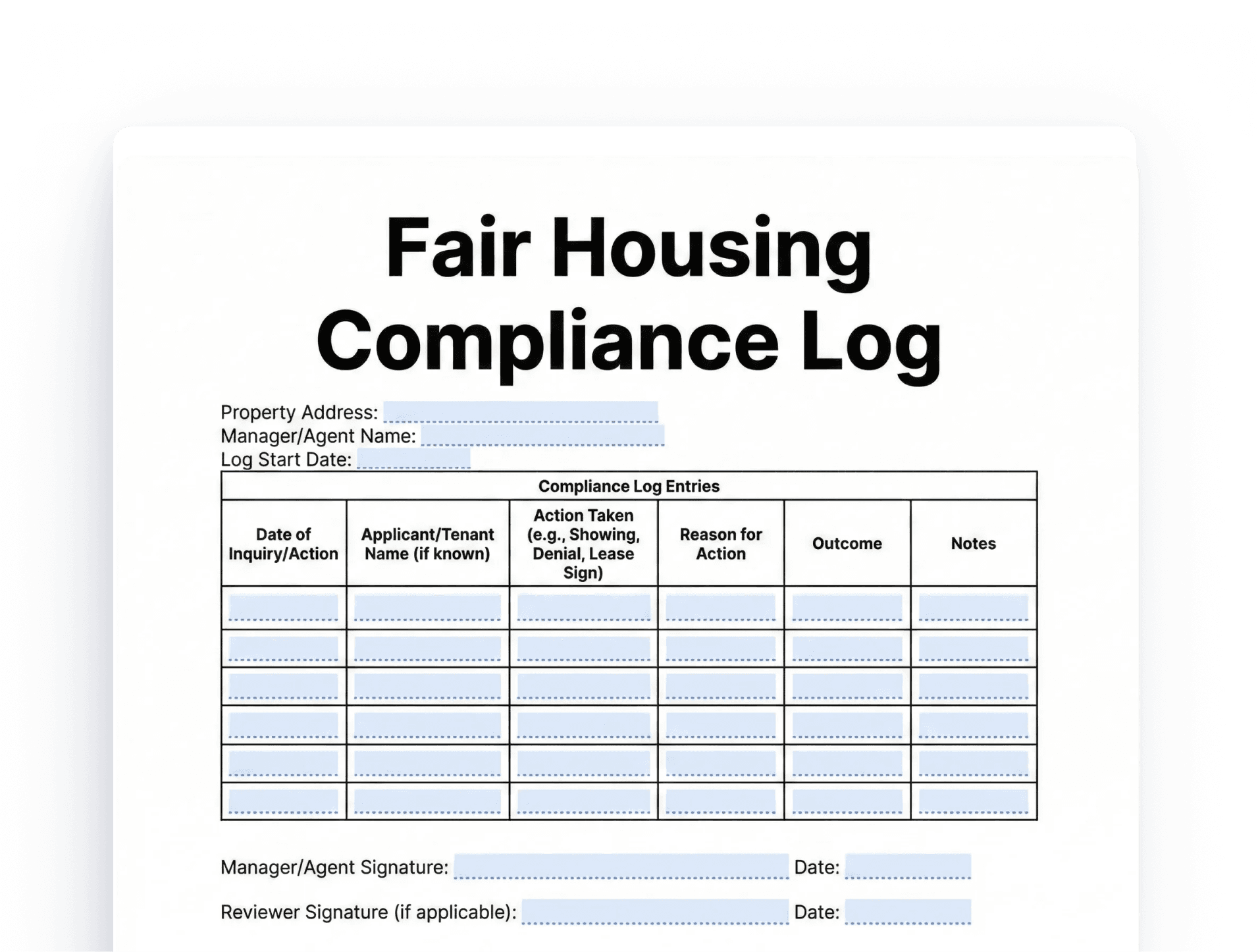
Download as PDF when complete


(No Ratings Yet)
What Is a Fair Housing Compliance Log?
The Fair Housing Act prohibits discrimination based on race, color, national origin, religion, sex, familial status, and disability. Additionally, many states and localities protect additional classes including sexual orientation, gender identity, source of income, and veteran status. Your compliance log demonstrates adherence to these laws by showing identical treatment of all applicants regardless of protected characteristics.
Why Every Landlord Needs This Documentation
Legal Protection During Investigations
Fair housing complaints trigger investigations by HUD or state agencies requiring extensive documentation. A well-maintained fair housing compliance log provides immediate evidence of non-discriminatory practices. Investigators review your records looking for patterns suggesting discrimination, such as approving similar applicants from one group while denying comparable applicants from protected classes.
Without proper documentation, defending against discrimination claims becomes extremely difficult. Your word alone rarely suffices when facing allegations of bias. Conversely, detailed logs showing consistent criteria application across all applicants provide powerful evidence supporting your defense. This documentation often prevents cases from proceeding beyond initial investigation stages.
Demonstrating Consistent Standards
Your fair housing compliance log proves you apply identical screening criteria to every applicant. Recording credit score requirements, income verification methods, rental history checks, and criminal background standards for each application shows consistency. This uniformity demonstrates that decisions stem from legitimate business criteria rather than discriminatory preferences.
The log also helps identify unintentional bias in your processes. Reviewing records periodically might reveal that you unconsciously apply stricter standards to certain applicant groups. Early detection of these patterns allows corrective action before complaints arise. Furthermore, regular review improves your overall tenant selection quality by highlighting which criteria actually predict tenancy success.
Staff Training and Accountability
A fair housing compliance log creates accountability for all staff members involved in tenant selection. When employees know their decisions undergo documentation and review, they exercise greater care following established policies. Additionally, the log provides concrete examples for training new staff about proper fair housing practices.
Review compliance logs during regular staff meetings to identify training needs. Perhaps certain team members struggle with properly documenting denial reasons or inconsistently apply screening criteria. Addressing these issues promptly prevents violations before they occur. Moreover, consistent documentation standards across your organization demonstrate systematic commitment to fair housing compliance.
Essential Components to Track
Applicant Demographics and Contact Information
Record basic applicant information including full names, contact details, and application dates. Document the advertised property, requested unit type, and move-in date preferences. This information establishes the complete timeline of each applicant’s journey through your screening process.
Never record protected class information unless legally required or voluntarily provided for specific purposes. For example, disability status matters only if applicants request reasonable accommodations. Similarly, familial status becomes relevant when applicants mention children. Recording this information unnecessarily creates risk that decisions might appear influenced by protected characteristics.
Screening Criteria Application
Document every screening criterion applied to each application. Include credit score requirements, income-to-rent ratios, employment verification results, rental history findings, and criminal background check outcomes. Specify the exact standards used and note whether applicants met each criterion.
Consistency matters critically in this section. If you require 3x monthly rent in income for one applicant, you must apply the identical standard to everyone. Similarly, if you verify employment through pay stubs for some applicants, use the same method for all. Your log should clearly show this uniformity across every application.
Decision Rationale and Timeline
Record your decision for each application along with specific reasons supporting approval or denial. Vague explanations like “not qualified” provide insufficient documentation. Instead, note “denied due to credit score 580, below 650 requirement” or “approved, met all screening criteria.” This specificity proves decisions stem from legitimate business reasons.
Document decision dates and communication timing. Note when you informed applicants of outcomes and through what method. Additionally, record any follow-up questions applicants asked and your responses. This complete communication record proves transparency and helps reconstruct events if disputes arise months or years later.
Accommodation Requests and Modifications
When applicants request disability accommodations or modifications, document these requests thoroughly. Note the exact accommodation requested, date received, and any supporting documentation provided. Record your response, whether approved or denied, with detailed reasoning.
Interactive dialogue requirements mean you must document discussions about alternative accommodations when original requests prove unreasonable. Show that you explored options in good faith. Furthermore, track accommodation implementation and any ongoing arrangements throughout tenancies. This documentation demonstrates ongoing fair housing commitment beyond initial application approval.
Best Practices for Maintaining Your Log
Establishing Standardized Procedures
Create written tenant selection criteria before accepting applications. These standards should specify minimum credit scores, income requirements, rental history expectations, and criminal background policies. Distribute these criteria to all staff members and apply them uniformly to every applicant.
Document your standardized procedures in policy manuals. Include specific instructions about information collection, screening methods, and decision-making authority. When everyone follows identical procedures, your compliance log naturally reflects consistency. Additionally, standardized processes reduce decision-making time and improve applicant experience.
Real-Time Documentation Requirements
Record information in your fair housing compliance log immediately as events occur. Waiting days or weeks to document applications from memory creates inaccuracies and raises credibility questions. Real-time documentation ensures accuracy and demonstrates professionalism during investigations.
Use digital systems allowing staff to update logs from smartphones or tablets during property showings. This technology enables immediate recording of showing attendance, questions asked, and follow-up actions taken. Furthermore, digital logs allow centralized storage and easy retrieval during audits or litigation.
Regular Audits and Reviews
Conduct quarterly audits of your fair housing compliance log examining approval and denial patterns. Calculate approval rates for different demographic groups if voluntarily disclosed. Significant disparities might indicate unintentional bias requiring process adjustments.
Review a random sample of logged applications to verify documentation completeness and accuracy. Ensure staff members consistently record all required information using proper formats. Address any deficiencies immediately through additional training or procedure clarification. Regular audits demonstrate ongoing commitment to fair housing compliance beyond minimum legal requirements.
Secure Storage and Confidentiality
Store fair housing compliance logs securely with access limited to authorized personnel only. These records contain sensitive applicant information requiring protection from unauthorized disclosure. Use password-protected digital systems or locked filing cabinets for physical records.
Maintain logs for at least three years after application dates per FCRA requirements. Some jurisdictions mandate longer retention periods. Additionally, keep logs for denied applicants equally long as approved tenant records. Premature destruction of denial records eliminates your ability to defend against delayed discrimination complaints.
Common Mistakes to Avoid
Inconsistent Application of Criteria
Never apply different standards to different applicants, even unintentionally. Requiring two references from some applicants while accepting one from others creates discrimination risk. Your compliance log should show identical criteria application across all applications without exception.
Avoid making exceptions for applicants you particularly like or who seem trustworthy. Personal impressions often reflect unconscious bias based on protected characteristics. Instead, let objective screening criteria guide every decision. When legitimate circumstances warrant exceptions, document extraordinary reasoning thoroughly in your compliance log.
Inadequate Denial Explanations
Generic denial reasons fail to demonstrate legitimate business justification for rejecting applicants. Always cite specific screening criteria failures with supporting details. Additionally, ensure denial reasons match your advertised selection criteria and company policies.
Never include assumptions or subjective judgments in denial explanations. Comments about applicants seeming unreliable, having attitude problems, or not being “good fits” suggest potential discrimination. Stick to objective, measurable criteria failures that your screening process documented clearly.
Failing to Document Verbal Communications
Many fair housing violations occur during phone conversations or property showings rather than formal application processes. Record all interactions with prospective tenants including initial inquiries, showing appointments, and informal conversations. Note questions applicants asked and answers you provided.
Document any statements about unit availability, rental requirements, or application procedures communicated verbally. Inconsistent verbal information given to different prospective tenants can constitute discrimination even when formal processes appear neutral. Thorough documentation proves consistent messaging across all interactions.
Conclusion
A fair housing compliance log protects your rental business from discrimination claims while ensuring equal treatment for all prospective tenants. By systematically documenting applications, screening criteria, decisions, and communications, you create powerful evidence of non-discriminatory practices. Implement standardized procedures, train staff thoroughly, and maintain detailed records for every applicant. Regular audits and consistent documentation standards demonstrate your commitment to fair housing beyond minimum legal requirements. Start using a comprehensive compliance log today to protect your business and provide equal housing opportunities for all qualified applicants.
FAQs
Record applicant names, application dates, screening criteria applied, credit and background check results, decision outcomes, and specific denial reasons for each application. Additionally, document all communication dates, accommodation requests, and any policy exceptions granted with detailed justification for consistency.
Maintain fair housing compliance logs for at least three years after the application date per FCRA requirements. Some states require longer retention periods, and keeping records for five years provides additional protection during discrimination investigations that may begin years after incidents occur.
Yes, recording unnecessary protected class information like race, religion, or national origin suggests these factors influenced decisions. Only document protected characteristics when legally required or when applicants voluntarily disclose them for specific purposes like requesting disability accommodations.
Address inconsistencies immediately by investigating causes and implementing corrective measures. Provide additional staff training, clarify policies, and consider consulting fair housing attorneys to assess potential liability and develop action plans preventing future violations.
While you can maintain one comprehensive log covering all interactions, many property managers use separate systems for applications versus tenant management. Regardless of structure, ensure you document all fair housing-relevant decisions and communications consistently across both prospective and current tenants.