
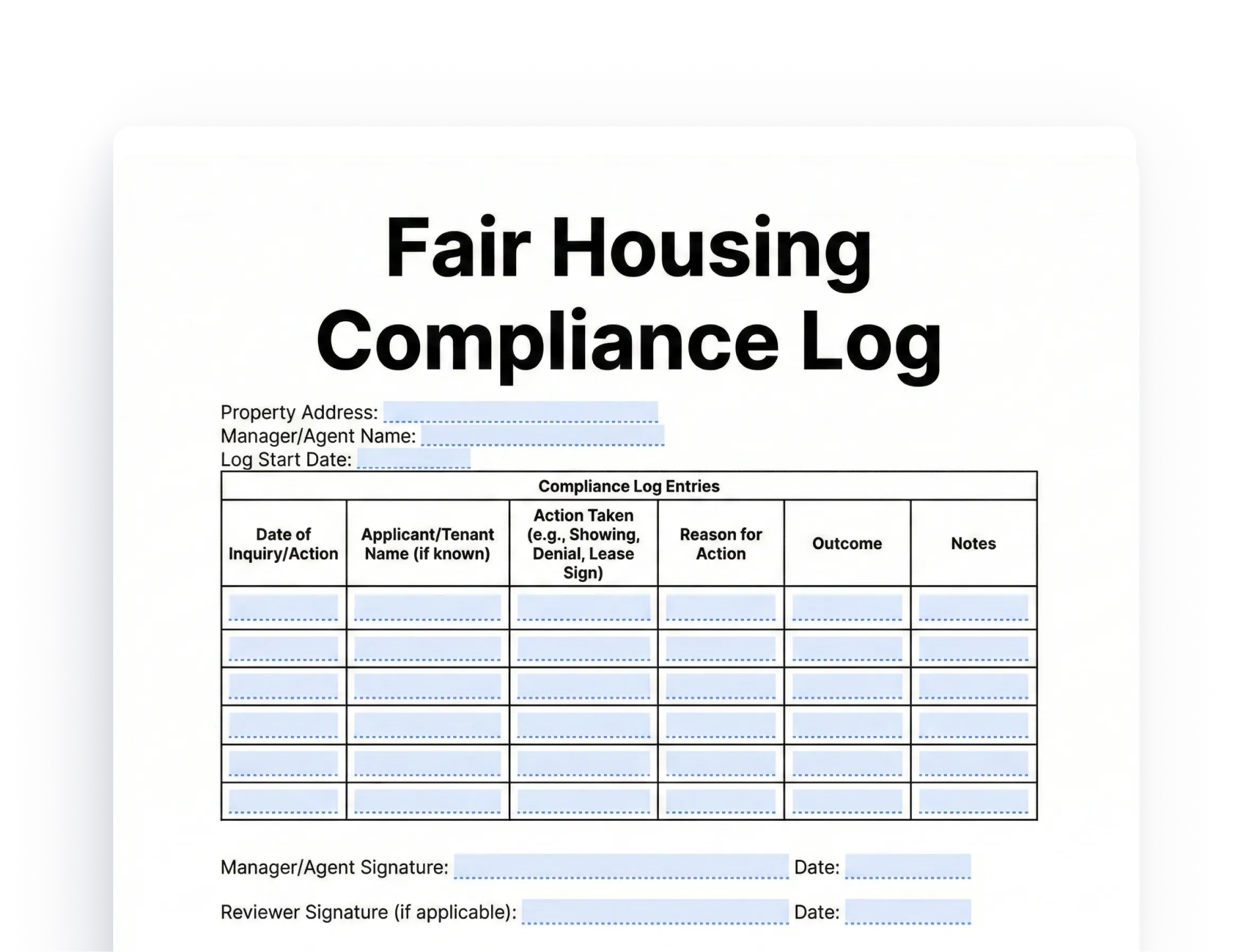
Fair Housing Compliance Log


(1)
A Fair Housing Compliance Log is a detailed record of all rental applications, tenant exchanges, and housing decisions. In particular, it shows how you apply fair housing laws the same way across all applicants. Property managers use this log to prove they screen tenants fairly and without bias based on protected traits.
Download as PDF when complete
Fair Housing Compliance Log: Definition and Legal Background
What the Fair Housing Act Requires
The Fair Housing Act prohibits bias based on:
- Race, color, and national origin
- Religion and sex
- Familial status
- Disability
In addition, many states and cities protect more groups, including sexual orientation, gender identity, source of income, and veteran status. Your Fair Housing Compliance Log shows that you treat all applicants the same, regardless of these traits.
How a Fair Housing Compliance Log Works
The log tracks applicant information, the screening criteria you used, decision outcomes, and the reasons behind each approval or denial. As a result, it creates a clear paper trail showing your decisions were based on consistent, objective standards — not personal bias.
Why Every Landlord Needs a Fair Housing Compliance Log
Legal Protection During Fair Housing Investigations
Fair housing complaints trigger reviews by HUD or state agencies that require detailed records. A well-kept Fair Housing Compliance Log gives you immediate evidence of fair practices. Investigators look for patterns — for example, approving similar applicants from one group while denying comparable ones from a protected class.
Without good records, defending against bias claims is very difficult. Your word alone is rarely enough when facing a bias claim. In contrast, a detailed log showing consistent standards across all applicants is powerful evidence. Also, strong records often stop cases from moving past the early investigation stage.
Demonstrating Consistent Screening Standards
Your Fair Housing Compliance Log proves you apply the same screening criteria to every applicant. Recording credit score rules, income checks, rental history reviews, and background check standards for each application shows the same standard. This the same standard shows that decisions came from real business reasons — not biased preferences.
The log also helps you spot patterns of accidental bias. For instance, reviewing records regularly might reveal that you apply stricter standards to certain groups without realizing it. Early detection lets you fix these issues before a complaint is filed. Moreover, regular reviews also improve the quality of your tenant selection over time.
Fair Housing Compliance Log and Staff Responsibility
Staff Training and Responsibility With Your Compliance Log
A Fair Housing Compliance Log creates responsibility for everyone involved in tenant selection. When staff know their decisions are recorded and reviewed, they follow policies more carefully. In addition, the log gives concrete examples for training new staff on proper fair housing practices.
Review the log at regular staff meetings to spot training gaps. For instance, some team members may struggle to document denial reasons clearly or apply screening criteria the same way. Fixing these issues quickly prevents breaches before they happen. Consistent records across your whole team show a genuine dedication to fair housing.
What to Track in Your Fair Housing Compliance Log
Applicant Demographics and Contact Information
Record basic applicant details, including:
- Full name and contact information
- Application date
- Advertised property and unit type requested
- Preferred move-in date
This information creates a full timeline of each applicant’s path through your screening process. However, never record protected class information unless it is legally required or voluntarily provided for a specific reason — for example, disability status only when an applicant requests a reasonable housing adjustment.
Screening Criteria Applied to Each Application
Document every screening criterion you apply to each application. Include:
- Credit score rules and the applicant’s score
- Income-to-rent ratio and verification results
- Employment verification method and outcome
- Rental history findings
- Criminal background check results and standards used
The same standard is critical here. If you require income equal to 3x the monthly rent for one applicant, you must apply the same standard to everyone. Your log should clearly show this same treatment across all applications.
Recording Decisions and Housing adjustments in Your Fair Housing Compliance Log
Decision Reasons and Timeline in Your Fair Housing Log
Record your decision for each application along with specific reasons. Vague notes like “not qualified” are not enough. Instead, write something like “denied — credit score 580, below our 650 minimum” or “approved — met all screening criteria.” This detail proves your decisions came from real business reasons.
Also document:
- The date you made each decision
- When and how you told the applicant
- Any follow-up questions the applicant asked and your responses
This full communication record shows transparency and helps piece together events if a dispute comes up months or years later.
Housing adjustment Requests and Disability Modifications
When applicants ask for disability housing adjustments or property changes, document the request fully. Record:
- The exact housing adjustment requested
- The date you received the request
- Any supporting documents provided
- Your response and the reasoning behind it
Also note any discussions about alternative options when the original request was not possible. Show that you explored solutions in good faith. Also, track any ongoing housing adjustment arrangements throughout the tenancy to show your dedication extends beyond the application stage.
Best Practices for Keeping Your Fair Housing Compliance Log
Establish Written Standards Before Accepting Applications
Create clear, written tenant selection criteria before you start accepting applications. These should cover:
- Minimum credit scores
- Income rules
- Rental history expectations
- Criminal background check policies
Share these standards with all staff and apply them to every applicant without exception. When everyone follows the same steps, your Fair Housing Compliance Log will naturally show the same standard. In addition, clear standards make decisions faster and improve the applicant experience.
Record Information in Real Time
Always update your Fair Housing Compliance Log right away — not days later from memory. Delayed records are less accurate and raise credibility questions during reviews. Real-time records show professionalism and accuracy.
Use digital tools that let staff update logs from phones or tablets during property showings. This allows instant recording of attendance, questions asked, and next steps. Moreover, digital logs allow central storage and easy access during audits or legal matters.
Auditing and Storing Your Fair Housing Compliance Log
Conduct Regular Fair Housing Compliance Audits
Review your Fair Housing Compliance Log every quarter. In particular, look at:
- Approval and denial rates across different applicant groups
- Whether staff are recording all required information
- Whether denial reasons are specific and consistent
If you see big differences in approval rates between groups, investigate whether your process needs adjustment. Address any record-keeping gaps right away through extra training or clearer procedures. Regular audits show ongoing dedication to fair housing — not just minimum legal compliance.
Store Your Fair Housing Log Securely
Keep your Fair Housing Compliance Log in a secure location with access limited to authorized staff only. These records contain sensitive applicant data that must be protected. Use password-protected digital systems or locked filing cabinets for paper records.
Keep records for at least three years after the application date, as required by the FCRA. Some areas require longer retention. Also keep denial records just as long as approved tenant records. Deleting denial records early removes your ability to defend against a late-filed bias complaint.
Common Mistakes to Avoid With Your Fair Housing Compliance Log
Inconsistent Application of Screening Criteria
Never apply different standards to different applicants, even by accident. For example, requiring two references from some applicants but only one from others creates legal risk. Your Fair Housing Compliance Log should show the same criteria applied to every application without exception.
Also avoid making exceptions for applicants you personally like or feel you can trust. Personal impressions often reflect hidden bias tied to protected traits. Let objective criteria guide every decision. If a real exception is needed, document the full reasoning in your log.
Weak or Vague Denial Explanations
Generic denial reasons do not show a real business reason for rejecting an applicant. Always cite the specific screening criteria that were not met, with supporting details. In addition, make sure your denial reasons match your written screening policies and posted criteria.
Never include subjective comments like “seemed unreliable” or “not a good fit.” These phrases suggest possible bias. Stick to objective, measurable failures that your screening process clearly documented.
Failing to Document Verbal Exchanges
Many fair housing breaches happen during phone calls or property showings — not just during formal applications. Record all exchanges with prospective tenants, including:
- Initial phone or email inquiries
- Showing appointments and attendance
- Questions asked during tours and your answers
- Any verbal statements about availability or rules
Giving different information to different applicants during these informal exchanges can still count as bias, even if your formal process looks neutral. Thorough records prove you said the same thing to everyone.
Fair Housing Compliance Log: Key Takeaways
A Fair Housing Compliance Log protects your rental business from bias claims by creating a clear, systematic record of every application, screening decision, and tenant communication. To maintain an effective log, write clear screening criteria upfront, train staff on fair housing rules, record everything in real time, audit quarterly, and store records for at least three years. Ultimately, landlords who keep thorough records protect their business and provide equal housing opportunities to every qualified applicant.
FAQs
A Fair Housing Compliance Log is a detailed record that documents all rental applications, tenant interactions, screening criteria, and housing decisions to prove consistent, non-discriminatory treatment of all applicants under fair housing laws.
Landlords need this log because it provides immediate, documented evidence of non-discriminatory practices during fair housing investigations, making it far easier to defend against discrimination claims than relying on memory or verbal explanations alone.
The log should include applicant contact details, application dates, all screening criteria applied, specific reasons for approval or denial, decision dates, communication records, and any disability accommodation requests and responses.
Landlords must keep records for at least three years after application dates per FCRA requirements, though some states require longer retention periods, and denial records must be kept just as long as approved tenant records.
The most common mistakes include applying inconsistent screening criteria to different applicants, writing vague denial reasons that lack specific justification, and failing to document verbal communications during phone calls or property showings.