
Virginia Real Estate Purchase Agreement
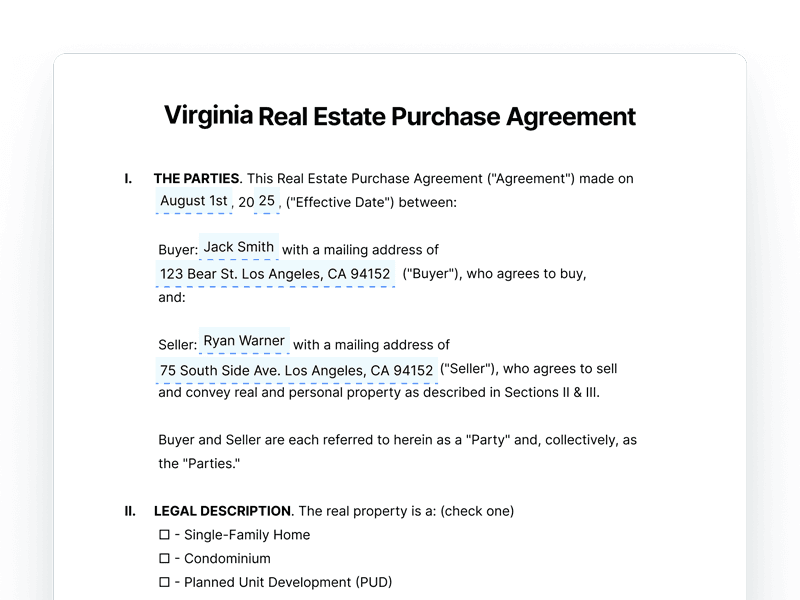
A Virginia real estate purchase agreement, also known as a “Contract for Sale and Purchase of Real Estate,” creates a formal document that allows a potential buyer to make an official offer to purchase a property. This comprehensive agreement outlines the buyer’s initial terms, including the purchase price, financing method, and closing date. The seller must respond to the offer within a specified period; otherwise, the offer will become invalid.
Download as PDF when complete


(No Ratings Yet)


Virginia Real Estate Purchase Agreement Requirements
Virginia maintains selective disclosure requirements based on buyer responsibility principles for residential real estate transactions throughout the state. Therefore, buyers and sellers must understand these distinctive obligations when completing a Virginia real estate purchase agreement. Additionally, Virginia places primary investigation responsibility on buyers while requiring specific disclosures for certain property conditions and environmental factors.
Virginia’s Buyer Responsibility Framework
Virginia operates under buyer responsibility principles that emphasize buyer due diligence rather than comprehensive seller disclosure requirements. Consequently, this approach places investigation responsibility primarily on buyers while requiring specific mandatory disclosures for certain situations.
Virginia’s Seller Disclosure Requirements
Limited Disclosure Obligations
Virginia sellers are not obligated to disclose all material defects before selling their property. This approach makes it primarily the buyer’s responsibility to conduct home inspections to assess property conditions. However, sellers must provide certain necessary disclosure statements mandated by Virginia law.
Buyer Investigation Emphasis
Virginia’s framework emphasizes buyer responsibility for property condition assessment through professional inspections and evaluations. This approach protects buyers through due diligence rather than comprehensive seller disclosure. Moreover, buyer investigation responsibility encourages thorough property evaluation throughout the Virginia real estate purchase agreement process.
Required Disclosures for Virginia Real Estate Purchase Agreement
Building and Zoning Disclosures
Building Code or Zoning Ordinance Violations Disclosure Virginia law requires sellers to notify buyers if they are aware of any impending building code violations or local zoning ordinance issues. This disclosure helps buyers understand potential compliance requirements and associated costs. Furthermore, building code disclosure supports informed decision-making about property legal compliance throughout transactions.
Environmental and Safety Disclosures
Lead-Based Paint Disclosure Requirements Virginia requires lead-based paint disclosures for homes built before 1978. This disclosure informs buyers about the presence of hazardous lead-based paint and includes educational materials on health risks. Moreover, federal law mandates these disclosures to protect families from potential lead exposure hazards throughout the state.
Methamphetamine Disclosure Requirements Virginia sellers must inform buyers if properties were previously used to produce methamphetamine and have not been cleaned according to state health procedures. This disclosure protects buyers from potential health hazards and contamination issues. Therefore, methamphetamine disclosure supports buyer safety and informed decision-making throughout transactions.
Specialized Property Disclosures
Flood Risk Information Form Virginia sellers must provide comprehensive flood risk information regarding properties throughout the disclosure process. This form helps buyers understand potential flooding hazards and insurance requirements for their properties. Additionally, flood risk disclosure supports comprehensive property evaluation and risk assessment for buyers.
Military Air Installation Disclosure Virginia requires sellers to alert buyers when properties are located in military air zones, which may have increased noise levels. This disclosure helps buyers understand environmental factors that could affect property enjoyment and value. Moreover, military air installation disclosure supports informed decision-making about location-specific concerns.
Septic System Disclosure Requirements Virginia sellers must inform buyers when home septic systems are faulty and require repair upon property acquisition. This disclosure helps buyers understand immediate repair obligations and associated costs. Therefore, septic system disclosure supports comprehensive property evaluation and financial planning for buyers.
Infrastructure and Environmental Disclosures
Privately Owned Stormwater Management Facility Disclosure When applicable, Virginia sellers must disclose long-term maintenance and inspection requirements of any known private stormwater management facilities on properties. This disclosure helps buyers understand ongoing maintenance obligations and associated costs. Additionally, stormwater facility disclosure supports comprehensive property ownership understanding.
Repetitive Risk-Loss Disclosure Statement Virginia requires disclosure statements for properties that have had two or more claims of at least $1,000 by the National Flood Insurance Program within any rolling 10-year period. This disclosure helps buyers understand flood history and potential insurance implications. Moreover, repetitive risk-loss disclosure supports informed decision-making about flood-prone properties.
Legal Protection Disclosures
Residential Property Disclosure Statement and Acknowledgment Virginia requires residential property disclosure statements that protect sellers from certain liabilities unless specifically exempt. Both parties must sign and acknowledge that they have exercised their rights throughout the process. Therefore, this disclosure creates legal protection while ensuring informed consent between parties.
Exemptions from Virginia Disclosure Requirements
Privacy Protection Standards
Certain facts are exempt from disclosure requirements in Virginia law. These exemptions protect individual privacy rights while focusing disclosure requirements on property conditions and environmental factors.
Facts Not Requiring Disclosure:
- Whether the property was ever the site of a homicide, suicide, or felony
- Whether the property was ever the site of events that did not affect the physical structure, environment, or improvements
Furthermore, these exemptions recognize that certain events may not affect property values while protecting sensitive information throughout Virginia.
Transfer-Specific Exemptions
Specific transactions are exempt from standard disclosure form requirements under Virginia law. These exemptions recognize unique circumstances where normal disclosure obligations may not be practical or necessary.
Exempt Transfers Include:
- Court-ordered sales and transfers
- Sales by foreclosure or other debt defaults
- Transfers as part of will execution or estate distribution
- Transfers to spouse, parent, or child
- Transfers to or from government entities
Additionally, these exemptions facilitate necessary property transfers while maintaining disclosure standards for typical market transactions.
Virginia Real Estate Purchase Agreement Development
Essential Contract Elements
A Virginia real estate purchase agreement must document the terms and conditions of the sale clearly to ensure legal validity and protect both parties throughout the transaction process.
Required Contract Components:
- Complete identification of all parties involved
- Legal property address and detailed description
- Comprehensive terms and conditions of the sale
- Purchase price and payment arrangements
- Financing method and approval requirements
- Closing date and possession timeline
Moreover, these elements create binding obligations and establish clear expectations for both parties throughout the Virginia real estate transaction.
Contract Preparation Standards
Professional preparation ensures Virginia real estate purchase agreements include all required legal elements while accommodating buyer responsibility principles. Customizable templates can be utilized for systematic contract creation that meets legal requirements. Therefore, proper contract preparation supports successful transaction completion.
Virginia Purchase Agreement Process
Contract Formation and Execution
The Virginia real estate purchase agreement becomes legally binding when both buyer and seller agree to all terms and execute the contract. This establishes the effective date that triggers all contractual obligations and creates enforceability. Furthermore, all obligations outlined in the contract become binding from this effective date throughout the transaction.
Offer Response Requirements
Virginia sellers must respond to offers within specified periods to maintain offer validity. When sellers fail to respond within required timeframes, offers become invalid automatically. Additionally, proper response timing ensures transaction momentum while protecting both parties’ interests throughout the process.
Contract Termination and Cancellation Rights
Seller Cancellation Rights
Virginia sellers can cancel real estate purchase agreements when buyers fail to meet specified contingencies outlined in the agreement. This includes various contingency types that protect both parties’ interests throughout the transaction process.
Seller Cancellation Triggers:
- Financial contingencies not met by buyers
- Appraisal contingencies failing to satisfy requirements
- Inspection contingencies revealing unacceptable conditions
- Insurance contingencies creating coverage problems
- Home sale contingencies extending beyond agreed timelines
Additionally, sellers may have cancellation options under unique circumstances that provide additional protection throughout Virginia transactions.
Legal Compliance and Professional Support
Virginia-Specific Requirements
Virginia real estate purchase agreements must comply with specific state statutes governing property transactions while accommodating buyer responsibility principles. These compliance standards protect both parties within Virginia’s legal framework. Furthermore, legal adherence ensures enforceable agreement creation throughout transactions.
Professional Guidance Benefits
Licensed Virginia real estate agents understand buyer responsibility principles and selective disclosure requirements. Professional agents can guide parties through transaction processes effectively while ensuring compliance with required disclosures. Therefore, professional guidance becomes valuable for navigating Virginia’s buyer-focused framework.
Best Practices for Virginia Transactions
Buyer Due Diligence Strategies
Given Virginia’s buyer responsibility approach, buyers should implement comprehensive due diligence strategies that include professional inspections, environmental assessments, and careful contract review. These strategies help identify potential issues while protecting buyer interests throughout the transaction process. Moreover, proactive buyer protection becomes essential for successful Virginia real estate purchase agreement completion.
Documentation and Risk Management
Virginia buyers should conduct thorough property investigations beyond limited seller disclosures to protect their interests effectively. Professional inspections become essential under buyer responsibility principles for identifying potential issues. Additionally, comprehensive documentation supports informed decision-making throughout the Virginia real estate purchase agreement process.
Understanding Virginia real estate purchase agreement requirements and buyer responsibility principles empowers buyers and sellers to navigate transactions confidently while protecting their interests throughout the property ownership transfer process.
Statutes
- Va. Code § 55.1-1226(A) – Security deposits
- Va. Code § 55.1-1205 – Prepaid rent; maintenance of escrow account
- Va. Code § 8.01-27.1 – Additional recovery in certain civil actions concerning checks or rejected electronic funds transfers
- Va. Code § 55.1-1239 – Wrongful failure to supply an essential service
- Va. Code § 55.1-1410 – Notice to terminate a tenancy in nonresidential rental property; notice of change in use of multifamily residential building
- Va. Code § 55.1-1241 – Landlord’s noncompliance as defense to action for possession for nonpayment of rent
- Va. Code § 55.1-1247 – Sheriffs authorized to serve certain notices; fee for service
- Va. Code § 55.1-1235 – Early termination of rental agreement by military personnel
- Va. Code § 55.1-1230 – Access following entry of certain court orders
- Va. Code § 55.1-1249 – Remedies for absence, nonuse, and abandonment
- Va. Code § 55.1-1223 – Notice to tenants for insecticide or pesticide use
- Va. Code § 55.1-1236 – Early termination of rental agreements by victims of family abuse, sexual abuse, or criminal sexual assault
- Va. Code § 55.1-1258 – Retaliatory conduct prohibited
- Va. Code § 55.1-1244.1 – Tenant’s remedy by repair
- Va. Code § 55.1-1245 – Noncompliance with rental agreement; monetary penalty
- Va. Code § 55.1-1204 – Terms and conditions of rental agreement; payment of rent; copy of rental agreement for tenant
- Va. Code § 55.1-1253 – Periodic tenancy; holdover remedies
- Va. Code § 55.1-1226 – Security deposits
- Va. Code § 55.1-1245 – Noncompliance with rental agreement; monetary penalty
- Va. Code § 55.1-1229 – Access; consent; correction of nonemergency conditions; relocation of tenant; security systems
- Va. Code § 55.1-1249 – Remedies for absence, nonuse, and abandonment
- Va. Code § 55.1-1209 – Confidentiality of tenant records
- Va. Code § 55.1-1220 – Landlord to maintain fit premises
- Va. Code § 55.1-1227 – Tenant to maintain dwelling unit
- Va. Code § 55.1-1258 – Retaliatory conduct prohibited
Sample
FAQs
Sellers in Virginia must provide several disclosures, including a Residential Property Disclosure Statement, Lead-Based Paint Disclosure for homes built before 1978, and disclosures regarding any known building code violations, military air installations, and previous methamphetamine production on the premises. These disclosures ensure buyers are informed about potential issues affecting the property.
No, Virginia does not require sellers to disclose all material defects. Sellers must disclose certain known issues through standardized forms, but they are not obligated to disclose facts such as whether the property was the site of a homicide or other non-structural issues.
A buyer can exit a real estate contract in Virginia if the seller’s contingencies, such as financial or inspection contingencies, are not met. Additionally, if the seller rejects the initial offer, the buyer can make a counter-offer or withdraw from the deal.
The effective date of a real estate contract in Virginia is the date when both the buyer and seller agree to the terms and sign the contract. All obligations outlined in the contract become binding on this date.
A Virginia residential purchase agreement should include the names of the buyer and seller, the legal property address, the purchase price, financing method, closing date, and any specific terms agreed upon by both parties. This document serves as the official offer to purchase the property.
If a seller fails to provide the required disclosures in Virginia, they may be held liable for any undisclosed defects or issues that arise after the sale. Buyers have the right to seek remedies if they discover material defects that were not disclosed.
Yes, a seller can cancel a real estate contract in Virginia if the buyer fails to meet specific contingencies outlined in the agreement, such as financing or inspection contingencies. Unique situations, like estate sales, may also provide additional grounds for cancellation.
The Lead-Based Paint Disclosure in Virginia is required for homes built before 1978 and informs buyers about the presence of lead-based paint on the property. It also includes educational materials on the health risks associated with lead exposure.