
Condominium
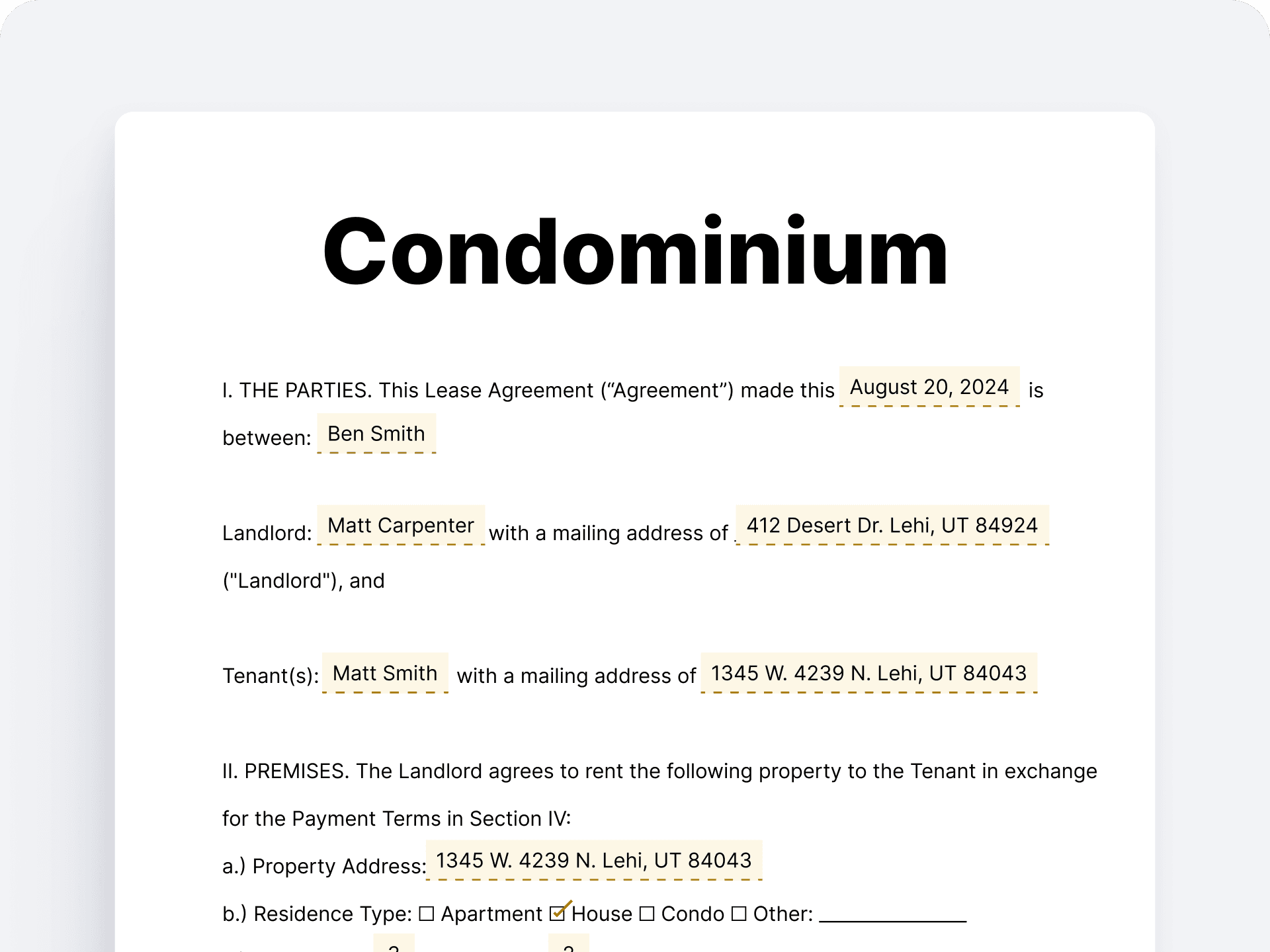
A condominium lease agreement is a legally binding rental contract between a condo owner (the landlord) and a tenant. It outlines the terms and conditions under which the tenant may occupy the condominium unit, including the monthly rent, lease duration, security deposit, and the rules governing the use of the property.
Download as PDF when complete


(No Ratings Yet)
What Is a Condominium Lease Agreement?
What sets a condominium lease agreement apart from a standard residential lease is the involvement of a homeowners association (HOA). Because condominiums exist within a common-interest community, both the landlord and the tenant are bound not only by the terms of the lease itself but also by the rules and bylaws of the condo association. This means that even if your lease does not specifically mention a restriction on pets, loud noise, or guest stays, the HOA’s rules still apply — and your tenant is expected to follow them.
Why Condo Owners Need a Written Condominium Lease Agreement
Some condo owners, especially those renting to friends or family members, may feel that a formal written agreement is unnecessary. This is a costly mistake. Without a written condominium lease agreement, disputes over rent payments, property damage, HOA violations, and move-out responsibilities can become extremely difficult to resolve.
A properly drafted condominium lease agreement protects you as the property owner by clearly documenting the financial obligations of the tenant, establishing your rights to reclaim the unit, and limiting your liability in the event of damage or legal disputes. It also gives your tenant a clear understanding of what is expected of them throughout the tenancy — including compliance with HOA rules that you as the landlord are ultimately responsible for enforcing.
Key Elements of a Condominium Lease Agreement
A comprehensive condominium lease agreement should include the following essential components:
1. Party Information Include the full legal names and contact information of both the landlord (condo owner) and the tenant. If there are co-tenants or co-signers, list all parties clearly.
2. Property Description Identify the condominium unit in full detail, including the unit number, building name or address, floor, and any additional spaces being rented such as a parking spot or storage unit.
3. Lease Term Specify whether the condominium lease agreement is a fixed-term lease (for example, 12 months) or a month-to-month arrangement. Include the exact start date and, if applicable, the end date of the tenancy.
4. Rent and Payment Terms State the monthly rent amount, the due date, the accepted payment methods, and the late fee that applies if rent is not paid on time. RocketRent makes it easy to collect rent directly and automatically — so you never have to chase payments.
5. Security Deposit Outline the deposit amount, the conditions under which deductions may be made, and the timeline for returning the deposit after the tenant vacates. Security deposit rules vary by state, so always check your local laws for the maximum allowable amount and return deadlines.
6. HOA Rules and Bylaws This is the most unique and critical section of any condominium lease agreement. Include a clause stating that the tenant agrees to comply with all current and future HOA rules, regulations, and bylaws. Attach a copy of the HOA documents to the lease so the tenant cannot claim they were unaware of any restrictions.
Common HOA rules that affect tenants include noise restrictions, guest and visitor policies, pet policies, use of shared amenities such as pools and gyms, moving procedures and designated moving hours, and rules on exterior modifications or decorations.
7. HOA Fees and Special Assessments Clarify who is responsible for paying the monthly HOA or condo association fees. In most cases, the landlord covers these fees, but this should be explicitly stated in the condominium lease agreement to avoid any confusion. Also address how special assessments — unexpected fees charged by the HOA for major repairs or improvements — will be handled.
8. Maintenance and Repairs Define which party is responsible for routine maintenance tasks such as appliance upkeep, HVAC filter changes, and pest control. Also outline the process for reporting and addressing larger repair needs that fall under the landlord’s responsibility.
9. Tenant Approval by HOA Many condo associations require prospective tenants to be reviewed and approved by the HOA board before they can move in. If your association has this requirement, include it in the lease and make the tenancy contingent on HOA approval. Failing to disclose this requirement upfront can delay move-in or create legal complications.
10. Termination and Notice Requirements Clearly state how much written notice either party must provide to end the tenancy, and outline the conditions under which the landlord may terminate the lease early — such as non-payment of rent, HOA violations, or unauthorized subletting.
Condominium Lease Agreement vs. Standard Apartment Lease
While both documents cover the fundamentals of a rental arrangement, a condominium lease agreement includes several additional layers of complexity. The biggest difference is the HOA factor — tenants in a condo are subject to a second set of rules beyond what the lease itself outlines. As the condo owner, you are responsible for making sure your tenant understands and follows those rules, because any HOA fines or violations are ultimately your responsibility.
Additionally, condo rentals may involve restrictions on subletting, short-term rentals, and even the percentage of units that can be rented at any one time within the building. Always review your condo association’s declaration and bylaws thoroughly before listing your unit for rent.
Manage Your Condo Rental Effortlessly with RocketRent
Creating a professional, legally sound condominium lease agreement does not have to take hours or cost a fortune. RocketRent offers a free condominium lease agreement template that you can customize for your unit, your state’s legal requirements, and your HOA’s specific rules — all in just minutes.
Beyond the lease, RocketRent’s free property management platform helps condo owners collect rent online, store documents securely, track expenses, handle maintenance requests, and give tenants a dedicated portal — everything you need to run a professional rental operation at no cost.
FAQs
A condominium lease agreement differs from a standard residential lease primarily because of the homeowners association (HOA). Tenants renting a condo must comply not only with the terms of the lease but also with the condo association’s rules and bylaws. These can include policies on pets, noise, guests, parking, and the use of shared amenities. As the condo owner, you are responsible for ensuring your tenant is aware of and follows all HOA regulations, since any violations or fines are ultimately your responsibility.
Yes, in many cases a condo association can place restrictions on renting out your unit. Common limitations include requiring HOA board approval of prospective tenants, capping the number or percentage of units that can be rented at one time, prohibiting short-term rentals, and requiring a minimum lease term. Before listing your condo for rent, always review your association’s declaration and bylaws carefully. If you are unsure about the restrictions that apply to your unit, consulting a real estate attorney is strongly recommended.
In most condominium lease agreements, the landlord (condo owner) is responsible for paying the monthly HOA or condo association fees. However, this is a negotiable term that should always be explicitly addressed in the lease to avoid disputes. Regardless of how you structure the arrangement, keep in mind that if a tenant fails to pay HOA fees that they have agreed to cover, the association will typically hold you — the owner — responsible for the unpaid balance.
Yes, absolutely. Your condominium lease agreement should include a clause stating that the tenant agrees to comply with all current HOA rules and bylaws, and you should attach a copy of the HOA documents to the lease. This protects you as the landlord and ensures that the tenant cannot claim ignorance if they violate a community rule. Some HOAs also require that tenants sign a separate acknowledgment form confirming they have received and reviewed the association’s governing documents.
If your tenant violates HOA rules, the association will typically issue a notice of violation to you as the property owner — not directly to the tenant. You will then be responsible for addressing the violation with your tenant. Repeated or serious violations can result in fines, legal action by the HOA, or in extreme cases, forced removal of the tenant. To protect yourself, make sure your condominium lease agreement includes a clause allowing you to terminate the tenancy if the tenant repeatedly violates HOA rules or causes fines to be levied against your unit.