
W-9 Request Template
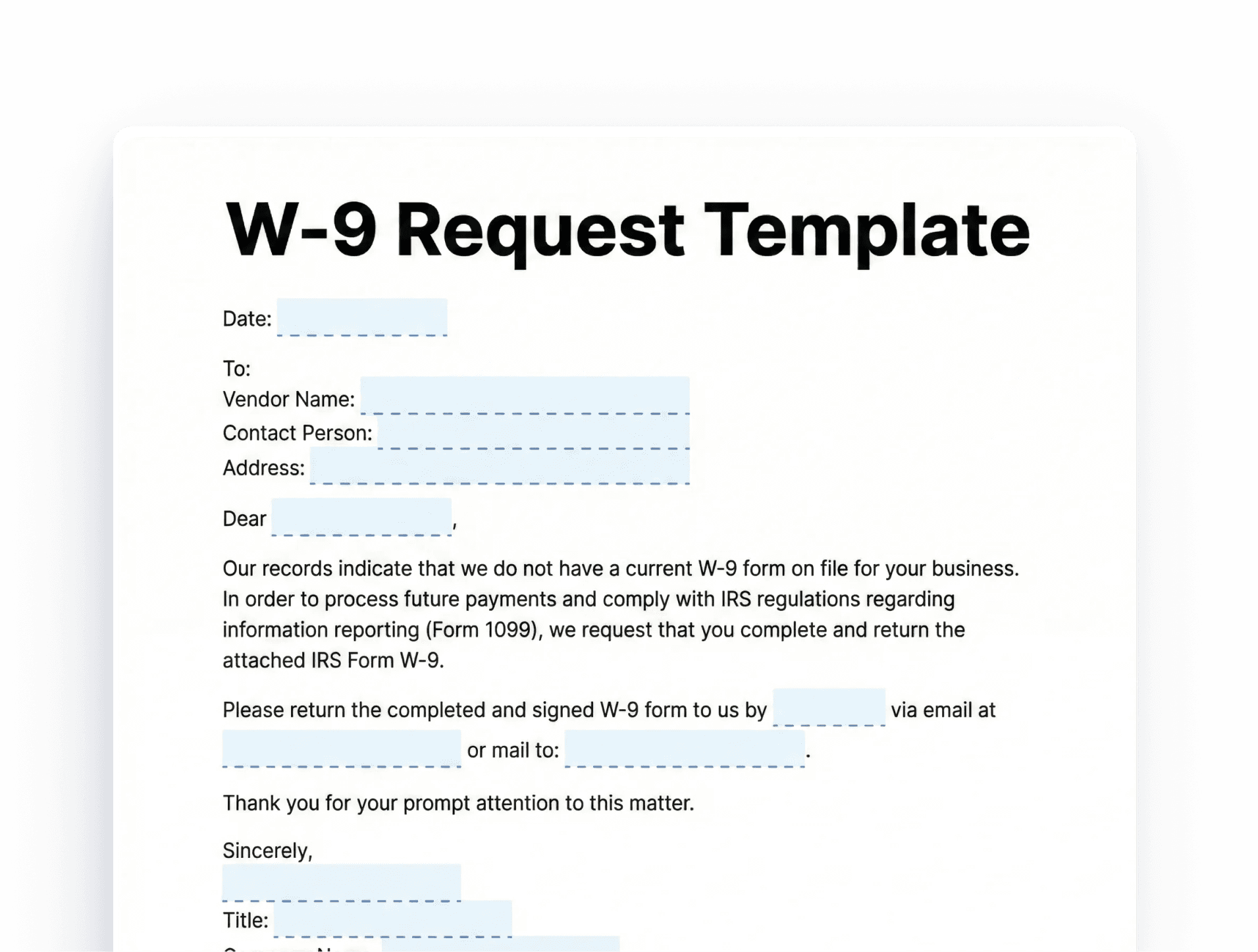
A W-9 request template is a structured communication requesting contractors or vendors completing IRS Form W-9 providing their taxpayer identification information. This template explains why W-9 forms are required, specifies collection deadlines, provides instructions for form completion, and includes copies of blank W-9 forms for recipient convenience.
Download as PDF when complete


(No Ratings Yet)
What Is a W-9 Request Template?
Property managers send these requests to all vendors before making payments exceeding $600 annually ensuring tax reporting compliance. The template serves multiple critical functions in property management operations. First, it creates systematic processes ensuring no vendors slip through without proper tax documentation. Second, it communicates professionalism demonstrating organized business practices to contractors. Third, it establishes clear expectations about information requirements before business relationships begin. Finally, it protects you from IRS penalties for failing to collect required taxpayer identification information supporting 1099 reporting obligations.
Why W-9 Forms Are Required
IRS Reporting Obligations
Federal law requires businesses issuing payments totaling $600 or more annually to unincorporated contractors reporting these payments on Form 1099-NEC. You cannot complete 1099 forms without recipient taxpayer identification numbers, legal names, and business classifications obtained through W-9 forms. Additionally, the IRS imposes penalties for filing incorrect 1099 forms due to missing or inaccurate W-9 information.
Most corporations don’t require 1099 reporting, but you need W-9 forms determining vendor business classifications. Without W-9 forms, you cannot distinguish corporations from unincorporated businesses requiring different tax treatments. Furthermore, some corporate types like single-member LLCs do require 1099 reporting despite corporate status making W-9 collection universally necessary.
Backup Withholding Protection
When vendors refuse providing W-9 forms or supply incorrect taxpayer identification numbers, IRS regulations require backup withholding 24% of payments. This withheld amount gets remitted to the IRS protecting you from penalties while ensuring tax collection. However, backup withholding creates administrative burdens and vendor relationship strains making proactive W-9 collection essential.
Additionally, vendors subject to backup withholding face cash flow problems since they receive only 76% of earned amounts. This financial impact motivates most contractors providing accurate W-9 forms promptly. Furthermore, proper W-9 collection eliminates backup withholding requirements simplifying payment processing.
Professional Documentation Standards
Requesting W-9 forms before making payments demonstrates professional business practices. Established companies systematically collect vendor documentation rather than scrambling for information during year-end tax preparation. Additionally, early W-9 collection identifies vendors unable or unwilling to provide proper documentation before significant business relationships develop.
Complete vendor files including W-9 forms, insurance certificates, and licenses create comprehensive records supporting due diligence if problems arise. Furthermore, organized documentation impresses property owners and investors demonstrating thorough financial management.
Essential Template Components
Clear Subject Line and Introduction
Begin W-9 request templates with descriptive subject lines like “Required Tax Form – W-9 Request for [Vendor Name]” ensuring recipients understand message importance. Open with friendly professional greetings explaining you’re gathering required tax information from all vendors and contractors.
State clearly that W-9 completion is mandatory before processing payments rather than optional courtesy. However, explain this requirement stems from IRS regulations, not arbitrary company policies. Additionally, thank vendors for cooperation showing appreciation while maintaining firm expectations.
Explanation of W-9 Purpose
Provide brief explanations helping vendors understanding why W-9 forms matter. State that IRS requires businesses collecting taxpayer identification information from service providers receiving $600 or more annually. Additionally, mention that information supports 1099 form preparation at year-end.
Clarify that W-9 forms benefit vendors by ensuring accurate tax reporting preventing IRS discrepancy notices. Furthermore, explain that complete forms enable prompt payment processing while missing forms create delays. This positive framing encourages cooperation rather than defensive resistance.
Completion Instructions
Include clear step-by-step instructions for W-9 form completion. Direct vendors to specific lines requiring attention like Name, Business Name, Tax Classification, and Taxpayer Identification Number. Additionally, emphasize signature and date requirements since unsigned forms are invalid for IRS purposes.
Explain common mistakes like using personal names instead of business names or providing wrong TIN types. For example, sole proprietors should use Social Security Numbers while corporations use Employer Identification Numbers. Furthermore, clarify that handwritten or typed forms are equally acceptable if legible and complete.
Submission Deadline and Methods
Establish specific submission deadlines typically requiring W-9 forms before processing first payments or within 10 business days of requests. Clear deadlines create urgency preventing indefinite delays. Additionally, state consequences of non-compliance like payment holds or relationship termination.
Provide multiple submission methods accommodating vendor preferences. Accept email attachments, fax submissions, physical mail delivery, or in-person drop-off. Furthermore, include contact information for submission confirmation or completion questions. Easy submission processes remove obstacles to compliance.
Attached Blank W-9 Form
Always attach blank IRS Form W-9 to request templates preventing vendors claiming they couldn’t locate official forms. Including forms demonstrates thoroughness and removes excuses. Additionally, attaching correct current-year forms ensures vendors don’t submit outdated versions.
Direct vendors to IRS website if they prefer downloading forms directly verifying authenticity. Provide specific URL links to official IRS Form W-9 pages. Furthermore, note that W-9 forms aren’t submitted to IRS but remain in your records for documentation purposes.
Best Practices for W-9 Collection
Proactive Early Collection
Request W-9 forms during vendor onboarding before approving any invoices or making payments. This proactive approach prevents you becoming dependent on vendors who then delay providing required documentation. Additionally, early collection establishes professional expectations from relationship beginnings.
Include W-9 requirements in vendor agreements or contracts making compliance contractual obligations. This language strengthens your position requiring documentation before payment processing. Furthermore, contract provisions support relationship termination if vendors refuse compliance.
Systematic Tracking and Follow-Up
Maintain tracking systems monitoring W-9 collection status for all vendors. Property management software typically includes vendor management modules flagging missing W-9 forms. Additionally, automated reminders prompt follow-up when forms aren’t received by deadlines.
Send polite reminder messages to non-responsive vendors escalating urgency with each communication. First reminders might be casual, while subsequent notices emphasize payment processing delays. Furthermore, final notices should state that business relationships cannot continue without proper documentation.
Verification and Quality Control
Verify W-9 information accuracy immediately upon receipt checking that names match business records, tax identification numbers contain correct digit counts, and forms include required signatures. The IRS provides TIN Matching services allowing large volume businesses verifying taxpayer identification numbers before filing 1099 forms.
Flag suspicious or incomplete forms requesting corrections before accepting them. Common problems include missing signatures, incorrect business classifications, or illegible handwriting. Additionally, verify that business names match invoices and vendor agreements preventing mismatched 1099 forms.
Secure Storage and Confidentiality
Store W-9 forms securely protecting sensitive taxpayer identification information from unauthorized access. Use locked filing cabinets for physical forms and password-protected systems for digital copies. Additionally, restrict access to authorized accounting personnel only preventing data breaches.
Maintain W-9 forms for at least four years as IRS recommends though many businesses retain them permanently. Long-term retention supports audit defense and simplifies vendor relationship continuity. Furthermore, permanent digital storage occupies minimal space making indefinite retention practical.
Handling Non-Compliance
Payment Holds
Implement firm policies holding payments until vendors provide complete W-9 forms. Communicate these policies clearly in request templates and follow through consistently. Additionally, apply payment holds uniformly to all vendors avoiding favoritism creating compliance loopholes.
Document payment hold reasons in writing protecting against vendor claims about unfair treatment. Explain that holds result from W-9 non-compliance, not arbitrary decisions. Furthermore, offer immediate payment processing upon receiving proper documentation incentivizing cooperation.
Alternative Verification Methods
When vendors claim Social Security Number privacy concerns, explain that sole proprietors can obtain Employer Identification Numbers from IRS providing alternative identification. This option addresses privacy worries while maintaining tax compliance. Additionally, inform vendors that you protect all tax information carefully.
For vendors refusing cooperation despite explanations, consult tax professionals about backup withholding implementation. This option allows business continuation while ensuring IRS compliance. Furthermore, backup withholding often motivates previously resistant vendors providing W-9 forms immediately.
Relationship Termination
Establish clear policies terminating vendor relationships when contractors absolutely refuse providing W-9 forms. This firm stance demonstrates your commitment to legal compliance over individual convenience. Additionally, relationship termination prevents ongoing rule violations creating liability exposure.
Document termination reasons thoroughly protecting against claims about unfair treatment. State clearly that termination resulted from vendor non-compliance, not performance issues. Furthermore, maintain professional communication even when ending relationships preserving your reputation.
Conclusion
A W-9 request template streamlines tax information collection ensuring IRS compliance while establishing professional vendor onboarding procedures. By requesting forms early, providing clear instructions, following up systematically, and maintaining secure records, you protect your business from tax penalties while building comprehensive vendor documentation. Always attach blank forms, explain requirements clearly, establish firm deadlines, and verify information accuracy upon receipt. Professional W-9 collection practices demonstrate fiscal responsibility supporting smooth year-end tax preparation and establishing organized business operations that impress property owners and satisfy regulatory requirements.
FAQs
Request W-9 forms during initial vendor onboarding before making any payments, ideally when establishing business relationships. This proactive timing prevents you becoming dependent on vendors who might delay providing required documentation, and it establishes professional expectations from the start.
Collect W-9 forms from all vendors regardless of anticipated payment amounts since relationships might exceed $600 unexpectedly during the year. Additionally, you need W-9 information determining which vendors require 1099 reporting at year-end, making universal collection the most efficient approach.
Explain that IRS regulations require collecting W-9 information for tax reporting compliance, not optional courtesy. For vendors with genuine privacy concerns, suggest obtaining Employer Identification Numbers instead of using Social Security Numbers, or implement backup withholding if they continue refusing.
Email submissions are acceptable and increasingly common, though you should maintain secure digital storage protecting sensitive tax information. Verify that emailed forms are complete with all required information and signatures, and confirm receipt with vendors creating mutual acknowledgment.
The IRS recommends retaining W-9 forms for at least four years, though many businesses keep them permanently since digital storage is minimal. Longer retention supports audit defense, simplifies vendor relationship continuity, and provides historical records if tax questions arise years later.