
Partial Payment Receipt
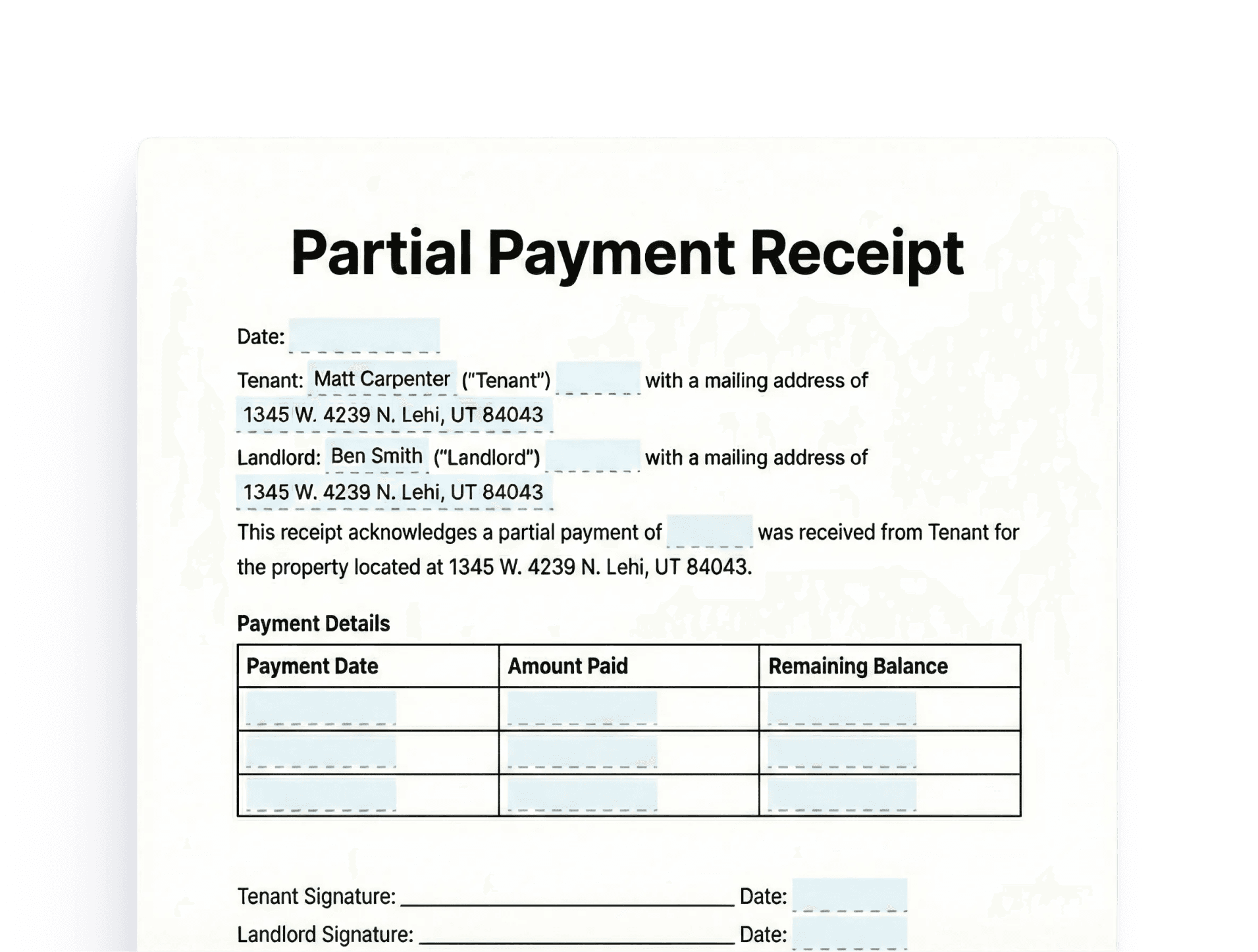
A partial payment receipt is a written acknowledgment documenting rent payments for amounts less than the total due for a given period. This receipt specifies the payment date, amount received, remaining balance owed, and critically important disclaimers preserving landlord rights to pursue eviction despite accepting partial amounts.
Download as PDF when complete


(No Ratings Yet)
What Is a Partial Payment Receipt?
The receipt serves multiple vital functions protecting both landlords and tenants. First, it prevents disputes about whether payments occurred and amounts tenants paid. Second, it maintains accurate accounting showing payment history and outstanding balances. Third, it documents that partial payment acceptance doesn’t waive your eviction rights or constitute payment agreement modifications. Finally, it provides evidence during legal proceedings proving tenants failed meeting full rent obligations despite your accommodation. Property managers issue these receipts whenever tenants pay less than full monthly rent creating clear records of incomplete payment situations.
Legal Implications of Accepting Partial Payments
Eviction Rights Considerations
In many jurisdictions, accepting partial rent payments can waive your right to evict for non-payment. Courts sometimes interpret partial payment acceptance as implicit agreement to payment plans or acknowledgment that tenants satisfied rent obligations. This interpretation particularly applies when landlords accept partial amounts without explicit reservations preserving eviction rights.
Your partial payment receipt must clearly state that acceptance doesn’t waive eviction rights or constitute lease modification. This explicit language protects your legal position allowing continued eviction proceedings despite accepting whatever tenants could pay. Without proper documentation, accepting even small partial amounts might require starting eviction processes over after statutory notice periods expire.
State-Specific Regulations
State laws vary dramatically regarding partial payment effects on landlord rights. Some jurisdictions automatically preserve eviction rights regardless of partial payment acceptance. Others presume landlords accepting partial amounts waive eviction rights unless receipts contain specific reservation language. Several states require certain timeframes between accepting payments and filing evictions.
Research your state’s specific laws before establishing partial payment policies. Consult with local attorneys specializing in landlord-tenant law ensuring your receipt language complies with jurisdictional requirements. Additionally, stay updated on law changes as courts frequently issue decisions affecting partial payment interpretation.
Payment Plan Distinctions
Distinguish between accepting single partial payments versus agreeing to ongoing payment plans. Single partial payments with proper reservations typically preserve eviction rights. However, accepting multiple partial payments over several months might establish implied payment plan agreements modifying lease terms. Courts view patterns of acceptance differently than isolated instances.
Document payment plans separately from standard partial payment receipts. Written payment agreements should specify amounts, due dates, and consequences of default. These formal arrangements provide clarity preventing courts from inferring unintended terms from your conduct accepting regular partial payments.
Essential Receipt Components
Payment Information Details
Your partial payment receipt must include the payment date, amount received, payment method (check, cash, money order, electronic transfer), and any transaction reference numbers. Specify the rental period the payment applies toward, such as “May 2024 rent” distinguishing from other charges. Additionally, note who made the payment if someone other than the lease-signatory tenant provided funds.
Calculate and clearly display the remaining balance owed after applying the partial payment. Show the original amount due, payment received, and outstanding balance using simple arithmetic. This transparency prevents confusion about how much tenants still owe. Furthermore, it establishes the incomplete payment situation unambiguously.
Legal Disclaimer Language
Include explicit language preserving your legal rights despite accepting partial payments. Standard disclaimer text states: “Acceptance of this partial payment does not waive landlord’s right to pursue eviction for non-payment of rent or constitute agreement to any payment plan or lease modification.” This clear reservation protects your position during legal proceedings.
Some attorneys recommend adding language specifying that tenants must pay remaining balances by specific deadlines to avoid eviction filing. This additional detail strengthens your documentation showing tenants received notice about payment expectations. Furthermore, explicit deadlines prevent tenants claiming they didn’t understand time-sensitive payment requirements.
Application Instructions
Specify how the partial payment applies to outstanding charges. Typically payments apply first to oldest amounts owed, then late fees, then current rent. However, state laws or lease terms might dictate specific application orders. Clearly documenting payment application prevents disputes about which charges remain outstanding.
Include language allowing you to apply payments at your discretion unless state law requires specific applications. This flexibility ensures you can maximize your legal position by applying payments to amounts not subject to habitability defenses or other tenant protections. Additionally, discretionary application helps you manage accounts strategically across multiple outstanding charges.
Contact and Account Information
Document complete tenant information including full names, rental property address, unit number, and lease agreement reference. Add your contact information encouraging tenants reaching out about remaining balances or payment arrangements. Additionally, include any account numbers or reference codes linking receipts to your property management system.
Provide clear instructions for paying remaining balances including acceptable payment methods, office hours, online payment portals, and mailing addresses. Making payment convenient encourages tenants completing payments rather than defaulting further. Furthermore, comprehensive instructions prevent tenants claiming they didn’t know how to pay outstanding amounts.
Best Practices for Issuing Receipts
Immediate Documentation
Issue partial payment receipts immediately upon receiving payments rather than delaying until month-end or processing batches. Immediate receipts provide tenants proof of payment while memories remain fresh. Additionally, real-time documentation prevents errors from forgotten payments or misallocated funds.
Use pre-printed receipt books, standardized computer-generated forms, or property management software producing instant receipts. Keep duplicate copies for your records maintaining complete payment histories. Furthermore, immediate documentation demonstrates professionalism encouraging continued tenant communication about financial difficulties.
Consistent Application Across Tenants
Apply identical partial payment policies to all tenants avoiding discrimination claims. Never accept partial payments from some tenants while refusing others in similar circumstances. Consistent treatment demonstrates fair dealing and prevents fair housing violations. Additionally, documented policies support your decisions if tenants question differential treatment.
Create written partial payment policies distributed to all tenants and staff. These policies should specify minimum acceptable amounts, maximum acceptance frequency, required disclaimers, and decision-making authority. Standardization ensures everyone understands rules preventing inconsistent applications that create liability.
Communication and Transparency
Discuss partial payment situations openly with tenants experiencing financial difficulties. Express willingness to work cooperatively while clearly explaining that partial payments don’t eliminate eviction risks. Encourage tenants pursuing community resources, government assistance programs, or personal loans covering full rent obligations.
Document all conversations about partial payments including dates, payment commitments, and any agreements reached. This documentation provides context for your partial payment acceptance showing good faith efforts helping tenants while protecting your interests. Furthermore, written communication summaries prevent misunderstandings about verbal discussions.
Strategic Decision-Making
Evaluate each partial payment situation individually considering tenant payment history, communication quality, and likelihood of receiving remaining balances. Accepting partial payments from reliable tenants experiencing temporary setbacks makes sense. Conversely, tenants with chronic non-payment patterns might not deserve accommodation risking your legal position.
Consider the partial amount offered relative to total owed. Payments covering 80-90% of rent differ significantly from token amounts covering minimal percentages. Larger partial payments suggest genuine effort and financial constraint. Conversely, very small amounts might indicate tenants stalling without real intention of full payment.
When to Refuse Partial Payments
Protecting Eviction Proceedings
Once you’ve filed eviction actions for non-payment, accepting partial payments typically requires dismissing cases and restarting processes. This setback costs time and money while extending non-payment periods. Therefore, many landlords refuse partial payments after eviction filing until tenants pay complete amounts owed including court costs.
Communicate this policy clearly when serving eviction notices. State that you will only accept full payment of rent, late fees, and legal costs to dismiss proceedings. Additionally, specify payment deadlines before which you’ll accept full payment versus after which you’ll proceed regardless of payment offers.
Chronic Non-Payment Patterns
Tenants repeatedly paying late or offering partial payments demonstrate unreliability justifying firmer approaches. Accepting partial payments from chronic problem tenants encourages continued patterns rather than motivating full compliance. After establishing patterns through documentation, refuse partial amounts demanding full payment or pursuing eviction.
Track payment histories meticulously identifying patterns warranting policy changes for specific tenants. Three or more late payments within six months might trigger stricter enforcement. Additionally, document your reasoning for refusing partial payments showing consistent application of objective criteria rather than arbitrary discrimination.
Minimal or Token Amounts
Very small partial payments like $50 on $1,500 rent accomplish little toward satisfying obligations while potentially complicating your legal position. These token amounts suggest tenants lack resources or commitment paying reasonable portions. Refusing minimal partial payments while offering payment plan discussions demonstrates willingness to help without accepting meaningless gestures.
Establish minimum partial payment thresholds, typically 50-75% of monthly rent. Amounts below thresholds get refused with encouragement to save until tenants can provide substantial payments. This approach maintains your firmness while acknowledging that truly struggling tenants need time accumulating larger amounts.
Documentation and Record Keeping
Comprehensive Filing Systems
Maintain dedicated files for tenants making partial payments including all receipts, correspondence, payment plans, and notes about conversations. Organize chronologically showing complete payment histories and your response patterns. This organization facilitates quick information retrieval during eviction proceedings or dispute resolution.
Store partial payment receipts separately from standard payment receipts highlighting accounts requiring special attention. Flag accounts in your property management software enabling monitoring and follow-up about outstanding balances. Furthermore, organized systems prevent overlooking tenants with incomplete payments who might otherwise slip through cracks.
Integration with Accounting Systems
Ensure partial payments post correctly in accounting systems showing payments received and remaining balances. Configure software to flag accounts with outstanding balances sending automatic reminders about incomplete payments. Additionally, generate reports showing all tenants with partial payment histories supporting portfolio-wide analysis.
Reconcile partial payment receipts against bank deposits and accounting entries verifying accuracy. Discrepancies between physical receipts and recorded amounts indicate errors requiring immediate correction. Furthermore, regular reconciliation prevents accumulating mistakes that complicate year-end financial reporting and tax preparation.
Conclusion
A partial payment receipt provides essential documentation when accepting less than full rent while protecting your legal rights to pursue eviction if necessary. By including proper disclaimer language, issuing receipts immediately, maintaining consistent policies, and making strategic decisions about when to accept or refuse partial amounts, you balance compassion for struggling tenants with protection of your business interests. Always consult local attorneys about jurisdiction-specific requirements ensuring your partial payment procedures comply with applicable laws. Professional documentation practices demonstrate fairness while preserving legal remedies when tenant financial situations fail to improve.
FAQs
This depends on your state’s laws and whether your receipt includes proper disclaimer language. Many jurisdictions allow eviction despite partial payment acceptance if receipts explicitly reserve landlord rights, but some states may require specific procedures or waiting periods.
Most property managers set minimums at 50-75% of monthly rent to ensure partial payments represent substantial progress toward obligations. Token amounts below these thresholds typically get refused since they provide minimal value while potentially complicating legal positions.
Yes, always document all payments received, but include explicit language that acceptance doesn’t dismiss pending eviction cases. Consult your attorney before accepting any payments after filing eviction to understand how acceptance might affect your proceedings.
State laws often dictate payment application order, typically requiring application to rent before fees. However, some jurisdictions allow landlords discretion in payment application, so research your state’s requirements and include application instructions on receipts.
Retain partial payment receipts for at least seven years covering potential legal claims and tax audit periods. However, many property managers keep records throughout tenancy and three years after to support eviction histories or reference checks from future landlords.