
Owner Statement
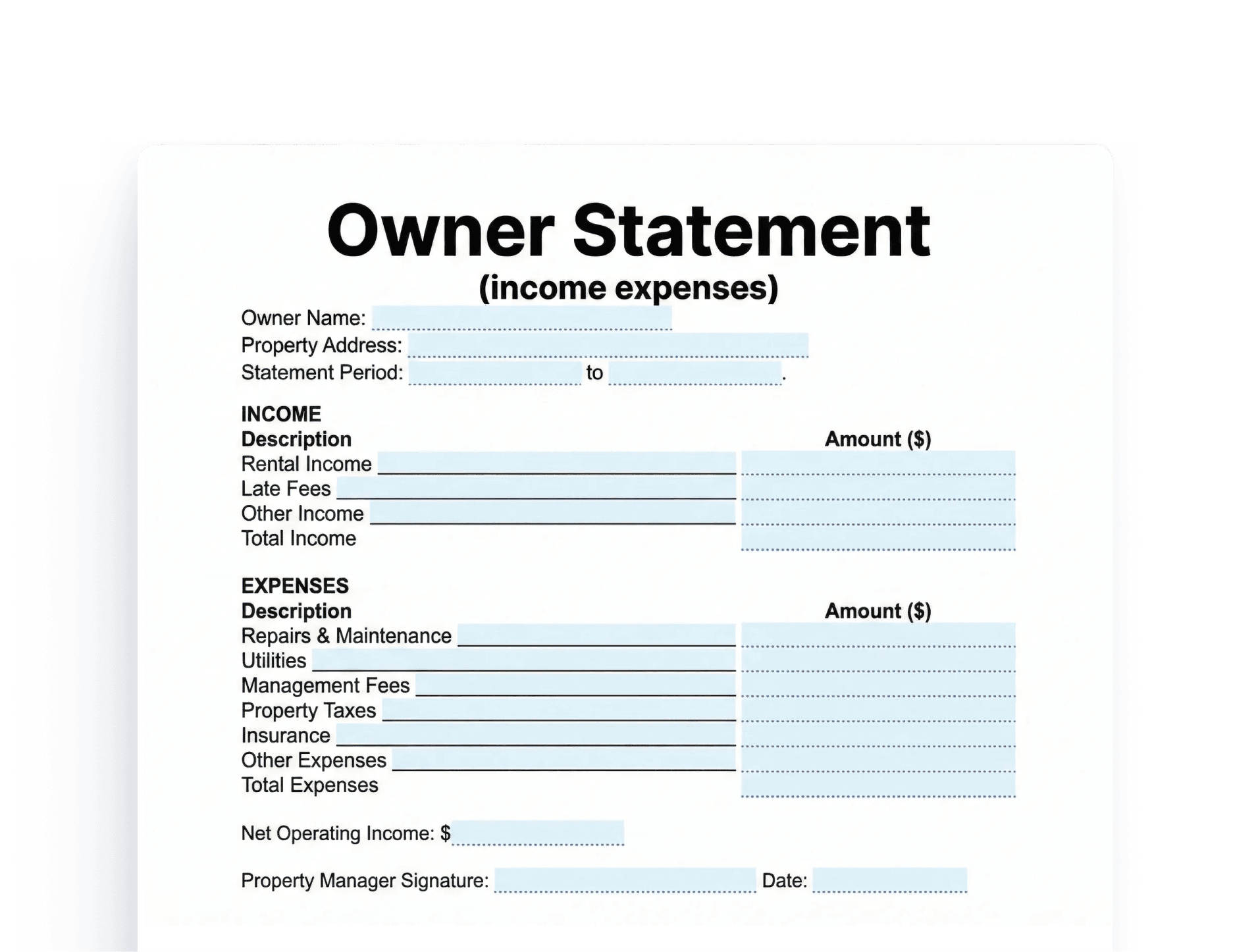
An owner statement is a detailed monthly financial report summarizing all transactions related to a rental property during a specific period. This document shows rental income received, operating expenses paid, reserve funds held, and net amount disbursed to property owners.
Download as PDF when complete


(No Ratings Yet)
What Is an Owner Statement?
The statement serves multiple critical purposes in property management. First, it provides owners with clear visibility into their investment returns and operating costs. Second, it documents your fiduciary responsibility managing owner funds appropriately. Third, it supports owner tax preparation by organizing income and expense data. Finally, it demonstrates your professionalism and attention to detail strengthening client relationships and referral potential. Property managers provide these statements monthly, typically within 10-15 days after month-end, maintaining transparent communication about property financial performance.
Essential Components of Owner Statements
Income Section
Begin your owner statement with a comprehensive income section listing all money received during the reporting period. Include monthly rent payments from each unit or tenant, late fees collected, pet rent, parking fees, and any other recurring charges. Additionally, document security deposits received from new tenants, though these remain separate from income until actually earned through deductions.
Break down income by source providing transparency about each revenue stream. For multi-unit properties, list income by unit number showing individual tenant contributions. This detail helps owners understand occupancy patterns and identify underperforming units. Furthermore, separate ordinary income from extraordinary items like lease break fees or damage reimbursements for clearer performance analysis.
Operating Expenses
Create detailed expense sections categorizing all payments made on behalf of property owners. Common categories include repairs and maintenance, utilities, property management fees, insurance premiums, property taxes, HOA fees, landscaping, pest control, and professional services. List each expense with date, vendor name, description, and amount paid.
Attach supporting documentation like invoices and receipts to your statements. This backup proves charges represent legitimate property expenses rather than questionable deductions. Additionally, categorized expenses help owners understand cost drivers and identify opportunities for expense reduction. Consistent categorization also simplifies tax preparation by organizing deductible expenses appropriately.
Reserve Funds and Escrow
Document any reserve funds held on behalf of property owners. These reserves typically include tenant security deposits, capital improvement funds, or operating reserves for anticipated expenses. Show beginning balances, additions, withdrawals, and ending balances for each reserve category creating complete transparency about held funds.
Clearly distinguish between security deposits belonging to tenants versus other reserves. Some states require maintaining security deposits in separate accounts with specific handling rules. Your statement should reflect these legal requirements showing compliant fund management. Furthermore, detailed reserve tracking prevents commingling concerns and demonstrates proper fiduciary management.
Management Fees and Deductions
Itemize all management fees charged including base management percentages, leasing fees for new tenants, renewal fees, and any additional service charges. Show fee calculations transparently, for example, “Management Fee: $1,500 rent x 10% = $150.” This clarity prevents confusion about how fees are determined.
List any other deductions from owner proceeds such as reimbursements for expenses you advanced, payment processing fees, or amounts withheld for upcoming bills. Explain each deduction clearly preventing owners from questioning why net proceeds differ from gross income. Transparency about all deductions builds trust and reduces disputes.
Net Owner Proceeds
Present net owner proceeds prominently showing the bottom-line amount disbursed or credited to owners. Calculate this by adding all income, subtracting all expenses and fees, and adjusting for reserve changes. Display the calculation clearly so owners can trace from gross income to net distribution.
Include disbursement details showing payment date, method (check, ACH, wire), and any reference numbers. If negative cash flow occurred requiring owner contributions, clearly explain the shortfall and request additional funds. This straightforward presentation prevents confusion about money flows and payment timing.
Best Practices for Statement Preparation
Timely and Consistent Delivery
Establish consistent schedules for owner statement delivery, typically within 10-15 days after month-end. Reliable timing allows owners planning their finances and demonstrates your organizational efficiency. Additionally, consistent delivery builds trust and reduces owner anxiety about property performance.
Use the same delivery date monthly rather than fluctuating schedules. For example, always send statements by the 10th of each month for previous month activities. This predictability helps owners anticipate information arrival. Furthermore, automated systems can enforce consistent timing eliminating manual scheduling errors.
Clear and Professional Formatting
Design owner statements with clean, professional formatting that’s easy to read and understand. Use clear section headers, consistent fonts, adequate white space, and logical information flow. Avoid cluttered layouts cramming too much information onto single pages without organization.
Include your company logo, contact information, and statement period prominently at the top. Add page numbers for multi-page statements preventing lost pages. Additionally, use highlighting or bold text drawing attention to key figures like net proceeds. Professional presentation reflects positively on your overall management quality.
Accuracy and Reconciliation
Verify all figures thoroughly before sending statements ensuring complete accuracy. Reconcile bank accounts against statement totals confirming all transactions are captured correctly. Additionally, cross-reference work orders against expense listings ensuring repair costs match authorized amounts.
Implement quality control procedures where second staff members review statements before distribution. Fresh eyes catch errors original preparers might miss. Furthermore, establish correction procedures for handling errors discovered after distribution maintaining credibility through prompt, transparent corrections.
Supporting Documentation
Attach relevant supporting documents to owner statements including repair invoices, inspection reports, lease renewal notices, or significant correspondence. This backup documentation helps owners understand expenses and property activities without requiring follow-up questions. Additionally, comprehensive packages demonstrate thorough management and attention to detail.
Organize attachments logically matching statement order. For example, attach invoices in the same sequence as expense listings. Label attachments clearly referencing corresponding statement line items. This organization saves owners time reviewing materials and reduces confusion about document purposes.
Technology and Automation
Property Management Software
Modern property management software automates owner statement generation pulling data directly from accounting systems. These platforms categorize transactions automatically, calculate totals accurately, and format statements professionally. Additionally, they maintain historical statements providing easy access to past reports.
Software systems also enable electronic delivery via email or owner portals reducing paper waste and postal delays. Owners access statements anytime from computers or smartphones. Furthermore, automated systems send notifications when statements become available ensuring owners never miss reports.
Integration with Accounting Systems
Integrate property management software with accounting platforms like QuickBooks ensuring data consistency across systems. This integration eliminates manual data entry reducing errors and saving time. Additionally, it enables real-time financial reporting showing current property performance between formal statement periods.
Proper integration ensures all transactions flow correctly into appropriate accounts. Rent payments post as income, expenses deduct properly, and owner distributions record accurately. This accuracy simplifies tax preparation and audit processes. Furthermore, integrated systems provide comprehensive financial reports beyond basic owner statements supporting strategic decision-making.
Owner Portal Access
Provide owners with secure portal access viewing statements, making online payments, submitting maintenance requests, and accessing property documents. These portals enhance transparency and reduce administrative burden answering routine owner questions. Additionally, 24/7 access improves owner satisfaction by providing information whenever needed.
Portals typically include dashboards showing key metrics like occupancy rates, year-to-date income, expense trends, and comparison to budgets. Visual presentations help owners quickly understand property performance without analyzing detailed statements. Furthermore, historical data access allows owners tracking long-term trends and investment returns.
Handling Special Situations
Negative Cash Flow Months
Some months produce negative cash flow when expenses exceed income requiring owner contributions. Clearly communicate these situations in statements explaining what caused shortfalls. Common reasons include major repairs, insurance renewals, property tax payments, or vacancy periods.
Request additional funds promptly providing payment instructions and deadlines. Explain whether shortfalls are temporary or indicate ongoing problems requiring attention. Additionally, suggest solutions like building larger operating reserves preventing future contribution requests. Proactive communication about negative months maintains owner confidence despite temporary losses.
Year-End Statements
Prepare comprehensive year-end statements summarizing entire calendar year performance. These annual reports consolidate twelve monthly statements providing complete pictures for tax preparation. Include annual totals for all income and expense categories, average occupancy rates, and year-over-year comparisons.
Year-end statements often include additional analysis like return on investment calculations, expense-to-income ratios, and performance against budgets. This comprehensive reporting demonstrates value beyond basic bookkeeping. Furthermore, annual summaries help owners evaluate whether properties meet investment objectives or require strategy adjustments.
Multi-Property Portfolios
Owners with multiple properties need individual statements for each property plus consolidated summaries showing total portfolio performance. Maintain separate accounting for each property preventing commingling and ensuring accurate individual property analysis. Additionally, consolidated views help owners understanding overall investment performance and comparing property returns.
Use consistent formatting across all property statements simplifying owner review. However, customize content reflecting each property’s unique characteristics and agreements. Furthermore, highlight portfolio-wide trends or concerns requiring owner attention across multiple investments.
Conclusion
An owner statement provides essential financial transparency strengthening property management relationships through clear communication and professional reporting. By including comprehensive income and expense details, maintaining accurate records, delivering statements consistently, and leveraging technology for efficiency, you demonstrate professionalism that retains clients and attracts referrals. Always prioritize accuracy over speed, provide supporting documentation, and communicate proactively about unusual situations. Well-prepared owner statements showcase your management quality while giving owners confidence their investments receive attentive, responsible oversight.
FAQs
Provide owner statements monthly, typically within 10-15 days after month-end closing. Consistent monthly reporting keeps owners informed about property performance and demonstrates professional management standards that build trust and client retention.
Gross proceeds represent total rental income collected before any deductions, while net proceeds show the actual amount disbursed to owners after subtracting expenses, management fees, and reserve contributions. Always show both figures clearly with detailed calculations explaining the difference.
Yes, owner statements should show security deposits as separate line items distinct from income, since deposits remain tenant property until earned through legitimate deductions. Clearly track beginning balances, new deposits received, amounts applied, and ending balances maintained in escrow.
Issue corrected statements immediately with clear explanations about errors and corrections made. Additionally, send adjustment disbursements or requests for reimbursement if errors affected owner proceeds, and implement quality control procedures preventing future mistakes.
This depends on your management agreement terms, as some contracts include statement preparation in base management fees while others allow separate charges. If charging separately, disclose fees clearly in agreements and itemize them on statements to maintain transparency.