
Capital Expense Request Form
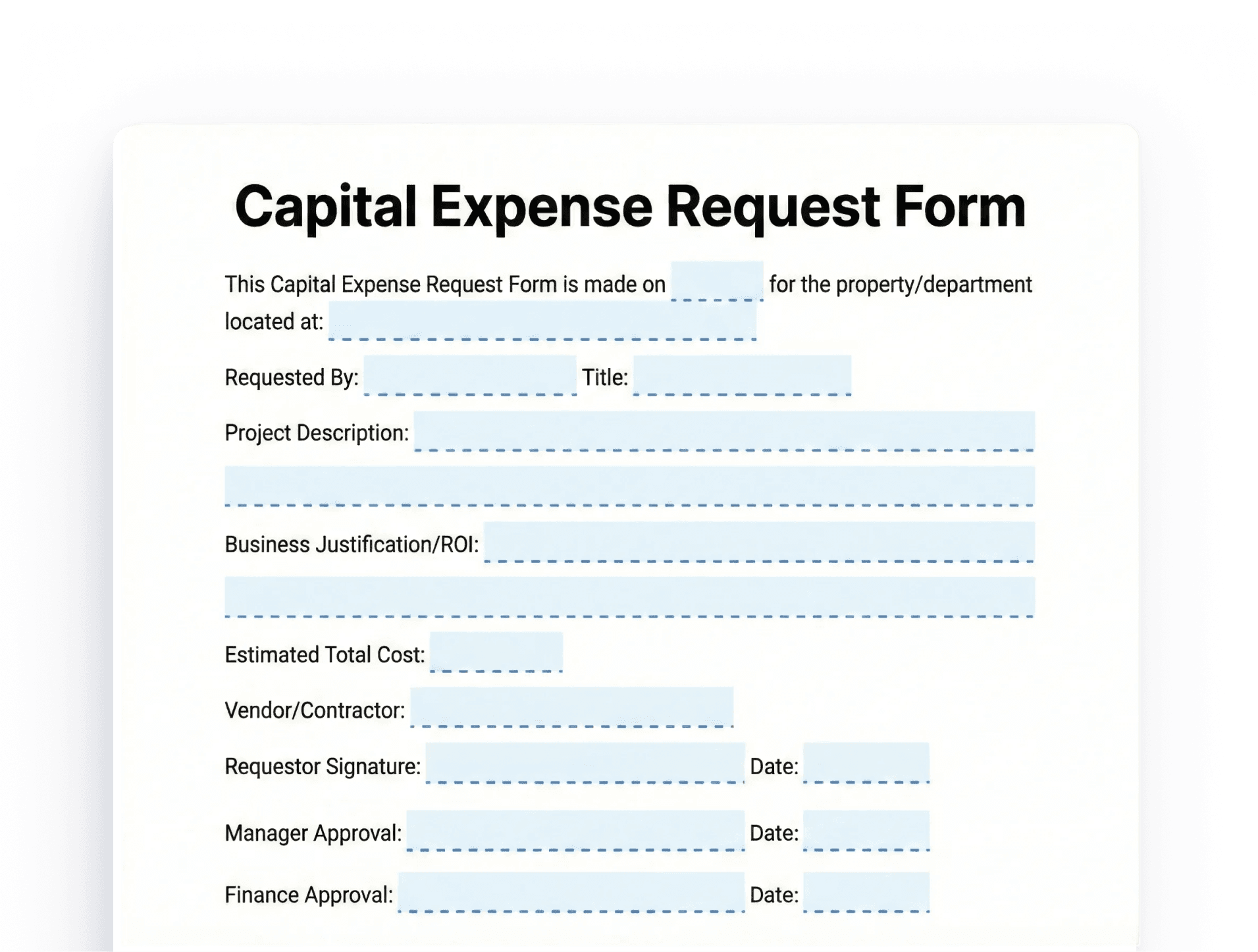
A Capital Expense Request Form is a standardized document used to propose, evaluate, and approve significant property investments. This form captures details about proposed purchases or improvements including cost estimates, expected benefits, and financial justifications. Property managers and maintenance teams use this tool to formally request funding for major expenditures exceeding predetermined thresholds.
Download as PDF when complete


(No Ratings Yet)
What Is a Capital Expense Request Form?
Capital expenses differ fundamentally from routine maintenance costs. These expenditures typically involve substantial amounts, provide benefits lasting multiple years, and often receive different tax treatment. Examples include roof replacements, HVAC system installations, major renovations, and equipment purchases. The form ensures every significant investment receives proper scrutiny before approval.
Understanding Capital Expenses vs Operating Expenses
Key Differences and Classifications
Capital expenses represent investments that add value, extend useful life, or adapt property to new uses. These costs get capitalized on your balance sheet and depreciated over time. Conversely, operating expenses maintain current property condition and get deducted entirely in the year incurred.
The distinction matters significantly for tax purposes and financial reporting. Replacing a broken water heater with a similar model constitutes maintenance expense. However, upgrading to a high-efficiency tankless system represents capital improvement. Understanding these differences ensures accurate accounting and maximizes tax benefits.
IRS Guidelines and Thresholds
The IRS provides specific criteria for distinguishing capital improvements from repairs. Improvements must substantially increase property value, extend useful life beyond one year, or adapt property to new uses. Additionally, many businesses set dollar thresholds, typically $500-$2,500, below which expenses are automatically treated as maintenance.
Your capital expense request form should reference these thresholds clearly. This guidance helps requesters determine whether their proposal requires formal approval. Moreover, it ensures consistent treatment of similar expenses across your property portfolio.
Essential Components of the Form
Project Information Section
Begin your capital expense request form with comprehensive project identification details. Include a descriptive project title, property address, and specific location within the building. Add the requesting department or individual’s name and contact information. Document the request date and desired completion timeline.
Provide space for detailed project descriptions explaining exactly what work will occur. Encourage requesters to be specific about scope, materials, and expected outcomes. This clarity helps evaluators understand the proposal fully and make informed decisions.
Financial Details and Justification
Create sections for detailed cost breakdowns including materials, labor, permits, and contingency amounts. Require multiple vendor quotes for projects exceeding certain thresholds, typically $5,000 or more. This requirement ensures competitive pricing and demonstrates due diligence.
Include fields for expected useful life and depreciation schedule. These details assist with tax planning and financial forecasting. Additionally, request information about ongoing maintenance costs or savings resulting from the improvement. Understanding total cost of ownership improves decision quality.
Business Case and Benefits
Require requesters to justify why the capital expense deserves approval. Common justifications include regulatory compliance, safety improvements, energy efficiency gains, tenant satisfaction, or competitive necessity. Quantify benefits whenever possible through reduced operating costs, increased rental income, or extended equipment lifespan.
Ask requesters to explain consequences of not approving the request. This information helps prioritizers understand urgency and potential risks. Sometimes delaying projects creates larger problems later, while other times postponement causes minimal harm.
Approval Workflow Section
Design a clear approval chain based on expense amounts and project types. Small projects under $10,000 might require only property manager approval. Medium projects between $10,000-$50,000 could need regional manager sign-off. Large projects exceeding $50,000 should require executive or ownership approval.
Include signature lines with dates for each approval level. Add space for comments where approvers can explain conditions, modifications, or reasons for denial. This documentation creates accountability and helps future requesters understand decision criteria.
Benefits of Structured Request Process
Improved Financial Planning
A formal capital expense request form enables better budget forecasting and cash flow management. You can track pending requests to anticipate future funding needs. Additionally, historical request data reveals spending patterns helping you allocate capital reserves appropriately.
The structured process prevents impulsive purchases that strain finances unexpectedly. Instead, you evaluate all significant investments deliberately, considering timing, financing options, and overall portfolio priorities. This discipline protects your financial stability while ensuring necessary improvements proceed systematically.
Enhanced Decision Quality
Requiring written justifications and cost-benefit analyses improves investment decisions. Requesters think through proposals more carefully when documentation is mandatory. Moreover, having complete information allows approvers to compare competing projects objectively.
The form facilitates meaningful conversations about priorities and alternatives. Perhaps a less expensive solution achieves similar benefits. Sometimes combining multiple small projects creates greater efficiency. These discussions happen naturally when formal evaluation processes exist.
Better Tax Compliance
Proper documentation of capital expenses simplifies tax preparation and maximizes deductions. Your form creates audit trails showing why expenditures qualified as capital improvements. Additionally, it captures depreciation information needed for accurate tax reporting.
Consistent categorization prevents errors that trigger IRS scrutiny. When you systematically document the nature, cost, and useful life of improvements, tax professionals can confidently prepare returns. Furthermore, organized records facilitate cost segregation studies that accelerate depreciation benefits.
Implementation Best Practices
Setting Appropriate Thresholds
Establish clear dollar thresholds determining when formal requests become mandatory. Consider your organization’s size, portfolio value, and decision-making structure. Smaller operations might require forms only for expenses exceeding $5,000. Larger organizations may set thresholds at $10,000 or higher.
Balance thoroughness against administrative burden. Requiring extensive documentation for minor purchases wastes time and frustrates staff. Conversely, insufficient oversight of major expenditures creates financial risk. Review and adjust thresholds annually based on experience.
Training and Communication
Educate all staff members about capital expense request procedures. Explain the difference between capital and operating expenses clearly. Provide examples relevant to your specific property types and common situations.
Make forms easily accessible through your property management software or shared network drives. Create simple instruction guides or video tutorials demonstrating proper completion. Additionally, designate specific staff members as resources for questions about the process.
Regular Process Review
Schedule annual reviews of your capital expense request process. Analyze approval rates, common rejection reasons, and average processing times. Identify bottlenecks or unnecessary complications that slow decisions without adding value.
Solicit feedback from requesters and approvers about form effectiveness. Perhaps certain fields provide little useful information and could be eliminated. Maybe additional data would improve decision quality. Continuous improvement keeps your process efficient and relevant.
Tracking and Reporting
Project Status Monitoring
Create a tracking system monitoring all capital expense requests from submission through completion. Record current status, approval dates, funding allocation, and project completion milestones. This visibility helps you manage multiple simultaneous projects effectively.
Regular status reports keep stakeholders informed about capital spending. Share monthly summaries showing approved projects, pending requests, and completed improvements. Transparency builds trust and demonstrates responsible stewardship of investment capital.
Performance Analysis
After project completion, conduct post-implementation reviews comparing actual costs and benefits against original estimates. This analysis improves future forecasting accuracy and identifies vendors who consistently deliver on promises. Additionally, it reveals whether projected benefits materialized as expected.
Document lessons learned from each major project. What went well? What challenges arose? How could future similar projects improve? This institutional knowledge makes your organization increasingly effective at capital project management over time.
Financial Reporting Integration
Ensure capital expense data flows smoothly into your accounting and financial reporting systems. Proper categorization enables accurate balance sheets, income statements, and cash flow projections. Additionally, organized capital expense records facilitate investor reports and loan applications.
Link approved capital expenses to your annual budget and multi-year capital improvement plans. This integration ensures strategic alignment between individual projects and overall property investment strategy. Furthermore, it helps you communicate clearly with property owners about fund utilization.
Conclusion
A capital expense request form brings structure and accountability to significant property investment decisions. By implementing a clear approval process with thorough documentation requirements, you protect financial resources while ensuring necessary improvements happen systematically. The form improves decision quality, enhances tax compliance, and creates valuable records for future planning. Start using a standardized request form today to professionalize your capital expenditure management and maximize return on property investments.
FAQs
Most property management companies require formal requests for expenditures exceeding $2,500-$10,000, depending on organization size and risk tolerance. Set thresholds that balance thorough oversight with administrative efficiency, and review them annually based on inflation and experience.
Small requests under $10,000 should receive approval within 3-5 business days, while larger projects may require 2-4 weeks for thorough evaluation. Urgent safety-related requests often follow expedited approval procedures to prevent property damage or liability issues.
Once properly approved and work begins, requests should only be cancelled for legitimate reasons like safety concerns or material cost changes. However, approvals typically expire after 90-180 days if projects don’t commence, requiring resubmission with updated information.
Approval authority should increase with expense amount, typically property managers for under $10,000, regional managers for $10,000-$50,000, and executives for amounts exceeding $50,000. Some organizations also require board approval for exceptionally large projects exceeding predetermined thresholds.
True emergencies like burst pipes or failed HVAC systems in extreme weather require immediate action without prior approval. However, you must document these expenses retroactively using the capital expense request form for proper accounting and to justify the emergency classification.