
Unconditional Quit Notice


(1)
An Unconditional Quit Notice is the most decisive legal tool available to landlords for immediate lease termination. Unlike other notices, it gives tenants no opportunity to fix violations or remedy breaches. This guide covers everything landlords need to know about issuing a legally valid unconditional quit notice.
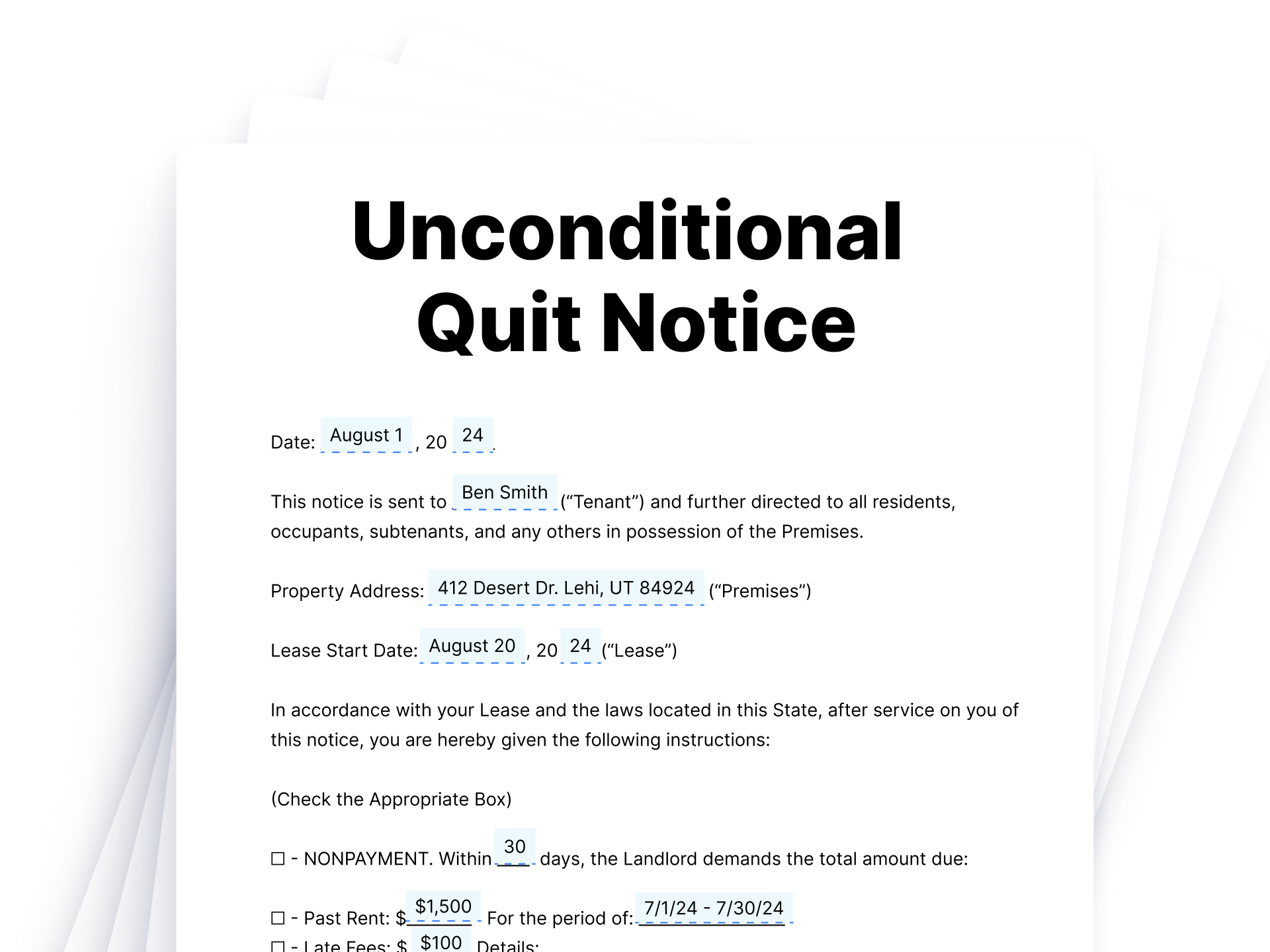
Download as PDF when complete
What Is an Unconditional Quit Notice?
Definition and Key Facts
An Unconditional Quit Notice is a formal document that requires a tenant to vacate immediately with no chance to cure the violation. Courts and housing agencies recognize properly drafted notices as legally enforceable for the most severe rental violations. In addition, unconditional quit notices are typically reserved for situations involving criminal activity, serious property damage, safety hazards, and other incurable breaches.
Why an Unconditional Quit Notice Matters
Smart property owners use legally valid unconditional quit notices to protect their properties from irreparable harm. These notices also ensure community safety, maintain property integrity, and enforce lease terms through decisive legal action. In addition, knowing the correct Unconditional Quit Notice process protects both landlord property rights and legal due process throughout critical rental emergencies.
Legal Protection Benefits of an Unconditional Quit Notice
Key Benefits Every Landlord Should Know
A properly issued Unconditional Quit Notice gives landlords key legal tools to act immediately. Specifically, it provides:
- Immediate termination authority — applies to serious violations that cannot be cured through tenant action
- Property protection — addresses violations that threaten significant damage, safety, or legal liability
- Constitutional compliance — meets due process rules while enabling decisive enforcement action
- Community safety — removes dangerous situations that threaten other tenants or the neighborhood
- Legal enforceability — ensures court recognition for the most serious violation action
- Complete records — provides essential evidence for immediate ending and eviction proceedings
Types of Violations Requiring an Unconditional Quit Notice
Criminal Activity and Illegal Behavior
Criminal activities typically warrant an Unconditional Quit Notice due to legal liability, community safety, and property protection concerns. Common examples include drug manufacturing, distribution, violence, theft, and other illegal behavior. In addition, criminal violation action requires close working with law enforcement and thorough evidence gathering during the process.
Significant Property Damage and Destruction
Intentional property destruction, building damage, or dangerous modifications may warrant immediate ending with no cure opportunity. These violations directly threaten property integrity and safety systems. In addition, property damage violations require thorough records including photographs, expert reports, and repair cost estimates before serving the notice.
Safety Hazards and Life-Threatening Violations
Safety violations typically justify unconditional ending due to their serious and immediate nature. Common examples include fire hazards, electrical tampering, emergency system interference, and conditions that threaten life safety. As a result, safety hazard enforcement requires immediate action along with thorough records and working with safety authorities during the emergency response.
State-Specific Unconditional Quit Notice Requirements
Statutory Criteria for Immediate Termination
State laws set specific criteria for violations that justify unconditional ending. These typically include:
- Criminal activities and drug-related offenses
- Property damage above a specific threshold
- Safety violations and fire hazards
- Other serious incurable breaches
Evidence rules and classification standards vary by state. Therefore, landlords should always confirm their state’s exact requirements before issuing any Unconditional Quit Notice.
Notice Period Requirements for Unconditional Quit Notices
Unconditional quit notice periods vary by state and violation type. Some states allow immediate ending, while others require a minimum notice period ranging from 3 to 30 days depending on violation severity. Consequently, landlords should verify the correct timeframe for their state before proceeding with any termination action.
Evidence and Records for an Unconditional Quit Notice
Substantial Evidence and Proof Standards
Unconditional quit notices require strong evidence to support immediate ending claims. Accepted evidence types include:
- Witness statements and signed declarations
- Photographs and video recordings of the violation
- Police reports and official agency records
- Professional safety or damage reports
Moreover, landlords must gather all evidence following legal rules to ensure courts will accept it.
Professional Assessment and Expert Records
Serious violations often require expert review before an Unconditional Quit Notice can be issued. Depending on the situation, this may include:
- Structural engineers for property damage reports
- Environmental specialists for hazardous conditions
- Law enforcement reports for criminal activities
- Safety experts for life-threatening situations
In addition, expert records strengthen legal credibility and ensure complete evidence gathering during the process. Landlords can also submit expert reports as court testimony if the case proceeds to a hearing.
Unconditional Quit Notice Content Requirements
Required Information in Every Unconditional Quit Notice
Every Unconditional Quit Notice must include specific details to be legally valid. Required content includes:
- A clear and specific description of the violation
- References to supporting evidence
- The immediate ending date and deadline to vacate
- Legal consequences of non-compliance
- Tenant rights information, including court options and legal assistance resources
In addition, landlords must write precise violation descriptions to meet legal due process rules and hold up in court.
Legal Language and Constitutional Compliance Standards
Notice language must comply with state rules, including required legal phrases and statutory compliance statements. Using vague or incorrect language can make the notice invalid. Also, state-approved language prevents court challenges while ensuring the tenant receives proper notification and legal protection during the process.
Violation Classification and Severity Records
Violation classification must match state law categories for unconditional ending. Specifically, classification should include:
- The exact statutory definition the violation falls under
- Evidence showing the violation meets the legal threshold
- Records of the severity and any immediate safety risks involved
Accurate classification ensures the correct legal process is applied. As a result, misclassifying a violation may cause a court to reject the notice and force the entire process to restart.
Specific Violations and Unconditional Quit Notice Applications
Drug-Related Criminal Activity Violations
Drug manufacturing, distribution, or possession violations typically warrant immediate unconditional ending due to federal law concerns, property damage risks, and community safety. For this reason, drug and criminal activity enforcement requires close working with law enforcement and thorough evidence gathering before serving the notice.
Violence, Assault, and Threatening Behavior
Physical violence, assault, domestic violence incidents, threats against other tenants, or intimidating behavior may justify an Unconditional Quit Notice depending on severity and community safety impact. In addition, these violations require immediate safety assessment, victim protection measures, and thorough evidence gathering throughout the emergency legal process.
Intentional Property Destruction and Vandalism
Deliberate property destruction, malicious vandalism, or intentional damage that goes beyond normal wear and tear typically justifies unconditional ending. Specifically, records should include photos, damage reports, and repair cost estimates. In addition, landlords should act quickly to prevent further damage while gathering the evidence needed for a valid notice.
Unauthorized Structural Changes and Safety System Interference
Unpermitted building changes, load-bearing alterations, or safety system tampering that compromise property integrity or tenant safety warrant immediate ending. Landlords need an expert engineering review to document the full scope of the problem. Consequently, landlords should bring in qualified qualifieds before issuing the notice to ensure evidence meets court standards.
Health and Safety Violations Requiring an Unconditional Quit Notice
Fire Safety and Emergency System Violations
Fire hazard creation, smoke detector tampering, sprinkler interference, emergency exit blocking, or fire equipment damage all warrant immediate unconditional ending due to life safety concerns. Therefore, landlords must act fast, document everything thoroughly, and coordinate immediately with fire safety authorities to confirm the violation and support the legal case.
Hazardous Material and Environmental Violations
Improper storage of hazardous materials, chemical violations, or environmental damage may warrant unconditional ending depending on severity and health risks. Landlords typically need a professional environmental review to document safety concerns. In addition, landlords should work with local regulatory agencies to address any ongoing health or safety threats during the legal process.
Severe Sanitation and Public Health Violations
Extreme sanitation violations, hoarding conditions, or severe cleanliness failures that threaten public health may justify an Unconditional Quit Notice when correction is not feasible. These situations require health authority involvement and expert review. As a result, landlords should engage local health agencies early to build a complete and credible record for court.
Infectious Disease and Contamination Violations
Tenant actions creating infectious disease risks, property damage, or public health hazards may warrant unconditional ending depending on severity and community impact. Similarly, these situations require health authority cooperation and thorough expert review. In addition, landlords should include cleanup cost estimates in the records to strengthen the legal case.
Service Methods for an Unconditional Quit Notice
Personal Service and Direct Delivery
Personal service provides the strongest legal evidence for an Unconditional Quit Notice, especially in emergency situations. Delivery records should include:
- The date and time of delivery
- The name and identification of the recipient
- A witness signature when available
Therefore, personal service is always the preferred method when the tenant is accessible and it is safe to proceed.
Certified Mail and Documented Delivery
Certified mail with return receipt provides essential legal delivery proof for an Unconditional Quit Notice. Specifically, landlords should keep the return receipt as legal evidence of delivery. In addition, proper addressing and timely mailing ensure the notice period starts on the correct date.
Posted Notice and Emergency Delivery Options
When personal service is not possible due to safety concerns or tenant absence, posted notice may be allowed under state law. Posting rules typically include a visible location, witness verification, and simultaneous certified mail delivery. Moreover, emergency situations involving immediate danger may also allow electronic service by email or text when traditional delivery is not safe or practical — though a backup method is always recommended.
Tenant Defenses Against an Unconditional Quit Notice
Tenant Contest Procedures and Court Challenges
Tenants may contest an Unconditional Quit Notice through court proceedings by challenging violation claims, evidence validity, or legal compliance. Specifically, landlords must be ready to present substantial evidence supporting the immediate ending claim. For this reason, well-prepared records and expert reports are the most effective tools for countering tenant challenges in court.
Constitutional Due Process and Legal Representation Rights
Tenants facing unconditional ending have legal rights to legal representation, court proceedings, and legal assistance. Landlords must acknowledge these rights throughout the process. In addition, landlords must ensure the notice includes all required tenant rights information and follows proper legal procedures from start to finish.
Emergency Injunctive Relief and Immediate Protection
Emergency situations may warrant immediate injunctive relief, temporary restraining orders, or expedited court procedures. These tools provide fast tenant removal while maintaining legal due process. As a result, landlords facing urgent safety situations should consult a legal qualified to determine whether emergency court relief is available in their jurisdiction.
Eviction Steps After a Failed Unconditional Quit Notice
Unlawful Detainer Actions and Court Filings
When a tenant does not leave after receiving an Unconditional Quit Notice, the landlord may file an unlawful detainer action. In that case, court filings typically require:
- The original lease agreement
- Copies of all notices served with delivery proof
- Violation evidence including photos, reports, and witness accounts
- Expert reviews supporting the immediate ending claim
Emergency Writ of Possession and Physical Removal
If the court rules in the landlord’s favor, an emergency writ of possession may be issued allowing law enforcement to carry out the physical removal of the tenant. Landlords must also follow state law rules for handling personal property left behind, including required notice, secure storage, and proper disposal steps.
Property Securing After an Unconditional Quit Notice
After the tenant is removed, landlords may need to take immediate steps to secure the property. In addition, this may include lock changes, security measures, and evidence preservation. In addition, landlords must handle any items left behind in compliance with state abandoned property laws to avoid additional legal liability.
Best Practices for Issuing an Unconditional Quit Notice
Gather Strong Evidence Before Serving the Notice
Before issuing any Unconditional Quit Notice, landlords should:
- Document the violation thoroughly with photos, video, and written reports
- Collect witness statements from neighbors or other tenants
- Obtain police reports or expert reviews where applicable
- Confirm the violation qualifies for unconditional ending under state law
Overall, taking these steps before serving the notice reduces the risk of a successful tenant challenge in court.
Use Technology to Support Unconditional Quit Notice Enforcement
Modern property management tools can improve the emergency legal process. Useful technology includes:
- Digital photo and video records — captures violation evidence for court use
- Secure cloud storage — protects all evidence and legal documents
- Automated deadline tracking — monitors notice periods and court dates
- Multi-channel communication logs — maintains complete records of all tenant interactions
In addition, property management software can help automate notice creation and stay compliant with state law during the process.
Consult Legal Professionals for Complex Unconditional Quit Situations
Complex violations — such as criminal activity, environmental damage, or building safety issues — benefit greatly from legal and legal support. Landlords should consider working with:
- An experienced landlord-tenant attorney for legal guidance
- Expert witnesses for violation reports
- Law enforcement for criminal activity coordination
- Environmental or building specialists for technical violations
Ultimately, legal support ensures the Unconditional Quit Notice is legally sound and gives the landlord the best possible outcome in court.
Unconditional Quit Notice: Key Takeaways
How to Handle the Process the Right Way
A properly issued Unconditional Quit Notice protects landlords, tenants, and communities by ensuring the most serious lease violations are addressed immediately and within the law. Specifically, to handle the process correctly:
- Confirm the violation qualifies for unconditional ending under your state’s law
- Gather strong evidence before serving the notice
- Include all required details with precise legal language
- Serve the notice using an approved delivery method and document every step
- Be prepared for court proceedings with complete records
The Bottom Line on Unconditional Quit Notices
Ultimately, a legally valid Unconditional Quit Notice protects property, ensures community safety, and gives landlords a clear legal path to removing tenants who commit the most serious and irreparable lease violations.
FAQs
An Unconditional Quit Notice is the most serious legal tool available to landlords, requiring a tenant to vacate immediately with no opportunity to fix or remedy the violation under state landlord-tenant law.
The most common violations include criminal activities such as drug manufacturing or violence, significant property damage, fire safety hazards, extreme sanitation failures, and any other serious breach that poses an immediate threat to property integrity or community safety.
Notice periods vary by state and violation type, ranging from immediate termination in some jurisdictions to minimum notice periods of 3 to 30 days depending on the severity of the violation and constitutional due process requirements.
Yes — tenants can contest the notice by challenging the violation claims, questioning the validity of the evidence, or arguing that the landlord failed to follow proper constitutional due process procedures during enforcement.
If the tenant does not vacate, the landlord may file an unlawful detainer action, and if the court rules in the landlord’s favor, an emergency writ of possession may be issued allowing law enforcement to carry out the immediate physical removal of the tenant.