
Notice to Comply or Quit


(1)
A Notice to Comply or Quit is a key legal tool for addressing lease violations. Specifically, it gives tenants a formal opportunity to fix breaches before facing eviction under state landlord-tenant law. This guide covers everything landlords and tenants need to know about the comply-or-quit process.
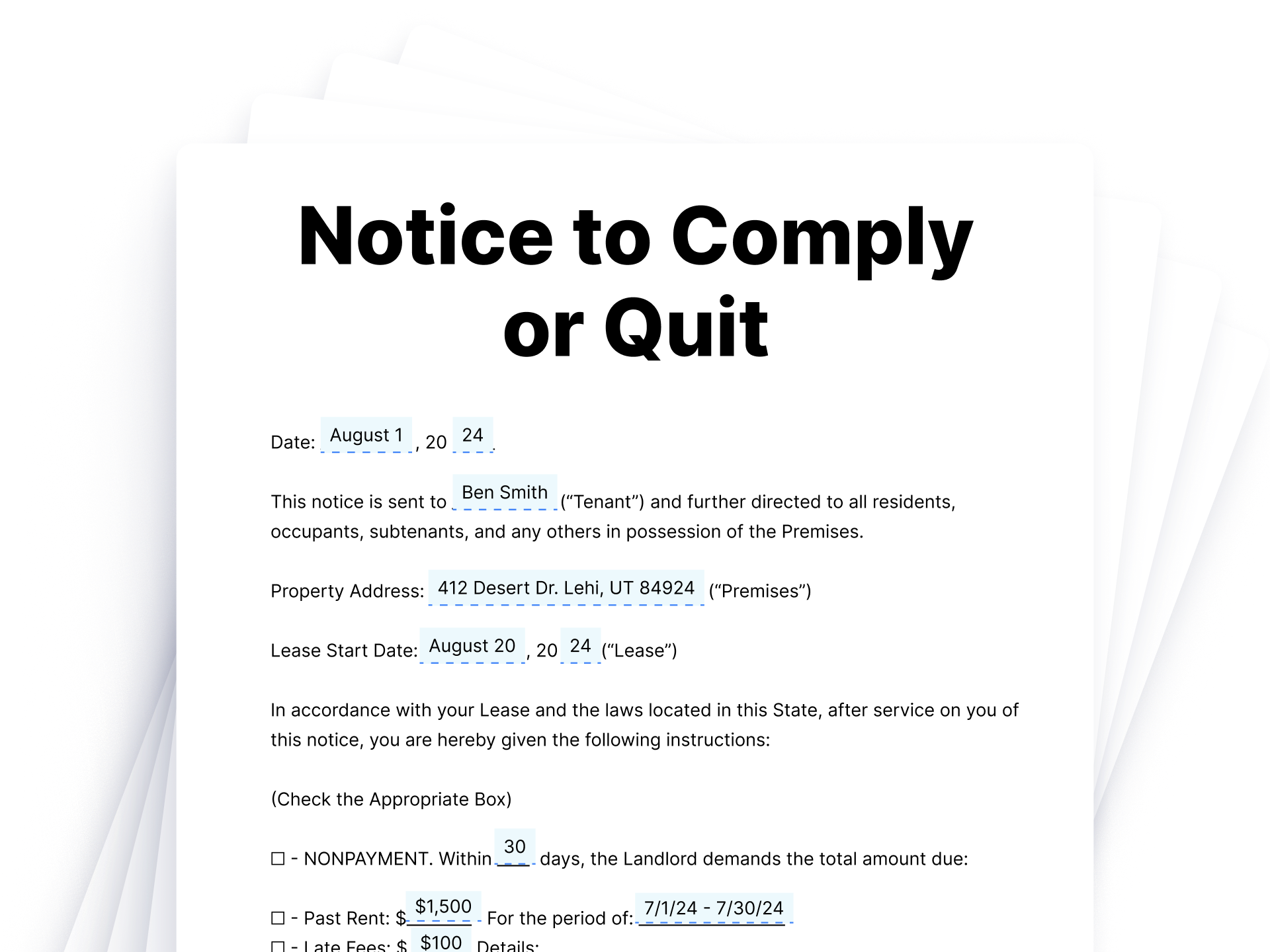
Download as PDF when complete
 Google Doc,
  PDF &
PDF &  Word) or create one online!
What Is a Notice to Comply or Quit?
A Notice to Comply or Quit is a written document that notifies a tenant of a lease violation and sets a deadline to correct it. Courts and housing authorities recognize properly drafted notices as legally enforceable when they meet state requirements. In addition, comply-or-quit procedures affect thousands of rental relationships each year, with cure periods ranging from 3 days for serious violations to 30 days for first-time breaches.
Why a Notice to Comply or Quit Matters for Landlords
Smart property owners use legally compliant comply-or-quit notices to protect their investments. These notices help maintain property standards, preserve positive tenant relationships, and prevent costly legal disputes. Furthermore, understanding proper Notice to Comply or Quit requirements protects both landlord property rights and tenant due process throughout the rental relationship.
Legal Protection Benefits of a Notice to Comply or Quit
A properly issued Notice to Comply or Quit provides critical legal protection for both parties. Specifically, it offers:
- State law compliance — meets statutory cure periods and notice requirements for each violation type
- Due process protection — ensures tenant rights while establishing legal grounds for enforcement
- Documentation standards — creates complete records for eviction proceedings and compliance verification
- Property protection — addresses violations before they escalate into serious damage or safety issues
- Tenant relationship preservation — offers cure opportunities that encourage cooperation
- Legal enforceability — ensures court recognition and valid eviction procedures if the cure fails
Types of Lease Violations and Comply-or-Quit Procedures
Non-Monetary Violations and Cure Opportunities
Non-monetary violations include unauthorized pets, occupancy issues, noise complaints, and unauthorized property changes. These violations typically allow tenants a reasonable timeframe to fix the problem through a comply-or-quit notice. As a result, clear violation details are essential for tenant understanding and successful resolution.
Serious Violations Requiring Shortened Comply-or-Quit Periods
Serious lease violations may warrant shorter cure periods or unconditional quit notices. Common examples include:
- Illegal activities on the property
- Significant property damage
- Safety hazards
- Ongoing nuisance behavior
In addition, responding to serious violations requires careful legal analysis to ensure proper tenant due process and thorough documentation.
Repeat Violations and Escalated Notice Procedures
Repeat lease violations by the same tenant may justify shorter cure periods, stronger enforcement, or unconditional quit notices. The appropriate response depends on violation patterns and state law provisions. Moreover, documenting repeat violations thoroughly is essential for maintaining consistent and legally defensible enforcement.
State-Specific Cure Periods and Notice to Comply Requirements
Statutory Cure Periods by Violation Type
State landlord-tenant laws set specific cure periods for different types of violations:
- 3-day notices — for serious or urgent violations
- 10-day notices — for standard lease breaches
- 30-day notices — for first-time, easily fixable violations
Cure period calculations begin from the date of proper notice service and must comply with state-specific timing rules. Therefore, landlords should always confirm their state’s requirements before issuing any Notice to Comply or Quit.
First-Time vs. Repeat Violation Treatment
Many states offer stronger protections for first-time violations, including longer cure periods and required opportunities to remedy the issue. Repeat violations, however, may receive shorter cure periods or lose cure rights entirely. As a result, first-time violation policies encourage compliance, while repeat violation procedures address chronic non-compliance patterns.
Incurable Violations and the Notice to Comply or Quit Process
Incurable Violation Types and Legal Standards
Certain violations may be deemed incurable under state law, meaning no cure opportunity is required. These typically include:
- Illegal drug activity or criminal behavior
- Significant property damage
- Serious safety violations threatening other tenants
Incurable violation determinations require careful legal analysis to ensure full compliance with state law standards. Consequently, landlords should consult a legal professional before issuing an unconditional quit notice.
Emergency Situations and Faster Comply-or-Quit Procedures
Emergency situations may warrant faster notice procedures with shortened cure periods or immediate termination rights. Health hazards, safety violations, and illegal activities all fall into this category. Throughout any emergency response, landlords must balance the need for immediate action with tenant due process rights and full legal compliance.
Notice to Comply or Quit Content Requirements
Required Information in Every Notice to Comply or Quit
Every Notice to Comply or Quit must include specific information to be legally valid. Required content includes:
- A clear description of the specific violation
- The exact corrective action the tenant must take
- The cure deadline
- Consequences of non-compliance
- Tenant rights information and available resources
Furthermore, violation specificity prevents tenant confusion and strengthens legal enforceability throughout the cure process.
Legal Language and Statutory Compliance Standards
Notice language must comply with state requirements, including specific statutory phrases, legal terminology, and required compliance statements. Using generic or non-compliant language can invalidate the notice entirely. Additionally, state-compliant language prevents notice challenges while ensuring comprehensive tenant notification and due process protection.
Language Accessibility and Tenant Rights Protection
Many jurisdictions require notices to be written in the tenant’s primary language or accompanied by a translation. Additional accessibility requirements may include:
- Large print options for visually impaired tenants
- Disability accommodations
- Alternative format availability upon request
Meeting these standards ensures due process compliance and, in turn, reduces the risk of a successful tenant defense in court.
Common Lease Violations and Notice to Comply Applications
Unauthorized Pet Violations and Animal Policy Enforcement
Pet policy violations include unauthorized animals, breed restriction violations, or failure to register a pet. These typically allow cure through pet removal or policy compliance within a specified timeframe. In addition, pet violation notices should specify policy requirements, cure procedures, and ongoing compliance expectations clearly.
Occupancy Violations and Guest Policy Enforcement
Unauthorized occupants, guest policy violations, or subletting without permission all require specific cure procedures. Notices should clearly identify unauthorized individuals and specify removal requirements. Moreover, occupancy notices must also address lease compliance standards to prevent future violations of the same type.
Noise and Nuisance Comply-or-Quit Violations
Noise violations require thorough documentation, including complaint records, incident reports, and witness statements. Unlike physical violations, noise cures typically involve behavioral changes rather than repairs. As a result, notices must set clear and measurable performance standards so tenants understand exactly what is expected of them.
Nuisance violations — such as disruptive behavior or interference with other tenants — follow a similar approach. Specifically, these notices should identify unacceptable behaviors, outline required changes, and reference applicable community standards.
Property Damage and Maintenance Comply-or-Quit Notices
Property damage violations require specific repair requirements, completion deadlines, and restoration standards. Notices should clearly specify the required repairs, acceptable completion methods, and how compliance will be verified. Furthermore, damage notices should address both immediate repair obligations and the tenant’s ongoing responsibility to maintain the property.
Sanitation violations — such as excessive clutter or health hazards — also require detailed remediation instructions and ongoing maintenance standards. In these cases, notices should specify required improvements and compliance checkpoints to address both the current violation and prevent recurrence.
Unauthorized Modification and Alteration Notices
Unauthorized property modifications require either restoration to the original condition or formal approval through proper procedures. Notices should specify restoration requirements, approval processes, and compliance standards. Additionally, fixture or equipment violations should address immediate compliance needs while establishing clear policies for future modification requests.
Service Methods and Legal Delivery of a Notice to Comply or Quit
Personal Service and Direct Delivery Standards
Personal service involves handing the notice directly to the tenant, which provides the strongest legal evidence of proper delivery. This method should include documentation of the delivery date, recipient identification, and witness verification. Therefore, personal service is always the preferred method when the tenant is available and accessible.
Substituted Service and Alternative Delivery Options
When personal service is not possible, states allow substituted service methods, such as:
- Delivery to an adult household member
- Posting the notice in a conspicuous location
- Certified mail with specific compliance requirements
Substituted service requires documentation of failed personal service attempts and strict compliance with state-specific alternative delivery procedures. Moreover, landlords should keep a detailed log of every service attempt in case of future disputes.
Electronic Notice to Comply or Quit Delivery
Many states now allow electronic service, including email, text message, or property management platform notifications, when tenants have consented to digital communication. Electronic service requires:
- Delivery confirmation or read receipts
- Backup delivery via traditional methods
- Compliance with state-specific electronic communication laws
Consequently, landlords using digital delivery should always maintain a backup paper trail to protect legal enforceability.
Cure Verification and Compliance Monitoring After a Notice to Comply or Quit
Cure Completion Standards and Verification
Successful violation cure requires thorough verification, including inspections, compliance documentation, and ongoing monitoring. Landlords should address both immediate compliance and establish procedures for continued monitoring after the cure deadline. In addition, clear cure completion standards prevent disputes about whether a violation was fully resolved.
Partial Cure and Incomplete Compliance Issues
Partial cure attempts that do not fully address the violation may not prevent eviction proceedings. For this reason, landlords must establish clear cure completion standards from the outset. Otherwise, ambiguous standards create opportunities for tenants to argue that partial action was sufficient.
Ongoing Compliance Monitoring and Violation Prevention
Successful cure completion should be followed by ongoing monitoring and violation prevention measures. Key strategies include:
- Policy clarification — explain lease terms and expectations clearly to prevent future violations
- Resource provision — offer educational materials to help tenants maintain compliance
- Regular check-ins — schedule follow-up reviews to ensure continued compliance
- Proactive measures — identify and address potential violations before they escalate
Furthermore, prevention strategies should address the underlying causes of violations while providing tenants with clear and consistent expectations.
Legal Results and Eviction After a Failed Notice to Comply or Quit
Failed Cure and Eviction Proceedings
When a tenant fails to cure a violation within the specified timeframe, the landlord may proceed with an unlawful detainer filing and court eviction proceedings. In that case, documentation of the failed cure becomes critical evidence. Specifically, landlords must be able to show that the Notice to Comply or Quit was properly served and that the tenant did not comply.
Court Filing Requirements and Evidence Standards
Eviction proceedings require complete documentation, including:
- The original lease agreement
- Copies of all comply-or-quit notices served
- Proof of proper legal delivery with dates and methods
- Evidence of the tenant’s failure to cure the violation
- All written or electronic communications with the tenant regarding the violation
Filing requirements vary by jurisdiction, but thorough documentation ensures the strongest possible legal position throughout the court process.
Tenant Defenses Against a Notice to Comply or Quit
Tenants may raise several legal defenses against comply-or-quit enforcement, including:
- Habitability defense — claiming the landlord failed to maintain livable property conditions
- Retaliation defense — arguing the notice was issued in response to a complaint or legal rights exercise
- Procedural defense — challenging the technical validity of the notice itself
Landlords must therefore document all legitimate enforcement reasons carefully. In particular, maintaining detailed records from the start of any violation issue is the most effective protection against these defenses.
Industry-Specific Notice to Comply or Quit Applications
Student Housing and University-Related Violations
Student housing properties often face unique violations, including party policy breaches, academic calendar non-compliance, and university coordination requirements. As a result, these notices may need to reference both lease terms and applicable university disciplinary standards. Coordination with the institution can also strengthen enforcement in these cases.
Senior and Age-Restricted Housing Violations
Age-restricted housing may involve specialized violations related to age compliance, community standards, and accessibility requirements. Notices in these communities must address community-specific standards while ensuring full compliance with fair housing and age discrimination laws. Additionally, cure procedures should be adapted to reflect the specific needs of senior residents.
Commercial and Mixed-Use Property Comply-or-Quit Notices
Commercial properties face unique violations including zoning non-compliance, business operation issues, and commercial use standard breaches. These situations require specialized comply-or-quit procedures that address specific business violations. Furthermore, mixed-use properties combining residential and commercial uses require careful legal application to ensure both tenant protections and commercial compliance standards are met.
Technology and Modern Notice to Comply or Quit Management
Digital Notice Systems and Compliance Tracking
Modern comply-or-quit procedures increasingly use digital platforms for notice generation, violation tracking, and compliance documentation. These tools ensure state law compliance and maintain comprehensive legal records. In addition, technology integration enhances violation management while protecting tenant rights throughout the process.
Automated Compliance Monitoring and Detection
Property management software can automate violation detection, notice generation, and compliance tracking. As a result, automated systems improve operational efficiency while maintaining legal validity and comprehensive documentation standards. However, landlords should always verify that automated notices meet current state law requirements before relying on them in court.
Tenant Portal Integration and Self-Service Compliance Tools
Modern tenant portals support the comply-or-quit process by providing:
- Violation reporting — tenants can submit cure progress and supporting documentation
- Document upload — easy submission of cure completion evidence
- Communication tracking — complete records of all tenant-landlord exchanges
- Compliance deadlines — automatic reminders and cure period tracking
- Resource library — access to lease terms, violation resolution guides, and tenant rights information
Ultimately, these tools improve transparency, promote tenant engagement, and reduce the likelihood of disputes throughout the comply-or-quit process.
Notice to Comply or Quit: Key Takeaways
A properly issued Notice to Comply or Quit protects both landlords and tenants by keeping all violation enforcement within state law. To do it right, use the correct notice type, include all required legal language, serve it through an approved method, and document every step. Ultimately, a legally compliant notice prevents costly disputes and gives both parties a fair path to resolution.
Sample
FAQs
A Notice to Comply or Quit is a legal document that gives tenants a specific timeframe to fix a lease violation before a landlord can proceed with eviction under state landlord-tenant laws.
Common violations include unauthorized pets, occupancy violations, noise complaints, property damage, unauthorized modifications, and sanitation issues, each with specific cure procedures and timeframes.
Cure periods vary by state and violation type, ranging from 3 days for serious violations to 10 days for standard breaches and up to 30 days for first-time fixable violations.
No — certain violations such as illegal drug activity, criminal behavior, or significant property damage may be deemed incurable under state law, allowing landlords to proceed with immediate termination without offering a cure period.
If the tenant fails to cure the violation within the specified timeframe, the landlord may file an unlawful detainer action and proceed with formal eviction court proceedings.