
Lease Termination Notice


(1)
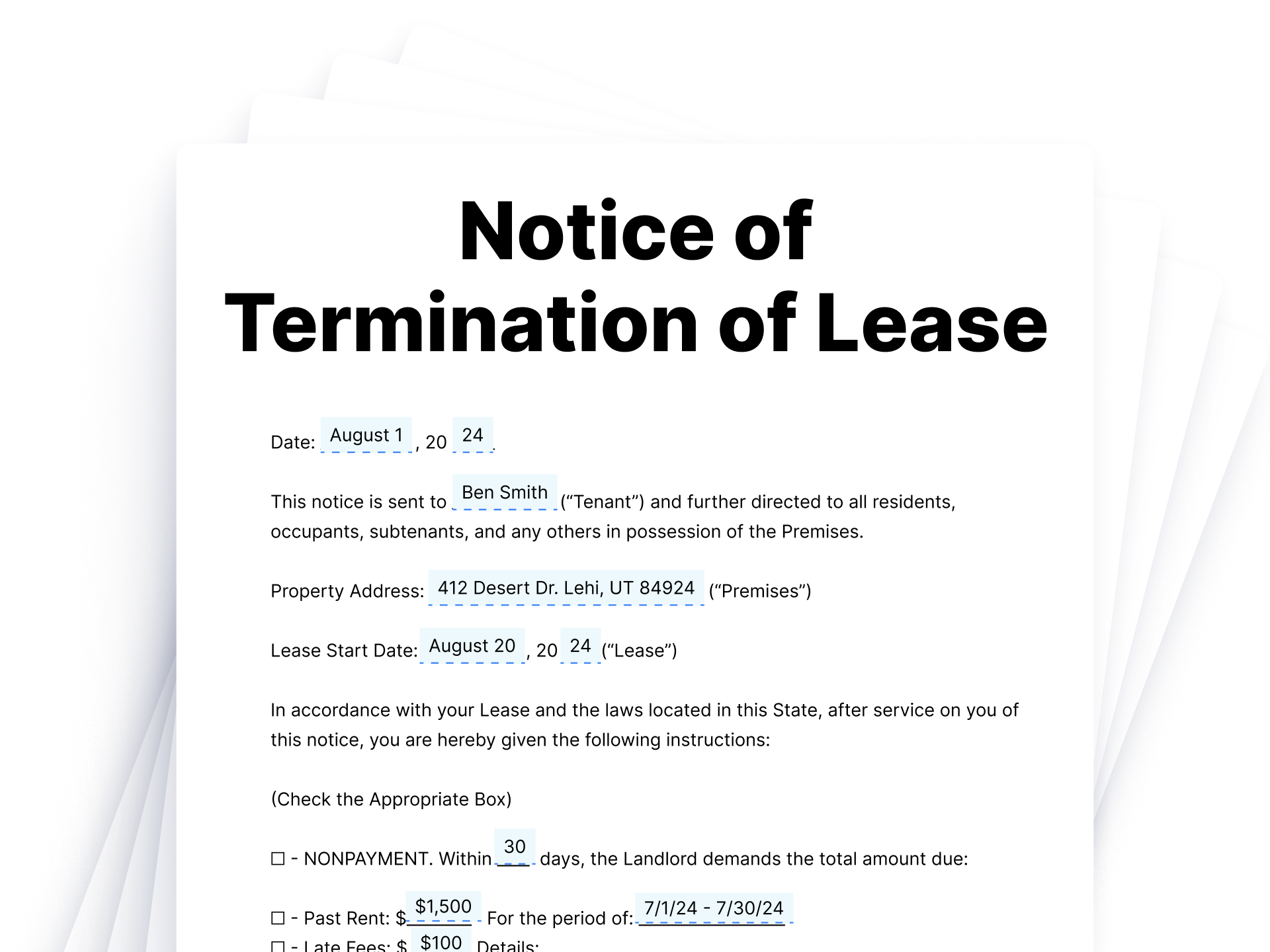
Lease Termination Notice requirements vary significantly across states and lease types. For this reason, proper notification procedures are essential for legal compliance and protection of both landlord and tenant rights. Ultimately, this guide covers everything you need to know about the rental termination process.
Download as PDF when complete
What Is a Lease Termination Notice?
A lease termination notice is a formal document that ends a rental agreement. Specifically, it must meet state-specific requirements for timing, content, and delivery method. In general, notice periods range from 3-day pay-or-quit notices for rent defaults to 30 to 60-day notices for month-to-month tenancies.
Why Lease Termination Notice Procedures Matter
Smart property owners and tenants use legally compliant termination notices to protect their rights. Proper notices also ensure regulatory compliance, maintain positive rental relationships, and prevent costly legal disputes. In addition, well-documented notices address state-specific requirements and support enforcement if disputes arise. As a result, following the correct procedures from the start saves both parties significant time and money.
Legal Protection Benefits of Proper Lease Termination Notice
Understanding lease termination notice requirements protects both parties and ensures smooth transitions. Specifically, proper notice provides:
- State law compliance — meets statutory notice periods and content requirements
- Legal enforceability — ensures court recognition and valid eviction procedures
- Documentation standards — creates records for legal proceedings and compliance verification
- Tenant rights protection — guarantees due process and proper notification
- Landlord property protection — establishes legal grounds for recovering possession
- Dispute prevention — promotes clear communication and proper legal procedure
Types of Lease Termination Notices
Pay-or-Quit Notices for Rent Default
Pay-or-quit notices address rent non-payment by giving tenants a short window — typically 3 to 5 days — to pay or vacate. These notices allow tenants to fix the default while, at the same time, giving landlords legal grounds to begin eviction if payment is not received.
A valid pay-or-quit lease termination notice must include:
- Exact amount owed
- Accepted payment methods
- Cure deadline
- Consequences of non-compliance
Cure-or-Quit Notices for Lease Violations
Cure-or-quit notices give tenants the chance to fix non-monetary lease breaches. For example, common violations include pet violations, noise complaints, or unauthorized occupants. In addition, cure periods vary by state and violation type — first-time violations often receive more time than repeat offenses. Therefore, landlords must review state law before setting any cure deadline.
Unconditional Quit Notices for Serious Violations
Some violations are serious enough to skip the cure option entirely. For instance, illegal activity, significant property damage, and repeat violations may all warrant an unconditional quit notice. Unlike other notice types, these require the tenant to leave within a statutory timeframe with no opportunity to remedy the issue. Consequently, landlords should only use unconditional quit notices when state law clearly permits them.
State-Specific Lease Termination Notice Requirements
Residential Notice Periods by State
State landlord-tenant laws set specific notice periods based on lease type:
- Month-to-month tenancies — typically 30 days
- Week-to-week arrangements — typically 7 days
- Fixed-term leases — must follow lease term requirements
Notice timing begins from the date of proper service. Depending on the state, calculation methods may use calendar days, business days, or exclude holidays. Therefore, landlords should always verify their state’s specific rules before issuing any lease termination notice. Otherwise, even a correctly written notice may be thrown out on a technicality.
Commercial Lease Termination Notice Requirements
Commercial lease terminations often involve longer notice periods, stricter performance deadlines, and different service methods than residential rentals. Furthermore, these notices must address business operational needs alongside property owner rights. As a result, commercial landlords and tenants should review their specific lease terms carefully before proceeding.
How to Calculate and Serve a Lease Termination Notice
Proper Notice Period Calculation
Notice periods begin from the date of proper service. Key calculation rules vary by state and may include:
- Calendar days vs. business days
- Holiday exclusions
- Requirements that notice periods end on a rent due date or lease anniversary
Some states also require that notice periods align with the rental payment cycle. Consequently, even a small calculation error can invalidate an otherwise proper lease termination notice. For this reason, double-checking calculations before delivery is strongly recommended.
Accepted Service Methods for Lease Termination Notice
Choosing the right delivery method is just as important as the notice content itself. Accepted service options typically include:
- Personal delivery — handing the notice directly to the tenant, which provides the strongest legal evidence
- Certified mail with return receipt — creates a reliable paper trail of delivery
- Substituted service — delivery to an adult household member when the tenant is unavailable
- Posted notice — used as a last resort when other methods fail, often requiring additional certified mail
Each method requires specific documentation. Therefore, landlords should keep copies of all delivery attempts and confirmations. Moreover, maintaining this documentation protects landlords if tenants later claim they never received the notice.
Electronic Lease Termination Notice and Digital Delivery
Many states now allow electronic notice delivery, including email and text message, when tenants have previously consented. In that case, digital service requires:
- Delivery confirmation or read receipts
- Backup delivery via traditional methods
- Compliance with state-specific electronic communication laws
Property management platforms can automate notice delivery, track compliance, and maintain records. However, technology should support legal validity, not replace it. Accordingly, always verify that your digital delivery method meets your state’s requirements.
Lease Termination Notice Content Requirements
Required Information in Every Lease Termination Notice
Every lease termination notice must include certain information to be legally valid. Required content typically includes:
- The reason for termination
- Cure periods, if applicable
- Consequences of non-compliance
- Tenant rights information
- Specific statutory language required by state law
Generic or vague language can invalidate a notice and delay eviction proceedings. As a result, always use state-compliant templates or consult a landlord-tenant attorney when drafting notices. In fact, a single missing element can force landlords to restart the entire process.
Language, Accessibility, and Due Process Standards
Many jurisdictions require notices to be written in the tenant’s primary language or accompanied by a translation. In addition, accessibility requirements may include:
- Large print options for visually impaired tenants
- Disability accommodations
- Alternative format availability upon request
Meeting these standards ensures due process compliance and, furthermore, reduces the risk of a successful tenant defense in court.
Lease Termination Notice for Non-Payment and Rent Default
Pay-or-Quit Notice Procedures
Non-payment termination requires a properly completed pay-or-quit notice. To be enforceable, the notice must include:
- The exact amount of rent owed
- Acceptable payment methods and locations
- A clear cure deadline
- What happens if the tenant does not pay
Accuracy is critical here. Even small errors in the amount owed can give tenants grounds to challenge the notice in court. Therefore, landlords should always verify the exact balance before drafting the notice.
Handling Partial Payments During a Termination Notice Period
Partial rent payments during a notice period can complicate the termination process. In some states, accepting a partial payment is treated as curing the default. In others, however, landlords can continue the eviction process regardless. For this reason, landlords should have a clear written policy on partial payments before issuing any lease termination notice. Otherwise, accepting even a small payment could unintentionally restart the notice period.
Late Fees and Security Deposits in Termination
Late fees may be included in a pay-or-quit notice when they are properly disclosed in the lease and comply with state law limits. Additionally, security deposit application at termination requires:
- Tenant notification of deposit use
- Itemized statements for deductions
- Return of remaining balance within statutory deadlines
Finally, the account settlement should address unpaid rent, property damage, and any outstanding fees to ensure a clean close.
Lease Termination Notice for Lease Violations
Cure-or-Quit Notice Requirements
A cure-or-quit lease termination notice must clearly identify:
- The specific violation committed
- The exact corrective action required
- The deadline by which the tenant must comply
- How compliance will be verified
Vague violation descriptions weaken legal enforceability and, as a result, give tenants more room to dispute the notice in court.
Repeat Violations and Escalated Enforcement
Repeat violations may allow landlords to shorten cure periods or issue unconditional quit notices. In those cases, proper documentation of prior violations is essential. Specifically, records should include:
- Previous notice copies
- Tenant responses or acknowledgments
- Dates and descriptions of each violation instance
Health, Safety, and Code Violation Notices
Health and safety violations may require immediate action, including emergency notices or tenant evacuation. In addition, coordination with local building authorities may also be necessary. Throughout this process, landlords must balance urgent safety needs with tenant rights protections and municipal compliance requirements. Moreover, failure to act quickly in these situations can create additional legal liability for property owners.
Voluntary Lease Termination and Mutual Agreements
Tenant-Initiated Lease Termination Notice
When a tenant chooses to leave, they must follow the notice requirements outlined in their lease and state law. Specifically, key obligations include:
- Providing the required notice period
- Specifying the intended move-out date
- Fulfilling any remaining financial obligations
Failure to provide proper notice can result in financial penalties, so tenants should always review their lease terms before setting a departure date.
Mutual Lease Termination Agreements
Both parties can agree to end a lease early through a mutual termination agreement. In that case, a strong agreement should cover:
- The agreed move-out date
- Financial settlement terms
- Property condition expectations
- Release of future claims by both parties
Early Termination Clauses and Special Circumstances
Many leases include early termination clauses that allow exit before the lease ends, typically with a fee. Furthermore, federal and state laws also provide special termination rights for military deployment, domestic violence situations, and other qualifying emergencies. Although these rights require specific documentation, they allow tenants to exit legally with proper notice. As a result, landlords should familiarize themselves with these provisions to avoid disputes.
Eviction Procedures After a Failed Lease Termination Notice
Unlawful Detainer Actions and Court Filings
When a tenant does not comply with a lease termination notice, the next step is an unlawful detainer action. In that event, court filings typically require:
- A copy of the original lease agreement
- Proof of notice service
- Payment records or violation documentation
- Evidence supporting the termination grounds
Tenant Defenses Against Lease Termination
Tenants can raise several legal defenses against eviction, including:
- Habitability defense — arguing the landlord failed to maintain livable conditions
- Retaliation defense — claiming the eviction is a response to a complaint or legal rights exercise
- Procedural defense — challenging the validity of the notice itself
Landlords must therefore document all legitimate termination reasons carefully to counter these defenses effectively. In particular, keeping detailed records from the very beginning of the lease is the most reliable protection.
Post-Termination Steps After a Lease Termination Notice
Move-Out Inspections and Property Assessment
After a lease ends, a thorough move-out inspection protects both parties. The inspection should document:
- Overall property condition
- Specific damage beyond normal wear and tear
- Outstanding cleaning or repair needs
As a result, inspection findings directly support security deposit decisions and final account settlement. Furthermore, conducting the inspection with the tenant present whenever possible reduces the likelihood of later disputes.
Security Deposit Return and Final Settlement
Security deposit return after a lease termination notice must comply with state law, including:
- Itemized written statements for any deductions
- Return of remaining funds within statutory deadlines
- Interest payments where required by state law
Missing these deadlines can expose landlords to penalties. Consequently, setting calendar reminders for deposit return deadlines is a simple but effective precaution.
Abandoned Property Handling After Lease Termination
When tenants leave property behind, landlords must follow state-specific abandoned property procedures. Key steps include:
- Providing required notice to the tenant about abandoned items
- Storing property for the legally required period
- Following approved disposal methods if property is unclaimed
- Documenting each step for legal protection
Storage and disposal timelines vary by state and property value. Therefore, landlords should verify local requirements before taking any action. Otherwise, improper disposal of abandoned property can result in additional legal claims from former tenants.
Best Practices for Managing Lease Termination Notices
Use State-Compliant Lease Termination Notice Templates
Always use notice templates that reflect current state law requirements. Specifically, a compliant lease termination notice template should include:
- Correct statutory language for your state
- Fields for all required information
- Proper formatting for court recognition
Track Compliance With Digital Notice Management Tools
Property management software can automate notice timing, track delivery, and maintain documentation. In addition, key benefits include:
- Automated reminders for notice deadlines
- Multi-channel delivery confirmation
- Long-term record storage for legal proceedings
Digital tools improve efficiency, but landlords should still verify that electronic methods meet state legal standards. Moreover, no software can substitute for a solid understanding of your local landlord-tenant laws.
Document Every Step of the Lease Termination Notice Process
Thorough documentation is the best protection against disputes. Therefore, keep records of:
- All notice drafts and final versions
- Every service attempt and delivery confirmation
- Tenant responses and communications
- Inspection reports, photos, and repair records
Ultimately, consistent documentation supports legal claims, protects landlord rights, and ensures tenant due process throughout the entire lease termination process.
Lease Termination Notice: Key Takeaways
A proper lease termination notice protects both landlords and tenants by ensuring all termination procedures follow state law. To handle lease termination correctly:
- Use the right notice type for the specific situation
- Follow state-specific timing, content, and service requirements
- Document every step with photos, receipts, and delivery confirmation
- Use state-compliant templates with proper legal language
- Address security deposits, abandoned property, and final settlements promptly
Ultimately, a legally compliant lease termination notice prevents costly disputes, supports court proceedings if needed, and ensures a smooth end to any rental relationship.
FAQs
A lease termination notice is a legally required document that notifies landlords or tenants of rental termination, with specific timing, content, and service requirements governed by state landlord-tenant laws.
The main types include pay-or-quit notices for rent non-payment, cure-or-quit notices for lease violations, and unconditional quit notices for serious violations like illegal activity or repeated breaches.
Notice requirements vary by state and situation, ranging from 3 to 5 days for rent default to 30 to 60 days for month-to-month tenancies, with additional variations for week-to-week arrangements and fixed-term leases.
Accepted service methods include personal hand delivery, certified mail with return receipt, substituted service to an adult household member, posted notice as a last resort, and electronic delivery in states where tenants have consented to digital communication.
Failure to follow proper notice procedures can invalidate the termination, delay eviction proceedings, expose landlords to legal liability, and give tenants grounds to assert defenses in court.