
Fair Housing Compliance Checklist


(1)
A Fair Housing Compliance Checklist protects landlords from discrimination lawsuits. It ensures equal treatment of all applicants and tenants. Following fair housing laws isn’t just a legal requirement — it’s fundamental to ethical property management. Ultimately, a detailed fair housing compliance checklist helps you avoid costly violations, fines, and legal battles.
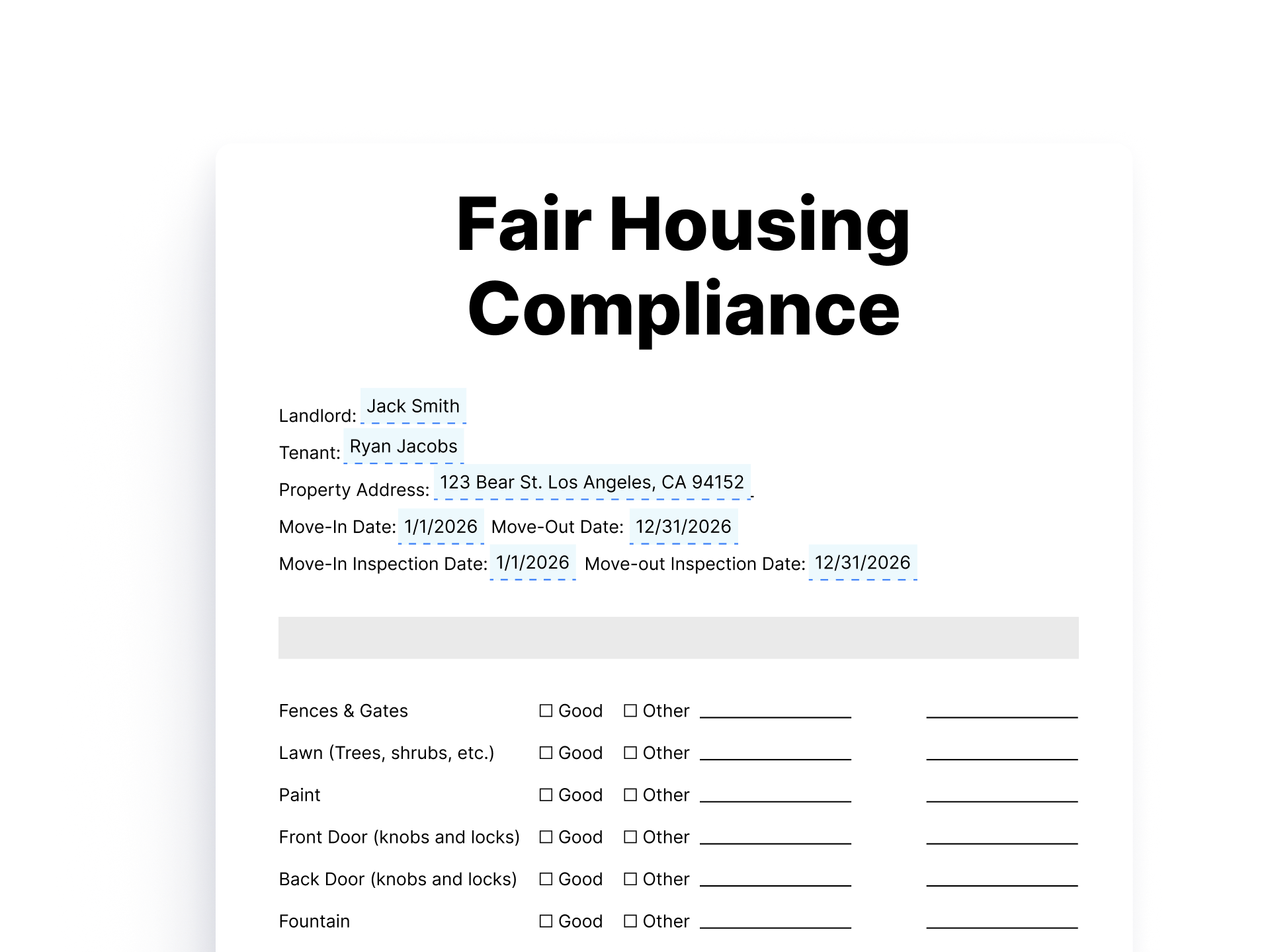
Download as PDF when complete
Understanding Fair Housing Laws
The Fair Housing Act and Protected Classes
The Fair Housing Act of 1968, amended in 1988, establishes federal protections against housing discrimination. Specifically, this law applies to landlords, property managers, real estate agents, and homeowners associations. Your fair housing compliance checklist must address seven federally protected classes:
- Race and color
- National origin and religion
- Sex (including sexual orientation and gender identity)
- Familial status (families with children under 18)
- Disability
In addition, many states and localities add extra protected classes. Common additions include source of income, age, marital status, and veteran status. Therefore, always check your state and local laws to ensure full compliance.
Consequences of Fair Housing Violations
Violations of fair housing laws result in serious consequences, including:
- Federal fines up to $21,039 for first violations
- Civil lawsuits with unlimited compensatory and punitive damages
- Legal fees and court costs
- Damage to your reputation and business
For these reasons, a strong fair housing compliance checklist is essential.
Advertising Review Checklist
Your rental advertising creates the first impression for potential tenants. As a result, every ad must comply with fair housing laws to ensure equal access to housing opportunities.
Prohibited Language in Fair Housing Advertising
Your fair housing compliance checklist should flag any language suggesting preference or discrimination. Never use:
- Race-related phrases like “Caucasian neighborhood” or “diverse community”
- Religious references like “near Christian school” or “perfect for church-goers”
- National origin indicators like “English-speaking only”
- Familial preferences like “adults only” or “no children”
- Gender-specific language like “female roommate preferred”
- Disability-related statements like “no wheelchairs” or “must climb stairs”
These violations can result in complaints and legal action.
Acceptable Fair Housing Advertising Practices
Your checklist should promote inclusive advertising. Always describe the property objectively using facts about features, amenities, location, and rental terms. Furthermore, include the equal housing opportunity logo in all advertising materials.
Acceptable descriptions include:
- Number of bedrooms and bathrooms
- Square footage and layout
- Amenities like parking or laundry
- Proximity to public transportation or schools
- Rental price and lease terms
In short, focus on property characteristics — not ideal tenant descriptions.
Digital Advertising and Fair Housing Compliance
Social media advertising allows demographic targeting, which can violate fair housing laws. As a result, your checklist must ensure digital ads reach broad audiences without discriminatory targeting. Specifically:
- Don’t use targeting based on age, gender, or familial status
- Set geographic targeting broadly
- Use inclusive images showing diverse individuals and families
- Review platform settings regularly for compliance
Marketing Materials Review
All brochures, flyers, website content, and signage must comply with fair housing standards. Also, ensure the equal housing opportunity logo appears on all printed materials. Moreover, update materials regularly to maintain current fair housing compliance.
Application Process Consistency Checklist
Consistent application processes form the foundation of fair housing compliance. Every applicant must receive identical treatment regardless of protected class membership. Otherwise, inconsistent procedures create discrimination claims even without intent. In short, consistency is your best legal protection.
Standardized Fair Housing Application Forms
Your fair housing compliance checklist requires identical application forms for all applicants. Use the same form, questions, and fee for every prospective tenant. In particular, application forms should request:
- Current contact information
- Rental history with landlord references
- Employment and income information
- Authorization for background and credit checks
Never ask about:
- Race, color, national origin, or religion
- Familial status, pregnancy, or plans to have children
- Disability unless directly related to lease obligations
- Source of income in jurisdictions protecting this characteristic
Application Fee Policies
Charge the same application fee to every applicant. Fees should cover actual screening costs including credit reports, background checks, and administrative time. Additionally, comply with state laws regarding fee limits and disclosure requirements. Never waive fees for some applicants but not others based on protected characteristics.
Fair Housing Application Processing Procedures
Process all applications in the order received using identical procedures. Review every application using the same screening criteria. Specifically, don’t rush processing for preferred applicants while delaying others.
Communicate with all applicants the same way regarding status, documentation, and decision timelines. Provide written explanations for denials citing specific, objective reasons. In addition, keep detailed records of all processing steps. Consequently, documentation protects you if discrimination complaints arise.
Waiting Lists and Tenant Selection
Maintain waiting lists in order of application receipt. Don’t bump applicants down based on protected characteristics. Instead, select tenants based on objective criteria applied consistently to everyone. Always record reasons for selecting each tenant. Ultimately, transparency in tenant selection prevents discrimination claims.
Reasonable Accommodation Policies Checklist
Federal fair housing law requires landlords to make reasonable accommodations for tenants with disabilities. Therefore, your fair housing compliance checklist must include clear procedures for handling these requests.
Understanding Fair Housing Accommodation Obligations
Reasonable accommodations are changes to rules, policies, or services that allow people with disabilities equal opportunity to use and enjoy housing. Common requests include:
- Allowing assistance animals despite no-pet policies
- Assigning accessible parking spaces
- Modifying lease terms for disability-related needs
- Allowing support persons to assist with lease obligations
You must grant requests unless they create undue financial burden or fundamentally alter your housing operation. In fact, most accommodation requests are reasonable and should be granted. Therefore, always approach accommodation requests with a cooperative mindset.
Accommodation Request Procedures
Establish clear procedures for requesting accommodations. Tenants can make requests verbally or in writing. You may request supporting documentation for non-obvious disabilities, but you cannot demand medical records. Healthcare providers or social workers can verify disability and necessity.
Respond to requests promptly, ideally within 10 business days. Then, engage in an interactive process to explore solutions. Furthermore, provide written responses documenting your decision and reasoning.
Assistance Animal Accommodations Under Fair Housing Law
Assistance animals are the most common accommodation request. Specifically, fair housing law covers both service animals and emotional support animals. You must:
- Waive pet fees, deposits, and rent for assistance animals
- Not require documentation of training or certification
- Not apply breed, size, or weight restrictions
However, you can deny requests if the specific animal poses a direct threat to health or safety.
Modification Requests
Reasonable modifications are structural changes that allow people with disabilities to use and enjoy housing. For example, common requests include:
- Installing grab bars in bathrooms
- Widening doorways for wheelchair access
- Adding ramps to entrances
- Lowering countertops or cabinets
Tenants typically pay for modifications at their own expense. Under no circumstances can you refuse reasonable modification requests. Therefore, condition approval on assurances the work will be done professionally with proper permits. Otherwise, you risk violating fair housing law.
Screening Criteria Documentation Checklist
Documented screening criteria protect you from fair housing complaints. Consequently, your checklist must include objective, written standards for evaluating all applications.
Written Fair Housing Screening Criteria
Create written screening criteria before accepting applications. Specifically, document specific standards for:
- Income requirements
- Credit history evaluation
- Rental history review
- Criminal background consideration
- Employment verification
Income requirements should be based on objective ratios — such as monthly income equaling 2.5 to 3 times monthly rent. Minimum credit scores must be clearly specified. Moreover, criminal background policies need careful crafting to avoid disparate impact discrimination.
Income Verification Standards
Apply consistent income verification standards to all applicants. Accept income from employment, self-employment, investments, retirement accounts, and government benefits equally. Verify income through:
- Pay stubs and tax returns
- Bank statements
- Benefit award letters
In particular, be aware that some jurisdictions prohibit discrimination based on lawful source of income including housing vouchers.
Credit History Evaluation
Evaluate credit history using consistent standards for all applicants. Specify minimum credit scores or credit issues that warrant denial. Consider explanations for credit problems and evidence of improved financial responsibility.
Specifically, document credit-related reasons for denials. Additionally, be aware that blanket credit requirements may have disparate impact on protected classes.
Criminal Background Screening and Fair Housing Compliance
Criminal background screening requires particular care. HUD guidance warns that blanket criminal history policies may violate fair housing law through disparate impact. As a result, criminal history policies should be individualized. In particular, consider:
- The nature and severity of the criminal conduct
- Time elapsed since conviction
- Evidence of rehabilitation
Instead of blanket bans, evaluate older and minor convictions individually. Furthermore, document all legitimate business reasons for denials.
Documentation and Record Keeping
Maintain detailed records of all screening decisions. Keep the following for at least three years:
- Application forms and screening reports
- Correspondence with applicants
- Written reasons for denials
Similarly, document all communications with applicants. Overall, organized records demonstrate your commitment to fair housing compliance.
FAQs
The Fair Housing Act prohibits housing discrimination based on seven federally protected classes: race, color, national origin, religion, sex, familial status, and disability. Many states and localities also extend additional protections covering source of income, age, marital status, and veteran status.
Landlords must avoid any language suggesting preference or limitation based on protected classes, such as “adults only,” “English-speaking only,” or references to nearby religious institutions. All advertising should describe the property objectively and include the equal housing opportunity logo or statement.
Yes — fair housing law requires landlords to waive pet fees, deposits, and rent for assistance animals as a reasonable accommodation for tenants with disabilities. Breed, size, and weight restrictions also do not apply to assistance animals.
Blanket bans on all criminal history may violate fair housing law due to disparate impact on protected classes, according to HUD guidance. Instead, landlords should evaluate criminal history individually, considering the nature of the offense, time elapsed, and evidence of rehabilitation.
Landlords should retain application forms, screening reports, applicant correspondence, and written reasons for denials for at least three years. Detailed documentation demonstrates consistent application of screening criteria and protects against discrimination complaints.