
No Smoking Addendum


(1)
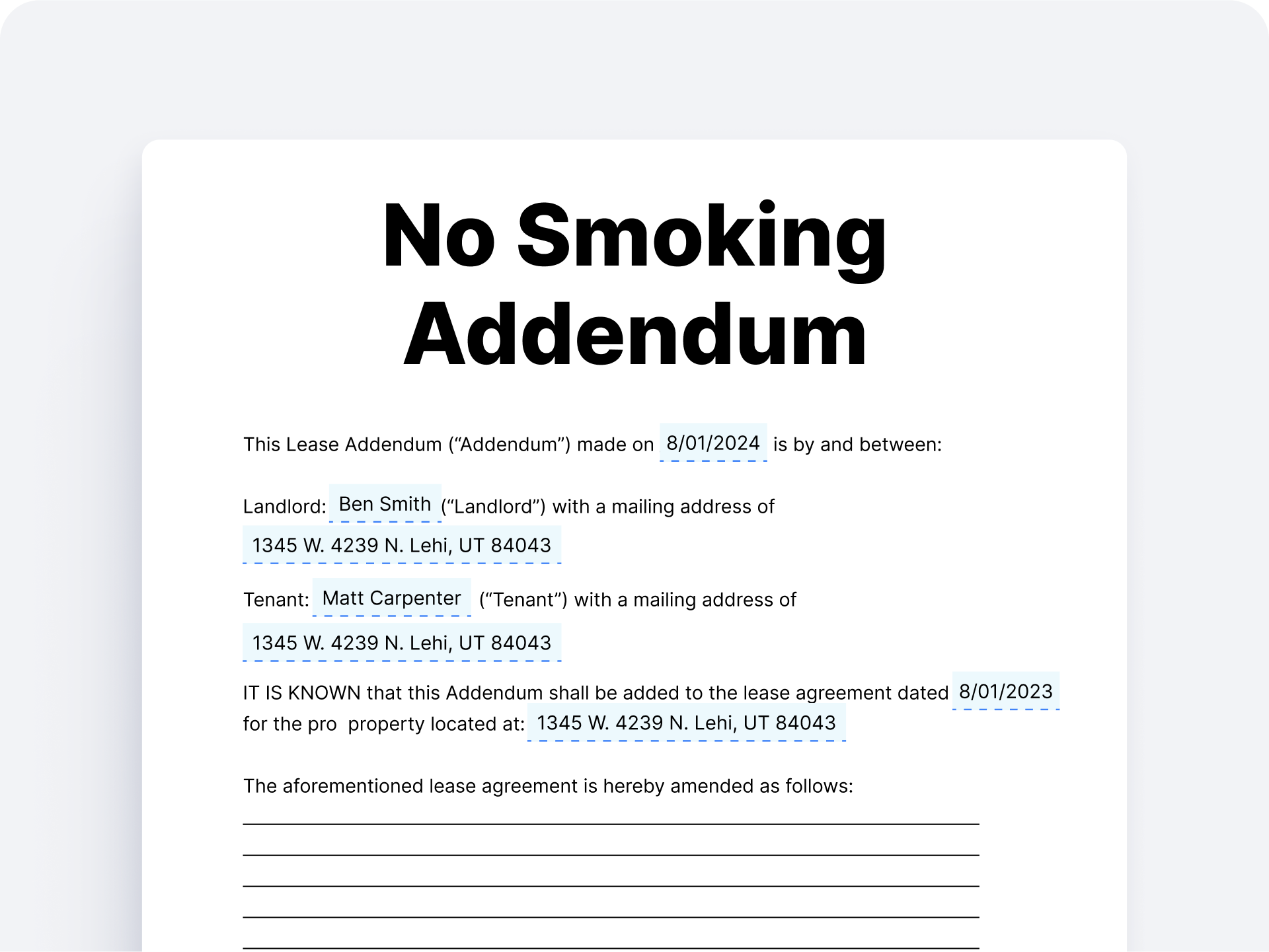
Our professionally-drafted no smoking addendum template provides essential legal framework. It creates and enforces smoke-free rental environments that preserve property condition, reduce fire risks, and maintain healthy living spaces for all tenants. This protects property values while ensuring tenant compliance and fair enforcement.
Download as PDF when complete
 Google Doc,
  PDF &
PDF &  Word) or create one online!
The Cost of Smoking-Related Property Damage
Smoking-related property damage costs landlords an average of $3,000-$8,000 per unit. These costs include cleaning, repainting, and odor remediation. Therefore, prevention through proper legal documentation is crucial for protecting rental property investments.
This customizable addendum addresses smoking prohibition enforcement, violation penalties, and remediation cost recovery. Additionally, it ensures compliance with fair housing laws that courts recognize and uphold.
Why Smart Landlords Use No Smoking Addendums
Smart landlords use no smoking addendums to prevent costly property damage. Furthermore, they attract health-conscious tenants who value smoke-free living environments. These tenants are willing to pay premium rents for clean, odor-free properties.
Why No Smoking Addendums Are Essential for Modern Landlords
The Growing Demand for Smoke-Free Living
The shift toward smoke-free living has accelerated dramatically. Over 80% of rental properties now implement smoking restrictions. This trend is driven by tenant demand, property preservation needs, and liability concerns.
Smoking-related property damage extends far beyond surface cleaning. It requires extensive remediation including HVAC system cleaning, carpet replacement, and specialized odor elimination treatments. These can cost thousands per unit.
Key Benefits of No Smoking Addendums
A comprehensive no smoking addendum provides crucial protection:
- Property value preservation preventing smoke damage and odor absorption
- Reduced fire risk eliminating smoking-related fire hazards and insurance claims
- Tenant attraction appealing to health-conscious renters willing to pay premium rates
Additional Legal Protections
Moreover, these addendums also provide:
- Legal enforcement tools providing clear violation procedures and penalty structures
- Cost recovery mechanisms ensuring tenant responsibility for smoking-related damage
- Fair housing compliance maintaining consistent enforcement without discrimination
Critical Components of Effective No Smoking Addendums
Comprehensive Smoking Prohibition Definitions
Modern no smoking addendums must address all forms of smoking. These include traditional tobacco products, e-cigarettes, vaping devices, and cannabis products regardless of legal status.
Therefore, your addendum should clearly define prohibited activities. Additionally, it should specify restricted areas and address emerging smoking technologies that traditional lease language doesn’t cover.
Comprehensive definitions prevent loopholes. These allow tenants to circumvent smoking restrictions through alternative products or consumption methods.
Violation Detection and Enforcement Procedures
Effective enforcement requires clear procedures for violation detection, tenant notification, and penalty implementation.
Consequently, your addendum should establish investigation protocols. Furthermore, it should include evidence documentation standards and due process rights. These ensure fair enforcement while providing landlords with effective tools for policy compliance.
Professional inspection procedures and witness documentation create legally defensible evidence. This supports violation proceedings.
Cost Recovery and Remediation Standards
Smoking-related property damage requires professional remediation. This includes deep cleaning, odor elimination, surface restoration, and HVAC system treatment.
Therefore, your addendum should specify tenant responsibility for all remediation costs. Additionally, it should establish professional service requirements that ensure effective restoration and prevent ongoing property damage.
Property Damage Prevention and Value Preservation
Understanding Smoking-Related Property Damage
Tobacco smoke creates persistent odors and staining. These penetrate building materials, HVAC systems, and furnishings. As a result, extensive professional remediation is required to eliminate contamination.
Cigarette smoke contains over 4,000 chemicals. These bond with surfaces and create long-lasting contamination. This affects property marketability and tenant health.
Professional Remediation Costs
Professional remediation costs average $3,000-$8,000 per unit. However, costs can exceed $15,000 for severe contamination requiring complete restoration.
Fire Risk Reduction and Insurance Benefits
Smoking restrictions significantly reduce fire risks. Smoking-related fires account for over 23% of residential fire fatalities according to NFPA data.
Therefore, insurance companies increasingly offer premium discounts for smoke-free properties. They recognize reduced fire risk and property damage exposure.
Consequently, your addendum should document fire safety benefits. Additionally, it should establish proper smoking material disposal requirements that prevent accidental fires.
Tenant Attraction and Market Positioning
Health-Conscious Tenant Demographics
Non-smoking tenants represent the majority of rental applicants. Furthermore, they often demonstrate superior rental payment history, longer tenancy periods, and better property care compared to smoking tenants.
Smoke-free properties can command 5-15% rental premiums in many markets. Additionally, they experience reduced vacancy periods and lower turnover costs.
Property Differentiation and Competitive Advantages
Smoke-free certification creates significant competitive advantages in rental markets. It appeals to families with children, health-sensitive individuals, and professional tenants seeking clean living environments.
Therefore, marketing properties as smoke-free attracts quality tenants. Furthermore, it deters problematic applicants who may violate other lease terms.
Legal Enforcement and Fair Housing Compliance
Violation Documentation and Due Process
Successful smoking violation enforcement requires comprehensive documentation. This includes photographic evidence, witness statements, and professional air quality testing results.
Consequently, your addendum should establish clear investigation procedures. Additionally, it should include tenant notification requirements and appeal processes. These ensure fair treatment while providing effective enforcement tools for legitimate violations.
Consistent Enforcement and Anti-Discrimination Measures
Smoking policies must be enforced consistently across all tenants. This applies regardless of protected class membership. Therefore, documented procedures and objective violation standards are required.
Your addendum should establish uniform penalty structures. Additionally, it should include evidence requirements and enforcement timelines. These prevent selective enforcement claims while ensuring effective policy compliance.
Medical Marijuana and Disability Accommodations
Medical Cannabis Legal Considerations
State medical marijuana laws don’t override private property smoking restrictions. However, landlords must consider reasonable accommodation requests for tenants with disabilities requiring medical cannabis.
Therefore, your addendum should address alternative consumption methods. Additionally, it should maintain smoke-free property standards and federal law compliance.
Reasonable Accommodation Procedures
Disability-related accommodation requests require interactive dialogue between landlords and tenants. This helps identify effective alternatives that meet medical needs without compromising property smoking restrictions.
Consequently, your addendum should establish accommodation request procedures. Furthermore, it should maintain flexibility for legitimate medical requirements.
E-Cigarettes, Vaping, and Modern Smoking Technologies
Electronic Cigarette Policy Development
E-cigarettes and vaping devices create vapor residue, odors, and potential fire hazards. These justify inclusion in smoking prohibitions.
Therefore, your addendum should address all electronic smoking devices. Additionally, it should establish enforcement procedures for vapor-related violations and property damage.
Emerging Technology Adaptability
New smoking technologies continuously emerge. This requires flexible addendum language that addresses future innovations without requiring constant policy updates.
Consequently, your addendum should include broad prohibition language. This covers any device producing smoke, vapor, or aerosol regardless of specific technology.
Cannabis Legalization and Property Rights
State Cannabis Laws vs. Property Rights
Cannabis legalization doesn’t require landlords to permit smoking in rental properties. Courts consistently uphold private property smoking restrictions regardless of substance legality.
Therefore, your addendum should clearly prohibit all cannabis smoking. Additionally, it should address alternative consumption methods for medical users.
Federal Law Compliance
Federal law continues to classify marijuana as illegal. This provides additional legal support for cannabis smoking prohibitions in rental properties.
Consequently, your addendum should reference federal law compliance. Furthermore, it should maintain flexibility for evolving state regulations and accommodation requirements.
Professional Remediation and Cost Recovery
Industry-Standard Remediation Procedures
Professional smoking remediation requires specialized equipment, certified technicians, and proven elimination methods. These completely remove smoke odors and residue.
Therefore, your addendum should specify professional service requirements. These include air quality testing, surface treatment, and clearance certification that ensure effective restoration.
Cost Recovery Documentation and Procedures
Successful cost recovery requires detailed documentation. This includes professional estimates, before/after photographs, and tenant violation records that support damage claims.
Consequently, your addendum should establish cost recovery procedures. These include security deposit deductions, additional billing processes, and collection rights for unpaid remediation expenses.
Insurance Considerations and Liability Protection
Property Insurance Benefits and Requirements
Smoke-free properties often qualify for insurance premium discounts. Additionally, they reduce claim risks from fire damage and property deterioration.
Therefore, your addendum should address insurance compliance requirements. Furthermore, it should document risk reduction measures that support favorable coverage terms.
Tenant Insurance and Liability Allocation
Requiring tenant renters insurance with liability coverage provides additional protection for smoking-related damage. Additionally, it ensures tenants understand their financial responsibility for violation consequences.
Consequently, your addendum should specify insurance requirements. Furthermore, it should establish clear liability allocation for smoking-related property damage.
Implementation Strategies and Best Practices
Property Conversion and Existing Tenant Management
Converting existing properties to smoke-free status requires careful planning. This includes tenant notification, compliance timelines, and accommodation procedures for current smoking tenants.
Therefore, your addendum should address implementation timing. Additionally, it should provide reasonable transition periods and cessation support resources.
New Tenant Education and Compliance Programs
Effective smoking prohibition requires comprehensive tenant education. This includes policy explanation, violation consequences, and cessation resource provision.
Consequently, your addendum should establish education requirements. Furthermore, it should create positive tenant relationships that encourage voluntary compliance.
Technology Integration and Monitoring Systems
Air Quality Monitoring and Detection Systems
Modern air quality monitors can detect smoking violations through chemical sensors and real-time alerts. These provide objective violation evidence.
Therefore, your addendum should address monitoring technology. Additionally, it should ensure tenant privacy rights and establish clear detection procedures.
Documentation Technology and Evidence Management
Digital documentation systems help landlords maintain comprehensive violation records. These include photographs, air quality data, and tenant communications that support enforcement actions.
Consequently, your addendum should accommodate technology integration. Furthermore, it should ensure legal admissibility of electronic evidence.
Download Your Free No Smoking Addendum Template
Our comprehensive no smoking addendum template provides essential legal protection. Additionally, it ensures effective policy enforcement and tenant compliance.
This professionally-drafted document addresses modern smoking technologies. Furthermore, it maintains fair housing compliance and practical enforceability.
Template Features:
- Comprehensive smoking prohibition definitions
- Clear violation detection and penalty procedures
- Professional remediation cost recovery mechanisms
Additional Benefits:
Moreover, the template includes:
- Fair housing and disability accommodation compliance
- Modern technology and cannabis consideration
- Flexible enforcement and appeal procedures
Sample
FAQs
A no smoking addendum is a legal document that prohibits smoking in rental properties and outlines violation penalties and remediation cost recovery. Without one, landlords risk smoking-related property damage that averages $3,000–$8,000 per unit to repair.
Yes — a well-drafted addendum should explicitly cover all forms of smoking, including e-cigarettes, vaping devices, and cannabis products regardless of their legal status. Broad prohibition language ensures tenants cannot find loopholes through alternative smoking methods.
Yes — courts consistently uphold private property smoking restrictions regardless of substance legality. Landlords should clearly prohibit all cannabis smoking in their addendum while including reasonable accommodation procedures for tenants with medical needs.
Tenants who violate the no smoking policy are responsible for all remediation costs, which can exceed $15,000 for severe contamination. Your addendum should specify professional service requirements and establish clear cost recovery procedures, including security deposit deductions.
Yes — smoking policies must be enforced consistently across all tenants regardless of protected class membership. Documenting violations objectively and following uniform penalty procedures protects landlords from selective enforcement and discrimination claims.