
California Real Estate Purchase Agreement
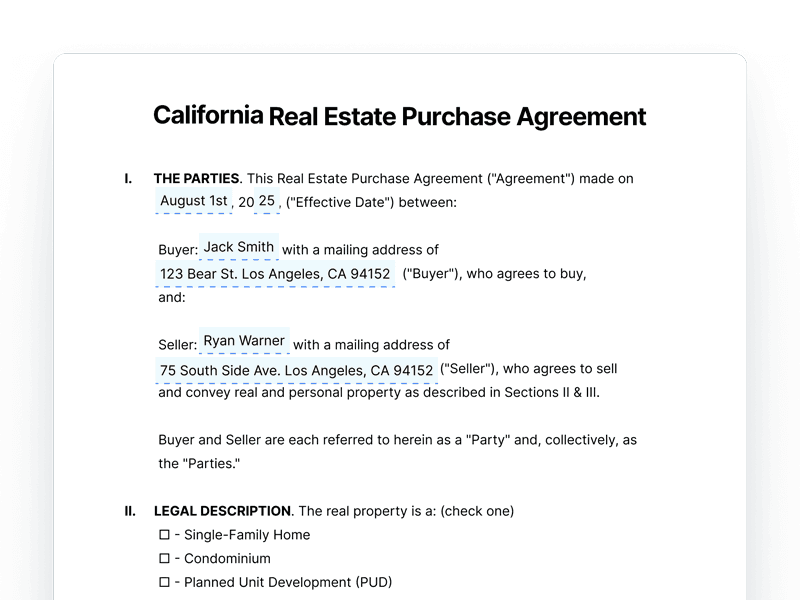
A California real estate purchase agreement creates a legally binding contract between buyers and sellers for residential property purchases. This comprehensive agreement outlines purchase prices and all terms and contingencies related to sales transactions. Furthermore, once both parties sign the document, it becomes fully enforceable under California law.
Download as PDF when complete


(No Ratings Yet)


Understanding California Real Estate Purchase Agreement Requirements
California maintains some of the most comprehensive disclosure requirements in the United States for residential real estate transactions. Therefore, buyers and sellers must understand these extensive obligations when completing a California real estate purchase agreement to ensure legal compliance and successful transactions.
California’s Extensive Seller Disclosure Requirements
Mandatory Material Defect Disclosure
Legal Obligation Standards California law mandates that sellers disclose all known material defects related to properties throughout real estate transactions. Additionally, this comprehensive obligation protects buyers by ensuring they receive essential information about property conditions before making purchase decisions.
Comprehensive Disclosure Framework California’s disclosure requirements exceed most other states’ standards, creating extensive protection for buyers during real estate purchase agreement processes. Moreover, these detailed requirements help prevent disputes and ensure informed decision-making throughout transactions.
Required California Purchase Agreement Disclosures
Safety and Structural Requirements
Structural Integrity Updates California real estate purchase agreements must include structural integrity reports. These reports address property safety concerns affecting residents. Furthermore, they identify potential structural issues that could impact property value or occupant safety.
Fire Detection Compliance Single-family home buyers must receive fire detector compliance statements. These statements confirm adherence to California state fire detector laws. Additionally, these disclosures ensure properties meet current safety standards for fire protection systems.
Water Heater Safety Standards California requires water heater compliance statements. These statements confirm proper securing to prevent displacement during earthquakes. Therefore, these safety measures protect residents and property during seismic events throughout the state.
Environmental and Hazardous Material Disclosures
Hazardous Materials Updates Sellers must provide comprehensive reports on hazardous materials present on properties. These reports include asbestos, radon gas, contaminated soil, and water intrusion issues. Moreover, these disclosures help buyers understand potential health risks and remediation needs.
Environmental Hazards Documentation California real estate purchase agreements require environmental hazards pamphlets. These pamphlets educate buyers about potential environmental concerns. Additionally, these materials help buyers make informed decisions about property suitability and risk factors.
Lead-Based Paint Requirements Federal law requires California sellers to provide lead-based paint disclosures for homes built before 1978. These disclosures include comprehensive information about lead presence and associated health risks. Furthermore, these disclosures protect families from lead exposure dangers.
Natural Disaster and Geographic Risk Disclosures
Natural Hazard Disclosure Statements California’s extensive natural hazard disclosure statements inform buyers about potential risks. These risks include flooding areas, high fire hazard zones, seismic hazard zones, and earthquake fault zones. Moreover, these disclosures address special flood hazard areas and wildland fire zones throughout the state.
Earthquake Safety Information California real estate purchase agreements must include the Homeowner’s Guide to Earthquake Safety. This guide provides essential information about earthquake preparedness and property protection. Therefore, buyers receive crucial safety information for living in seismically active areas.
Property Condition and Inspection Requirements
Transfer Disclosure Statements (TDS) California requires comprehensive Transfer Disclosure Statements. These statements list known issues potentially impacting home values or posing health risks to residents. Additionally, these detailed statements provide buyers with essential property condition information.
Structural Pest Control Reports When sales contracts or financing stipulate pest inspections, California real estate purchase agreements must include structural pest control reports. Furthermore, these inspections identify potential damage from wood-destroying pests and organisms.
Wood Destroying Pest Inspection Reports California sellers must provide wood destroying pest and organism inspection reports. These reports are provided after completion of professional evaluations. Moreover, these reports help buyers understand potential structural damage and treatment requirements.
Legal and Administrative Disclosures
Death on Premises Disclosure California requires disclosure when deaths occurred in units within three years prior to purchase offers. These disclosures exclude deaths related to HIV/AIDS. Additionally, these disclosures help buyers make informed decisions about property histories.
Megan’s Law Information California real estate purchase agreements must include Megan’s Law information. This information allows buyers to search for registered sex offenders in surrounding areas. Therefore, buyers receive important safety information about neighborhood conditions.
Tax and Conservation Requirements
Real Estate Tax Disclosures California requires real estate tax disclosures. These disclosures inform buyers about potential supplemental property tax bills arising from ownership changes. Moreover, these disclosures help buyers understand complete tax obligations associated with property purchases.
Water Conservation Requirements California mandates water-conserving fixtures and carbon monoxide detector notices. These notices inform buyers about fixture status and detector compliance. Furthermore, these disclosures address state conservation requirements and safety standards.
California Purchase Agreement Termination Rights
Buyer Termination Protections
Three-Day Disclosure Period When buyers do not receive required disclosures, California law grants three days to terminate agreements. Buyers must notify sellers or their agents to exercise this right. Additionally, buyers receive five days from mailing dates when disclosures are sent via mail rather than delivered personally.
Termination Procedure Standards
Written Notice Requirements Buyers must provide written notification to sellers or their agents to exercise termination rights effectively. This notification must occur within specified timeframes. Moreover, proper notice delivery ensures buyers can exit contracts without penalty when disclosure requirements are not met.
Timeline Compliance The termination period begins when buyers receive required disclosures from sellers or their representatives. Therefore, buyers must act promptly to preserve their termination rights under California law.
Seller Cancellation Rights
Buyer Breach Situations California sellers may cancel real estate purchase agreements when buyers breach contracts. This applies when buyers fail to fulfill specified obligations within agreed timeframes. Furthermore, seller cancellation rights protect property owners from buyers who cannot complete their contractual commitments.
Special Circumstances Unique situations such as estate sales may provide California sellers with additional contract cancellation options. These options extend beyond standard breach scenarios. Moreover, these special circumstances require careful legal review to ensure proper cancellation procedures.
California Real Estate Purchase Agreement Effective Dates
Contract Binding Requirements
Mutual Execution Standards California real estate purchase agreements become effective on specific dates. This occurs when both buyers and sellers agree to all terms and execute contracts completely. Additionally, all contractual obligations become binding and enforceable from these specific execution dates forward.
Obligation Activation
Once contracts become effective, both parties must fulfill all specified obligations. These obligations must be met according to established timelines and procedures throughout California. Therefore, prompt performance becomes essential for successful transaction completion and closing.
Contract Completion Process in California
Template Utilization Benefits
Document Preparation Standards Real estate professionals recommend downloading customizable California real estate purchase agreement templates that include state-specific requirements and comprehensive disclosure provisions. Moreover, these templates ensure compliance with California’s extensive regulations while streamlining document preparation.
Required Information Elements
Party Documentation Standards California contracts must include comprehensive information for each party, including full legal names, current addresses, and appropriate contact information throughout transactions. Additionally, party type designation helps clarify each participant’s role during real estate processes.
Transaction Terms Specification
Financial Arrangement Details California real estate purchase agreements must specify purchase prices, earnest money deposits, and financing arrangements with precise documentation to prevent future disputes. Furthermore, clear financial terms support successful transaction completion and smooth closing procedures throughout the state.
Performance Timeline Establishment Comprehensive contracts include specific timelines for contingency completion, inspections, appraisals, and closing dates throughout California transactions. Therefore, established schedules help all parties coordinate their obligations effectively during transaction periods.
Legal Compliance and Professional Guidance
California-Specific Requirements
State Law Adherence California real estate purchase agreement documents must comply with specific state statutes governing property transactions and extensive disclosure requirements. Additionally, legal compliance protects both parties from potential disputes and ensures enforceable agreement creation.
Comprehensive Disclosure Compliance California’s extensive disclosure requirements create specific obligations that parties must understand and fulfill throughout real estate transactions. Moreover, proper compliance prevents legal disputes and protects transaction integrity during the process.
Professional Support Benefits
Legal Counsel Advantages Complex California real estate purchase agreement transactions benefit significantly from attorney review to ensure compliance with state laws and comprehensive regulations. Furthermore, legal counsel helps identify potential issues before they become expensive problems after closing completion.
Real Estate Professional Guidance Licensed California real estate agents understand state-specific requirements and can guide parties through contract preparation and extensive disclosure processes effectively. Therefore, professional support often leads to smoother transactions and better outcomes for all participants throughout California’s complex regulatory environment.
Understanding California’s comprehensive real estate purchase agreement requirements and extensive disclosure obligations empowers buyers and sellers to navigate transactions confidently while protecting their interests throughout the property ownership transfer process in this highly regulated legal environment.
Statutes
- Civ. Code §§ 1950.5(f) – [Operative 7/1/2024] Security for rental agreement
- Civ. Code §§ 1950.5 – Security Deposit Maximum, Non-Refundable Fees, Deadline for Returning Security Deposit
- Civ. Code §§ 1947 – Rent is Due
- Civ. Code §§ 1947.3(1-2) – Payment Methods
- Civ. Code §§ 827(b)(2-3) – Rent Increase Notice
- Civ. Code §§ 1950.6(b) – Application Fees
- Civ. Code §§ 1942(a) – Tenant Allowed to Repair and Deduct Rent
- Civ. Code §§ 1951.2 – Recovery by lessor upon breach of lease and abandonment of property by lessee
- Civ. Code §§ 1946 – Renewal of hiring for term not specified by parties
- Civ. Code §§ 1946.1 – Notice of intention terminate hiring for term not specified by parties
- Civ. Code §§ 1954a – Entry of dwelling by landlord
- Civ. Code §§ 1954b – Entry of dwelling by landlord
- Civ. Code §§ 789.3a – Acts by landlord with intent to terminate occupancy
- Civ. Code §§ 789.3b(1) – Acts by landlord with intent to terminate occupancy
- Civ. Code §§ 789.3d – Acts by landlord with intent to terminate occupancy
- Civ. Code §§ 1954.602 – Duty of landlord
- Civ. Code §§ 1962(4) – Obligations of owner or party signing rental agreement or lease on behalf of owner
- Civ. Code §§ 1940.9 – Disclosure that tenant’s gas and electric meter serves area outside tenant’s dwelling unit
- Civ. Code §§ 1950.6(b) – Application Fees
- Civ. Code §§ 1940.7 – Notice of actual knowledge of former federal or state ordnance locations in neighborhood area
- Civ. Code §§ 2079.10a – Notice as to database of person required to register as to sex offenders
- Civ. Code §§ 1940.8 – Copy of notice provided by registered structural pest control company
- Civ. Code §§ 1947.5 – Prohibition of smoking of cigarettes or other tobacco products
- Civ. Code §§ 1941.5 – Changing locks of protected tenant’s dwelling unit upon request of protected tenant
- Civ. Code §§ 1941.6 – Changing locks of protected tenant’s dwelling unit upon request of protected tenant
- Civ. Code §§ 1946.7(d) – Notice by victim of domestic violence, sexual assault, stalking, human trafficking, elder abuse, and certain other crimes of intent to terminate
- Civ. Code §§ 1942.5 – Retaliation by lessor against lessee for exercising rights under chapter
- Civ. Code §§ 1965 – Generally
- Civ. Procedure Code §§ 1161.3 – Acts against tenant or tenant’s household member constituting domestic violence
- Civ. Procedure Code §§ 1161.3 – Acts against tenant or tenant’s household member constituting domestic violence
- Civ. Procedure Code §§ 1161(2) – [Operative 2/1/2025] When tenant for term less than life guilty of unlawful detainer
- Civ. Procedure Code §§ 1161(3) – [Operative 2/1/2025] When tenant for term less than life guilty of unlawful detainer
- Cal. Civ. Code § 1719 – Obligations Imposed by Law
- Cal. Civ. Code § 1940.8.5(b)(1)(A)(B)(C) – Notice to Tenants for Pesticide Use
- Cal. Civ. Code § 1940.8.5(d)(2)(b)(iii) – Electronic Notices Allowed
- Cal. Civ. Code § 1941.1 – Landlord’s Duties
- Cal. Civ. Code § 1941.2 – Tenant’s Duties
- Cal. Civ. Code § 1927 – Quiet Enjoyment
- Cal. Civ. Code § 1995.230 – Subleasing
- Health & Safety Code §§ 26147 – Disclosure by residential landlords
- Business and Professional Code §§ 8538 – Written notice to owner and tenant of premises
Sample
FAQs
Sellers in California must provide several required disclosures, including a Transfer Disclosure Statement, Natural Hazard Disclosure Statement, Lead-Based Paint Disclosure (for homes built before 1978), and reports on environmental hazards. Additional disclosures may include information on structural integrity, pest control, and compliance with smoke detector and water heater laws.
A buyer can terminate a real estate contract in California if they do not receive the required disclosures within three days of signing the agreement, or five days from the date of mailing. They must deliver notice to the seller or seller’s agent to formally terminate the agreement.
The effective date of a real estate contract in California is the date when both the buyer and seller have agreed to all terms and executed the contract. This date marks when all obligations become binding and enforceable.
Yes, sellers in California must disclose if a death occurred on the property within the last three years, unless the death was due to HIV or AIDS-related complications. This is part of the seller’s obligation to inform potential buyers of material facts.
If a seller cancels a real estate contract in California without a valid reason, they may be allowed to keep the buyer’s deposit. However, sellers can cancel the contract if the buyer breaches or fails to meet their obligations under the agreement.
The Transfer Disclosure Statement (TDS) includes a list of known issues that could negatively impact a property’s value or pose risks to the buyer’s safety or health. It is a specific form required by law to be completed by the seller.
If a buyer does not receive the required disclosures, they have the right to terminate the agreement within three days or five days from the mailing date. This allows buyers to protect themselves from unforeseen issues with the property.
The Natural Hazard Disclosure Statement informs buyers if the property is located in areas prone to natural hazards, such as flooding, high fire hazard zones, or seismic hazard zones. This disclosure is crucial for buyer awareness and safety.