
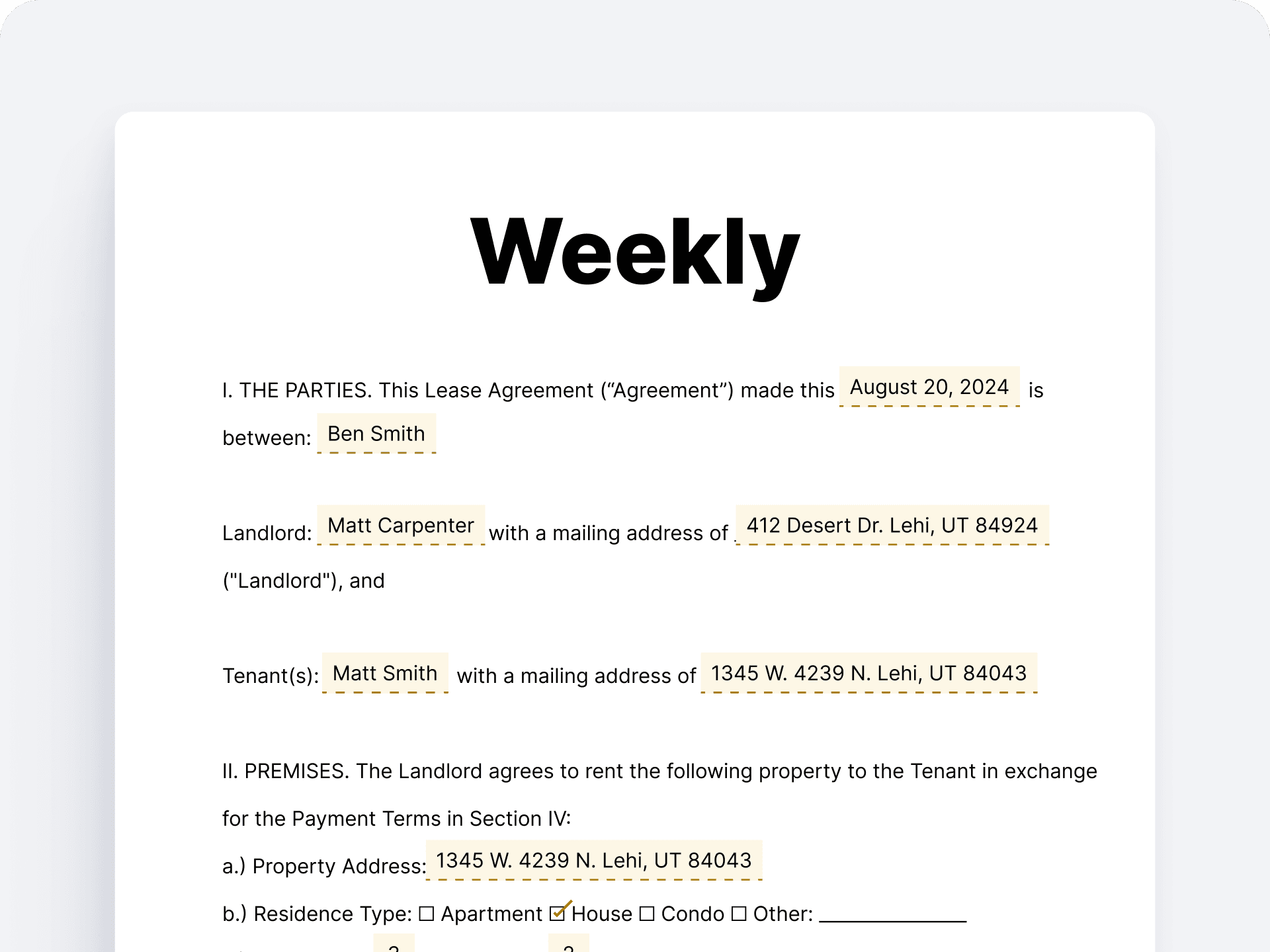
Week to Week Lease Agreement
A week to week lease agreement is a short-term rental contract between a landlord and a tenant that renews automatically every seven days. Unlike a traditional annual or monthly lease, this agreement does not have a fixed end date. Instead, it continues on a rolling basis until either the landlord or the tenant provides proper written notice to terminate.
Download as PDF when complete


(No Ratings Yet)
What Is a Week to Week Lease Agreement?
Because rent is paid every week, the lease technically restarts at the beginning of each new rental period. This makes a week to week lease agreement one of the most flexible rental arrangements available in the residential housing market.
How Does a Week to Week Lease Agreement Work?
Under a week to week lease agreement, the tenant pays rent every seven days — typically on the same day each week. As long as rent is paid and neither party sends notice to end the tenancy, the agreement automatically renews.
Either party can terminate the lease by providing written notice, with the required notice period varying by state. In most states, a minimum of 7 days’ written notice is required to end a week to week tenancy. However, some states may require longer notice periods, so it is important to check your local landlord-tenant laws before drafting your agreement.
Even with a week to week lease agreement, landlords must still follow the legal eviction process if a tenant refuses to vacate after receiving proper notice. The tenant cannot simply be removed without going through the appropriate court procedures.
What to Include in a Week to Week Lease Agreement
A well-drafted week to week lease agreement protects both the landlord and the tenant. Here are the key components your agreement should cover:
- Party Information — Full legal names and contact details of the landlord and tenant
- Property Address — The complete address of the rental unit
- Start Date — The date the tenancy begins
- Weekly Rent Amount — The exact rent due each week and the day it is owed
- Security Deposit — The deposit amount, typically equivalent to one month’s rent, and the conditions for its return
- Notice Requirements — How much written notice either party must give to terminate the agreement
- Utilities and Responsibilities — Which party is responsible for paying utilities such as electricity, water, and internet
- Guest and Occupancy Rules — Who is permitted to live in or regularly visit the rental unit
- Pet Policy — Whether pets are allowed and any associated fees
- Property Rules — Noise restrictions, parking, and other house rules
Using a professionally drafted template saves time and ensures legal compliance. RocketRent offers a free week to week lease agreement template that you can customize to meet your state’s requirements.
Pros and Cons of a Week to Week Lease Agreement
Before signing or offering a week to week lease agreement, it is important to weigh the advantages and disadvantages for both parties.
Benefits for Landlords
A week to week lease agreement gives landlords the ability to adjust rent more frequently and regain possession of the property with shorter notice compared to a month-to-month or annual lease. It is also an excellent option for transitional or seasonal rental properties where long-term occupancy is not always guaranteed.
Landlords can also use week to week arrangements to accommodate short-term tenants such as traveling workers, seasonal employees, or renters who are in between permanent housing situations.
Benefits for Tenants
For tenants, a week to week lease agreement offers maximum flexibility. It is ideal for people who are relocating, working on a temporary assignment, or simply not ready to commit to a longer lease. Tenants can move out with just a week’s notice, making it a low-risk option for those with unpredictable schedules or living situations.
Potential Drawbacks
The main downside of a week to week lease agreement for landlords is the risk of higher vacancy rates and increased turnover costs. Frequent tenant changes mean more time and money spent on cleaning, re-listing, and screening new applicants.
For tenants, the biggest drawback is instability. A landlord can end the tenancy with just a week’s notice, which can make long-term planning difficult. Weekly rent payments may also add up to more than a comparable monthly rent arrangement.
When Should You Use a Week to Week Lease Agreement?
A week to week lease agreement is best suited for the following situations:
- Vacation or short-term rentals where guests stay for days or weeks at a time
- Corporate housing for employees on temporary work assignments
- Transitional housing for tenants who are between permanent homes
- Seasonal rentals in areas with high demand during specific times of the year
- Test periods for new tenants before converting to a longer lease
Week to Week Lease Agreement vs. Month to Month Lease
Both a week to week lease agreement and a month-to-month lease offer flexibility, but they differ in a few important ways. A week to week lease renews every seven days with typically shorter termination notice, while a month-to-month lease renews each calendar month and usually requires 30 days’ notice.
Week to week agreements tend to carry higher weekly rent rates but offer more frequent turnover opportunities for landlords. Month-to-month leases provide slightly more stability for both parties while still avoiding the rigidity of a fixed annual lease.
Create Your Week to Week Lease Agreement for Free with RocketRent
Managing rental agreements doesn’t have to be complicated. RocketRent provides a free week to week lease agreement template that you can customize for your state, sign digitally, and store securely — all in one place.
Whether you are a first-time landlord or a seasoned property manager, RocketRent’s property management software makes it easy to create legally compliant lease documents, collect rent online, track expenses, and communicate with tenants — at absolutely no cost.
FAQs
A week to week lease agreement renews every seven days and typically requires only 7 days’ written notice to terminate, while a month-to-month lease renews every calendar month and usually requires 30 days’ notice. Week to week leases offer more flexibility but may come with higher weekly rental rates and greater turnover risk for landlords.
In most states, either the landlord or the tenant must provide a minimum of 7 days’ written notice to terminate a week to week lease agreement. However, notice requirements vary by state, so it is always best to review your local landlord-tenant laws or consult a licensed attorney to confirm the exact notice period in your area.
Yes, a landlord can increase rent on a week to week lease agreement, but they must provide proper written notice before the increase takes effect. The required notice period for rent increases varies by state. For example, in New Jersey, landlords must give at least 7 days’ notice for week to week rentals, while other states may require more advance notice. Always check your state’s landlord-tenant laws before raising rent.
Yes, a week to week lease agreement is a legally binding contract between a landlord and a tenant. Both parties are required to honor the terms outlined in the agreement, including rent payment, property rules, and notice requirements. Even though it is a short-term arrangement, landlords must still follow the legal eviction process if a tenant refuses to vacate after receiving proper written notice.
Absolutely. A week to week lease agreement is one of the most common arrangements used for vacation rentals, furnished short-term units, and corporate housing. It gives landlords the flexibility to accommodate guests for short stays while maintaining a legally documented rental arrangement. Platforms like Airbnb also allow landlords to rent to verified short-term tenants under similar flexible terms.